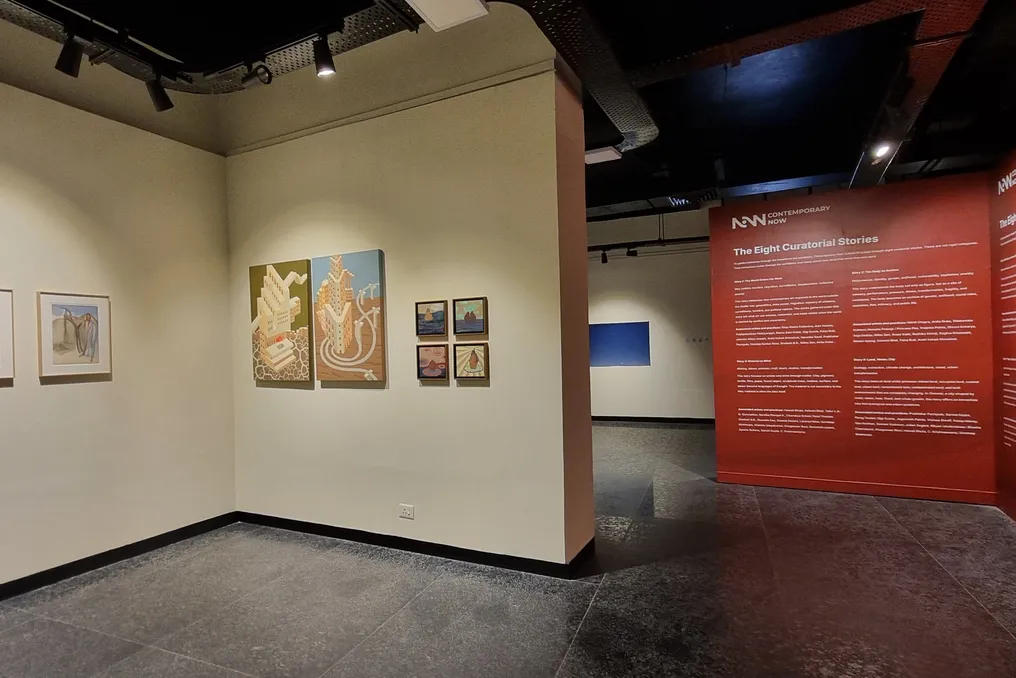
The third session of the 'Contemporary Now' modern art festival concluded this week in the city of Chennai. The festival, which started in 2014, is a weekly segment from YourStory dedicated to creativity and innovation. Previously, this segment featured various events, including art exhibitions, comic galleries, world music festivals, telecommunications exhibitions, grain fairs, climate change expositions, wildlife conferences, startup festivals, Diwali rangolis, and jazz festivals.
'Contemporary Now' ran for 20 days, transforming Chennai into a vibrant center of contemporary art through a city-wide program. It gathered leading galleries, artists, collectors, cultural figures, and institutions.
Festival Director Ashwin E. Rajagopalan explained in curator's notes that the goal of 'Contemporary Now: Edition III' is to encourage viewers to look deeper than just at an artwork as a separate object, and to engage with the broader practice, context, and ecosystem from which it originates.
The main exhibition, titled 'Practices in Continuum: The Work and the World,' took place at the Lalit Kala Academy. Artists participating in the festival included Jagannath Panda, Ragava KK, Talur LN, Tukral and Tagra, Ashta Butail, Gidhi Scaria, Shailesh BR, Arshi Irshad Ahmadzai, Jasmine Nilani Joseph, Faiza Batt, and Srimanti Saha.
One of the art exhibitions was 'In Dialogue with Nature' (limited edition photographs and portfolio), presented by the Chennai Photo Biennale Foundation and WWF-India at Avtar Foundation for the Arts. Ashvita's Flagship gallery hosted the exhibition by K. Benita Persial titled 'How Long Will We Live? Or When Will We Die?'
Other festival locations included Apparao Galleries, Ashvita's Campus, George K Studio, Gallery Veda, and Alliance Francaise of Madras. The mixed-media artist, K. Benita Persial, actively uses wood. She told YourStory that she chose wood as her primary material but feels the material also chose her. She uses any available materials, including those others discard.
Persial adds that she takes discarded materials into her studio and restores them, and also uses bark, leaves, roots, seeds, and tree resin. Even the colors she uses are mostly derived from natural materials. She notes that it is sometimes difficult for her to decide which works from her portfolio to sell and which to keep.
'Everything that feels close to me, everything that carries me to another world, I keep as a reference,' explains Persial. She asserts that ideas come to her not only in the studio but from anywhere. 'Every one of my teachers is everything around me. My dog is my teacher, my squirrel was a teacher, my carpenter was a teacher. I learned some things in college, but I kept learning after that,' she says.
The festival explored contemporary artistic practices through themes of identity, ecology, memory, politics, materiality, and cultural change. Diverse artworks prompt viewers to reflect and engage in dialogue.
Co-chair Priyanjoli Basu added that what was particularly exciting about this session was how the audience moved around the city, participating in exhibitions, discussions, visits to studios, archives, and institutions as part of a collective cultural experience. She emphasized that 'Contemporary Now' is not just an exhibition, but an educational structure that invites viewers to move from the gallery program to the artist's voice, from the artist's voice to the artwork, and then from the artwork to the wider world it reflects.
Overall, more than 15 events across 10 venues showcased the platform's vision, positioning Chennai as a hub for artistic interaction and cultural exchange. Galleries from other Indian cities also presented their work, sourced from Calcutta (Experimenter), Ahmedabad (Archer), New Delhi (Vadehra Art Gallery, Ojas Art, Art Alive), and Mumbai (TARQ, Chatterjee & Lal, Chemould Prescott Road, Project 88).
Such festivals open up significant opportunities for artists, collectors, curators, critics, educators, and cultural institutions. They create pathways for commissions, collaborations, sales, residencies, and international connections. The ecosystem itself strengthens as artists from different disciplines and social strata exchange ideas and build long-term relationships. Large and accessible festivals reach people who might not typically visit galleries or cultural spaces.
Focused attention during the festival can lead to increased sales, greater collector engagement, and the establishment of new business contacts. Galleries are viewed as part of a larger cultural narrative rather than as isolated destinations. Other opportunities arise for partners in hospitality, media, and international cultural networks. The sense of occasion created by the annual festival stimulates cultural momentum and encourages people to explore the city through art.
The greatest benefit comes from connecting the entire ecosystem. The city benefits from cultural tourism, local economic activity, international attention, and the strengthening of its reputation as a creative destination. Thus, a successful festival does more than just display art—it creates temporary cultural infrastructure that connects people, places, ideas, and markets across the city. Its influence can extend far beyond the festival itself, reinforcing the city's artistic ecosystem and building relationships that continue throughout the year.
Basu concludes that regardless of whether the visitor is a first-timer, a student, an artist, or a collector, the festival's exhibitions offer an invitation to look closer, think deeper, and recognize contemporary art as the evolving chronicle of the time we live in.