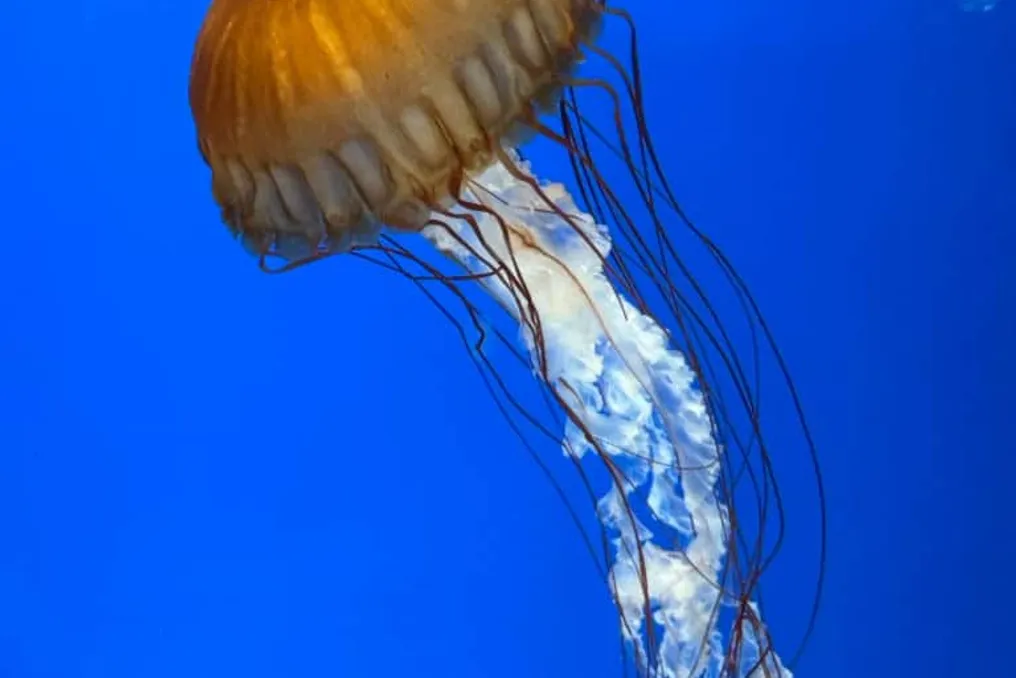
The jellyfish Turritopsis dohrnii possesses an extremely rare ability among animals: after reaching the adult phase, it can revert to a previous stage of its development. Instead of proceeding directly to the end of its life cycle, the jellyfish can transform back into a polyp stage—a younger form attached to a surface.
This process is called transdifferentiation, which occurs when an already specialized cell changes its function and begins to perform another role. Essentially, the organism dismantles part of its adult structure and reorganizes tissues to return to an earlier developmental stage. This is why the species has earned the nickname 'immortal jellyfish.'
The life cycle of Turritopsis dohrnii usually begins with a polyp. Small jellyfish emerge from it, growing until they reach the adult phase. A distinctive feature of this species is the ability to take the reverse path.
When an adult jellyfish is damaged, ages, or subjected to adverse conditions, it can initiate the reversal process. The body loses signs of the adult phase and passes through an intermediate stage called a cyst. Then, the tissue reorganizes until a polyp is formed again.
A study published in 2019 in the journal G3: Genes, Genomes, Genetics, signed by Yu Matsumoto, Stefano Piraino, and Maria Pia Milletta, detailed this process. Researchers discovered changes in gene activity during the transformation and found signs related to DNA repair, telomere maintenance—structures that protect chromosome ends—and changes in cell function.
This ability is not just a hypothesis. Experiments demonstrate that the species is capable of carrying out this reversion and beginning to produce a new generation of jellyfish. It is this potential for returning to an earlier stage of development that supports the concept of biological immortality associated with this species.
However, this nickname can be misleading. Turritopsis dohrnii is not invulnerable and is not protected from all environmental risks. So-called biological immortality only means that the organism can avoid death caused by aging by reversing its development.
A more detailed understanding of the process
It is important to understand that the mechanism allowing the organism to rejuvenate does not eliminate all other threats to survival. Therefore, it is more accurate to say that the species has an exceptional ability to prevent aging, rather than claiming that it will never die.
Recent research aims to determine what allows this species to do what human cells cannot naturally do. In 2021, Yu Matsumoto and Maria Pia Milletta from Texas A&M University published a study in the journal Genome Biology and Evolution on changes in gene activity during the reverse life cycle.
The results have strengthened interest in processes related to DNA repair, cell renewal capacity, and cellular reprogramming. The goal is not to find a formula for human immortality, but to better understand how different organisms cope with cellular damage and aging.
In 2022, another study published in Proceedings of the National Academy of Sciences compared the genome of Turritopsis dohrnii with the genome of a closely related species that does not possess the same rejuvenation ability. Researchers identified differences in genes related to DNA repair, telomere maintenance, cells capable of generating different tissue types, and intercellular communication.
These findings help scientists investigate why some cells can restore characteristics of earlier life stages, and how such mechanisms might be related to aging. This is still in the field of fundamental research and does not imply that there is a medical application for human rejuvenation.
The most striking thing about Turritopsis dohrnii is that its life cycle is not obliged to follow a single direction. While aging is usually considered an irreversible path, this small jellyfish has a biological strategy that allows it to return to a previous stage. It is this ability that makes it one of nature's most intriguing examples for those trying to understand why organisms age.