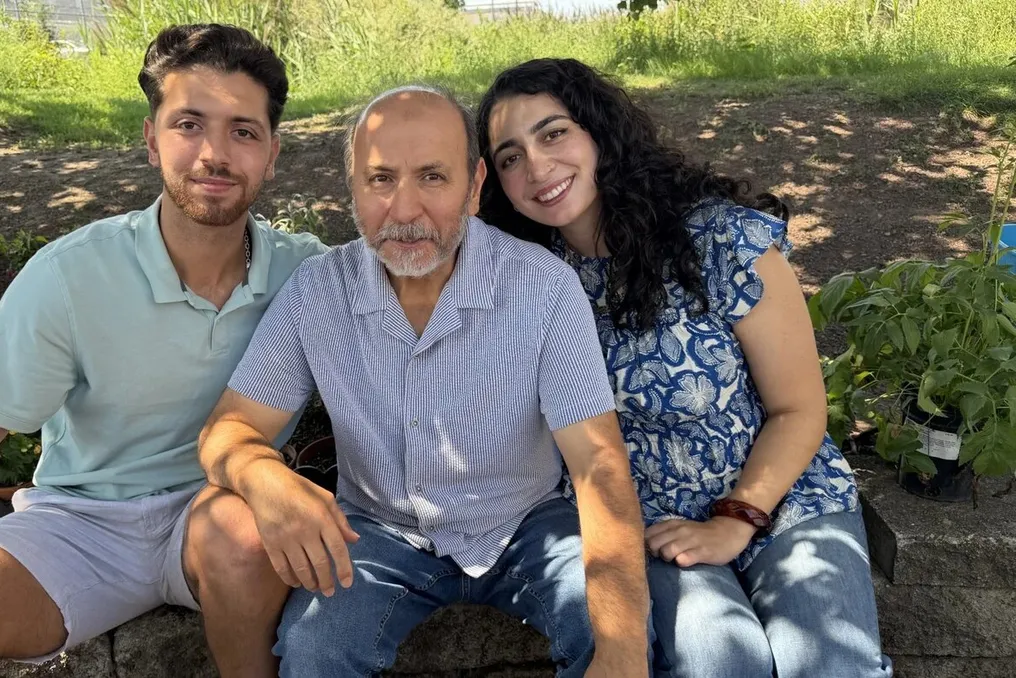
When Zena Saifo arrived at the U.S. Immigration and Customs Enforcement (ICE) office in New Jersey with her father, she expected a routine visit. Her father, Imad Saifo, had received a letter requiring him to appear for a 'check'.
At that time, he was not overly concerned as he was working with lawyers on his immigration case and complying with all requirements placed upon him. Although the family was aware of immigrant detentions across the United States, they did not expect Imad to be arrested.
They arrived at the ICE office in Mount Laurel at 7:30 AM on July 31st for his 8:00 AM appointment. They waited for several hours before an officer asked Imad if he had any medications. It was then that Zena told Middle East Eye that she began to doubt: 'Is he going to be detained?'
Shortly after, Imad was called to a back area of the office with his lawyer. A few minutes later, the lawyer returned and informed the family that ICE was detaining him. Zena asked for permission to at least say goodbye, but her request was denied.
Twenty-seven-year-old Zena told MEE: 'I just felt like my whole world stopped. My heart dropped into my stomach.' Imad, a 65-year-old Syrian immigrant and father of four children, spent about two weeks in ICE custody before an immigration judge released him on bail on August 15th.
For his family, this detention became not only a legal battle but also a race against time to bring their father home.
Immigration Status History
Imad arrived in the U.S. from Syria in 2002 on a joint tourist/business B-1/B-2 visa and subsequently opened Zena's American Mediterranean Cuisine restaurant in Collingswood, New Jersey, along with other businesses. His wife and children are U.S. citizens, and the family sought legal ways to obtain permanent residency for him.
However, his immigration history is complex. According to the Department of Homeland Security (DHS), Imad's visa expired in May 2002. An immigration judge ordered his removal in September 2010, but the case was reopened in January 2011. In February 2023, the immigration judge administratively closed his removal case.
Furthermore, Imad has a criminal record. DHS described him as a 'criminal alien' and stated that he was convicted of witness tampering. Court records reviewed by WHYY showed that he pleaded guilty to the offense and was sentenced to five years of probation, 100 hours of community service, a fine, and restitution.
DHS also referenced previous arrests for theft fraud and impersonation. Zena rejected this description of her father, calling him 'the pillar of our family and our community.' She emphasized that since moving to the U.S., he has been seeking legal paths to citizenship.
Imad disputed how the government described his immigration status. In an interview after his release, he stated that he was pursuing permanent residency through his U.S. citizen family and was awaiting an interview. He said: 'I am waiting, I meet the requirements, and I am waiting for my interview.'
His lawyer, Fiona Powell, stated that Imad was entitled to file a bond application given the circumstances of his immigration case and his history in the U.S. During his detention, over 150 people, including family members and community supporters, wrote and notarized letters supporting Imad's character and urging the judge to release him. His lawyers and family also gathered thousands of signatures on petitions and letters of support from local elected officials and community organizations. Powell noted that community support played a significant role during the bond hearing, and the judge decided on his release, citing Imad's strong ties to the community.
Scale of ICE Operations
Imad's detention occurred amid the expansion of ICE operations across the U.S. According to government data provided by the Deportation Data Project at UC Berkeley, ICE arrested 49,571 people in July. This was the highest monthly figure under the second Trump administration, 15 percent more than in June, and 70 percent more than in February.
This increase was accompanied by a rise in arrests outside high-profile immigration raids, including arrests at workplaces, roadside stops, and immigration appointments. As a result, immigrants who might have previously considered routine interaction with immigration authorities low-risk developed a growing sense of uncertainty.
According to July data, more than half of those arrested had no convictions or charges. The Trump administration and DHS defended this campaign as necessary to ensure compliance with U.S. immigration law, repeatedly stating that the agency prioritizes individuals with criminal backgrounds.
ICE justified Imad's detention by pointing to his lack of permanent immigration status and his charge of witness tampering. A DHS representative stated in a statement about Imad: 'Under President Trump and Secretary Mulino, ICE is targeting the worst of the worst.' He added: 'Nearly 70 percent of ICE arrests involve undocumented foreigners charged or convicted of a crime in the U.S.'
Consequences of Detention
Despite Imad's release, the fear of re-detention has not disappeared. His immigration case is still pending review, and Zena expresses concern about what may happen to her father and other immigrants facing this system. She said: 'The anxiety, the fear, the huge stress experienced over the last two weeks—that is not something that just goes away.'
Now that Imad is home, the family is grateful to the people who helped them through this ordeal. However, this experience has changed their view of the surrounding community. She noted that her father's detention showed that the consequences of the anti-immigration campaign can extend far beyond the detained individual, affecting families, friends, and communities forced to cope with this uncertainty.
'It really shows that we have a responsibility to the communities around us,' she said. 'We were able to ensure that we support others and that no harm is left unattended.'