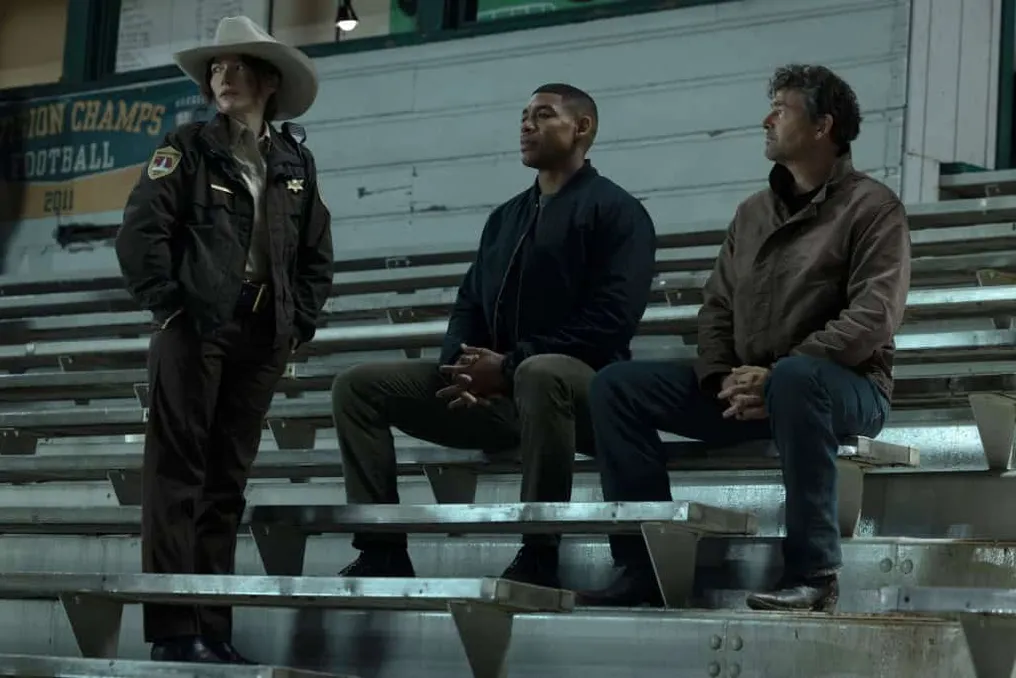
The new DC Studios production adopts a criminal investigation structure to introduce the characters Hal Jordan and John Stewart. However, the second episode already signals that these characters' cosmic context will not remain in the background.
The series begins with the 'space cops' of the DC Universe investigating a homicide in a small town in the American Midwest. The plot follows Hal Jordan, a veteran of the Green Lantern Corps, and John Stewart, a recruit under his training. Instead of starting with a major galactic threat, the narrative places them before a mysterious case in Rushville, Nebraska.
This initial focus choice caught the author's attention, who, despite being tired of superhero series, maintains great interest in police investigation narratives, especially those with the atmosphere of HBO productions. Cited examples include True Detective, Mare of Easttown, and Task, series that use crime as a starting point to explore deeper characters, relationships, and secrets. Lanterns follows this same line, although its detectives belong to a police force that patrols the Universe.
Tom King, one of the creators, informed The Wrap that he conceived the project as a fusion between the movie Training Day (2001, starring Denzel Washington and Ethan Hawke) and True Detective, applied to the Green Lanterns. The premise was clear: to create a 'space police procedural'. Damon Lindelof, another creator, mentioned to Screen Brief that the idea of a True Detective-style story set on Earth immediately suggested the possibility of applying it to the 'space cops'.
The dynamic works because the Green Lanterns already act as an interstellar police force, monitoring various sectors of the Universe and using rings that convert willpower into physical structures. Hal has vast experience in this work, while John, still a trainee, is being prepared to take over his role.
However, the relationship between the two is not that of a patient mentor teaching a novice. Hal retains information and provides unusual guidance, seemingly having his own reasons for keeping John at a distance. In turn, John must learn the function while trying to understand the man who should guide him. Simultaneously, both must investigate a murder that progressively reveals itself to be more complex.
The series also explores chronology in a non-linear way; the episodes do not follow a strict sequence, alternating between the years 2016 and 2026. This alternation allows the series to reveal facts from both periods, requiring the viewer to establish the connections. The second chapter, for example, returns to 2016, elevating the importance of events that seemed secondary at the beginning of the first episode.
Initially, much of the experience resides in what happens outside the scope of the rings. Hal and John conduct interrogations, follow leads, visit locations, and talk in vehicles, trying to identify who is lying. Rushville serves as that typical small town of police dramas, where everyone seems to know each other, but few are willing to share what they know. The crucial distinction is that this investigation covers an organization that monitors the Universe.
Those expecting the Green Lantern mythology to appear in its entirety immediately must be patient. The first episode prioritizes building the case and introducing the characters. The second, on the other hand, intensifies the cosmic element by introducing the Star Sappers, ancient artificial beings linked to the Corps' history, and introduces Sinestro (Ulrich Thomsen).
This balance is a strategic decision for a production aimed at an audience that may only know the Green Lanterns by name. Instead of immediately exposing the Corps, the rings, the Guardians, and all the surrounding mythology, Lanterns invites the viewer to follow the investigation first. When the larger universe begins to emerge, there is already a concrete story serving as a foundation.
This perhaps explains why the series does not convey the feeling of merely setting the stage for a future big DC Universe film. There is a homicide to be solved, a tense relationship between the protagonists, and a narrative told in two distinct timelines. Superhero elements are present, but they do not dominate every scene.
By the end of the second episode, however, it becomes difficult to classify the case merely as a homicide in Nebraska. The story begins to reveal its broader dimensions, reminding that these two investigators are part of a police force responsible for protecting an entire portion of the Universe.
So far, this union of science fiction and police work is working well. It might be one of the most engaging ways to introduce the Green Lanterns: starting with bodies, two suspicious investigators, and a town full of secrets, and only later referring to the fact that it is a space cop saga.
The series has weekly releases on HBO and HBO Max, always on Sundays, and is recommended for anyone who appreciates investigative stories, even without familiarity with the comics. Lanterns manages to introduce the characters' mythology gradually, without neglecting the police mystery that sustains the initial episodes. The combination of investigation, science fiction, and superheroes has proven effective so far, and there is much potential to discover what lies behind this plot.