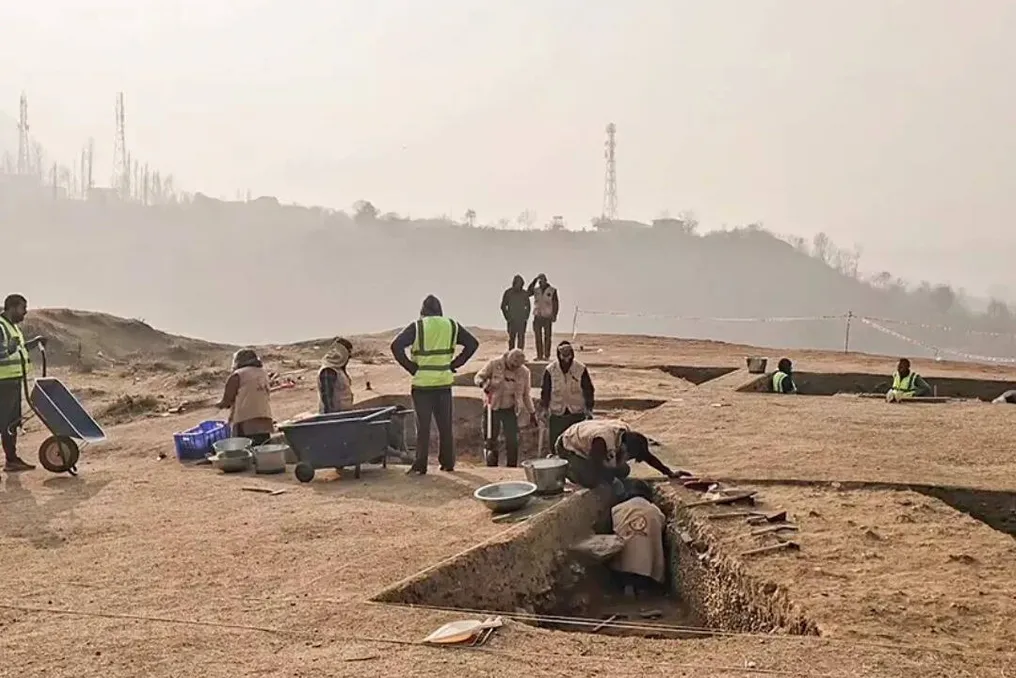
The second phase of archaeological work on the Buddhist site has started in Zehanpora, located in Baramulla, northern Kashmir. The project opening ceremony will be conducted by the Chief Secretary of Jammu and Kashmir, Atal Dullo.
The existence of a 2000-year-old Buddhist civilization in this area was discovered last year by Professor Mohammad Ajmal Shah of Kashmir University. This fact gained widespread recognition after Prime Minister Narendra Modi mentioned it during his monthly radio program 'Mann Ki Baat' on December 28 last year.
The Prime Minister recalled that people had long noticed high embankments in Zehanpora without realizing their true significance. What was initially considered unusual rock formations later turned out to be similar to three stupas of Buddha depicted in photographs from a French museum.
According to Modi, the blurry pictures taken thousands of kilometers away proved decisive because they showed three Buddhist stupas, which helped archaeologists connect the facts and reconstruct the ancient history of Kashmir. This discovery confirms the rich cultural heritage of Jammu and Kashmir.
It all began in October 2023 when Shah was on an internship in France and came across photographs about a hundred years old in the Guimet Museum. These pictures showed the domes of stupas in Baramulla. Shah noted: 'I immediately realized I had visited this place. I was amazed by the domes in the photographs, which looked much larger than what we see now.'
Later, Shah approached the Department of Archaeology of the Government of Jammu and Kashmir with a request to fund the project, and the department agreed. Shah and his team began excavations last November, initially discovering a hall identified as an apsidal (semicircular) stupa. Additionally, the team found iron and copper artifacts, decorated needles, and other materials.
Shah reported that they determined the wall alignments using drone images and were excavating precisely at these points. He added: 'There is a high probability that many structures and artifacts are still preserved underground.'
Shah highlighted the possibility of a connection between this site and the Fourth Buddhist Council (1st century AD). He stated that 'Kashmir was a major center of Buddhism in ancient times. It was here that the Hinayana school of Buddhism evolved into Mahayana, giving the religion a new philosophical and cultural form.'
Shah also pointed out that the Chinese researcher Xuanzang mentioned Baramulla in his travel notes. According to Shah, Xuanzang spent the night in Uskur, a Buddhist site near the town of Baramulla, and visited several monasteries in the area. 'This suggests that Xuanzang likely also visited a monastery in Zehanpora.'