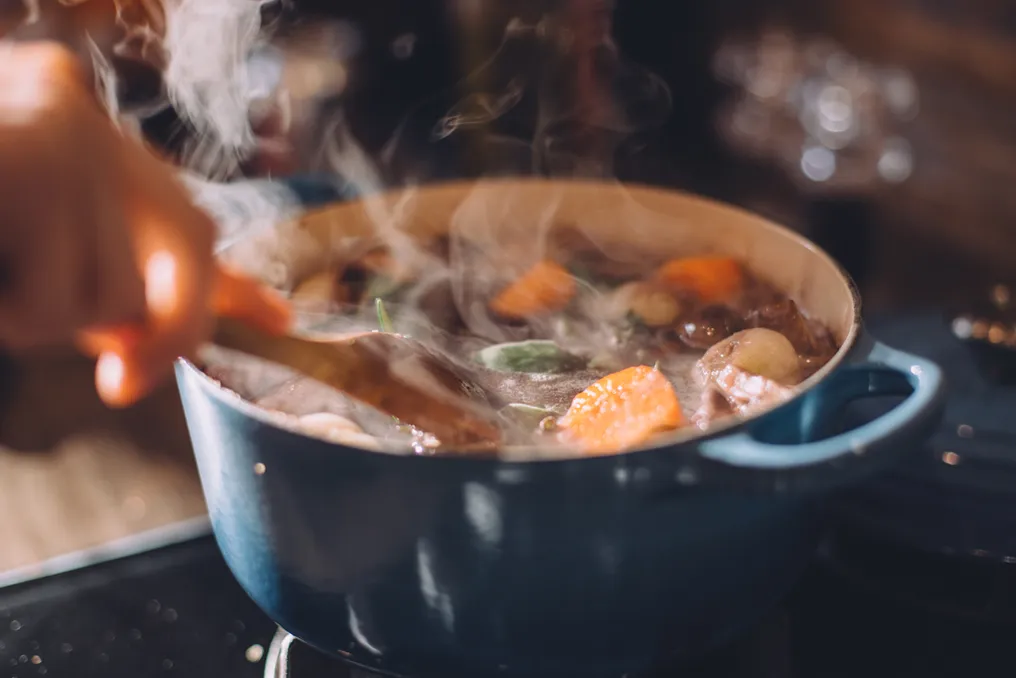
The question of how the eternal broth is created is linked to a philosophical dilemma known as the Ship of Theseus Paradox, which arose after an American culinary blogger named Zaq (@zaq.makes) began experimenting with this concept. This debate became so popular that Zaq named his recipe Stewtheus—a combination of the terms stew and Theseus.
Cooking videos usually do not spark philosophical discussions among internet users, but Theseus's broth is different. Since 2024, Zaq has been documenting the process of his eternal broth daily. He has published nearly 500 videos showing the appearance of the product simmering in an electric pot, tasting and evaluating the broth, and then adding water and new ingredients, often suggested by fans in the comments.
The broth continues to boil continuously until the next day and subsequent days, and it can be used at any time. Although Zaq does not show this in the videos, he strains the broth several times a week to remove excess suspended fat and clean up materials that accumulate as melted residue at the bottom of the pot.
He claims to consume this broth daily for over a year. Moreover, this is not just another trend invented by TikTokers. In fact, various versions of eternal broths have existed in Asian cuisine for centuries, and it is presumed they were also part of medieval life in Europe.
To date, there are two well-known eternal broths that continue to boil: Otafuku broth in Japan, which has been simmering since 1945, and Watthanapaniich broth in Thailand, which has been boiling since 1974. Connoisseurs claim that these broths possess a complex, indefinable, and unique taste.
Expert Evgenia Figiredu, a retired professor from the Department of Food Engineering at the Federal University of Ceará (UFC), explains that these products are safe if very specific conditions are met. To prevent microbial growth, the broth temperature must be constantly maintained above 64°C, and this must be monitored with a thermometer.
As with most recipes, the final result heavily depends on the quality of the raw materials. Figiredu emphasizes that it is crucial that the ingredients show no signs of mold, as fungi can produce heat-resistant toxins that remain in the broth even after boiling.
Despite the excellent quality of the ingredients, the professor notes that prolonged cooking can alter the nutritional value of the dish. This means that while fans sometimes view eternal broths as a panacea for immunity, they are not necessarily healthier than regular soup.
A small amount of fat in the broth is not harmful; it is even beneficial for adding more flavor and protection against microorganisms. As for other ingredients, Zaq has tested hundreds—which, incidentally, were collected by a fan on an interactive website where the frequency and influence of each could be analyzed. Based on his experience, he states that meat, bones, mushrooms, tubers, chili, and spices are excellent for eternal broth.
Most other ingredients acquire a strange texture after such long cooking. Therefore, he avoids vegetables, pasta, rice, dairy products, fish, and seafood.
The broth is convenient for Zaq's demanding and irregular work schedule, which previously made cooking difficult for him. Today, the pot is inside a small 3D-printed compartment equipped with chimneys that vent the broth vapors—because preparing something like this in one's own kitchen guarantees the whole house will smell like soup.
Although he likes it, he admits that if it weren't for the success of the social media videos, he would take breaks from making the broth. One option would be to finish the broth, wash the pot, and start a new one from scratch, or adopt practices similar to the Chinese tradition of lǔshuǐ, also known as master stock or broth master. In this case, after serving, solid particles are removed, the broth is rapidly cooled, frozen, and then intensely boiled before reuse. Figiredu explains that this process is also safe, but it is critically important that cooling occurs as quickly as possible, and the broth is not left at room temperature.
Zaq reports that it is hard for one person to handle such a workload and believes this initiative is well-suited for groups. The eternal broth gained fame on American social media following an initiative in 2023 by influencer Ann Raverdy, who offered a public eternal broth in a New York park for 60 days. She announced on her social media that all one needed to bring was one ingredient for the pot, a bowl, and a spoon.
Zaq shares: 'I used to invite some friends to try it, but I don't invite them as often now. I worry that heat destroys the flavor, but I don't know if it destroys allergens either. So, if someone is allergic to any ingredient, I don't know how long it will last, and there are so many.'
It is the same dilemma as at the beginning of the text, known for millennia: after adding and removing so many ingredients, is it still the same broth? Is even a single atom from the first day Zaq started cooking the broth left? There is no definitive answer to this question—but enthusiasts seem less concerned with philosophy than gastronomy. For many, it is simply dinner.