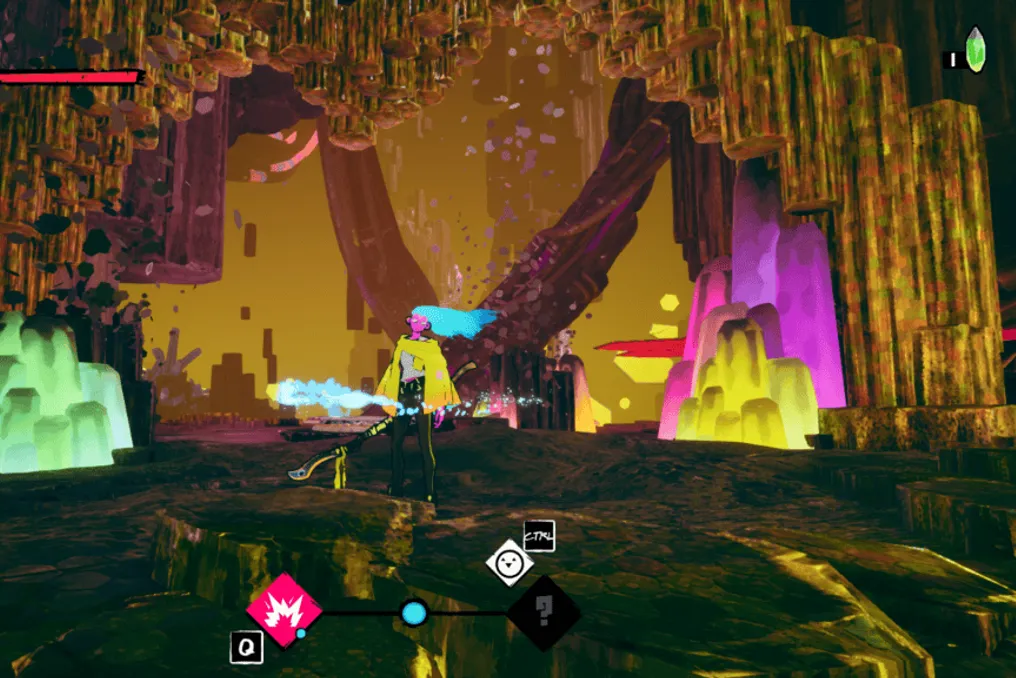
In Fading Echo, the player controls One, a young Legend capable of morphing into a living sphere of water. This transformation is the pillar of the game, used for mobility, combat, and puzzle-solving. The mechanics allow sliding through pipelines, traversing gaps, and attacking enemies from above, demonstrating the depth derived from a simple premise.
The game's environment is Corel, a universe fragmented into various realities, where combat rules and resources vary depending on the explored area. The narrative is driven by the Paradox Corruption, a destructive force that gradually distorts the reality of Corel. One becomes involved in this crisis due to a unique power needed to face it, and time is a critical factor.
The initial objective is to traverse floating islands filled with adversaries and chaotic zones, aiming to contain the expansion of the Paradox before it annihilates the rest of the world. Maddock, introduced as the leader of this corruption, shows complete lack of mercy during his appearance in the campaign.
One's journey is accompanied by a diverse group of allies, each motivated by different reasons—loyalty, guilt, or lack of direction. This cast lends weight to the protagonist's decisions without forcing immediate explanations.
Confrontations are structured around mixing water with lava, toxic residues, and the energy of the Paradox Corruption itself, generating chain reactions that serve to open paths or solve battles. Although most elemental interactions are well-designed, the combat is considered mediocre. However, a technical issue was reported: when trying to use the dash while already transformed into water to cross a grate faster, the game would freeze movement, causing the character to collide with the grate, despite a sphere of water having no physical form for such impact. While this was not a decisive factor in the experience, it represents a potential annoyance for speed-focused players.
It should be noted that combat is not the title's strong suit, but it fulfills its function without being the most captivating element. The true highlight of the game lies elsewhere.
Fading Echo shines in its puzzle design. Instead of providing ready-made solutions, the game presented the necessary components—the correct element, the appropriate obstacle—encouraging the player to experiment until finding the answer. The progression is well-planned: the first enigmas teach the logic of element combination, and subsequent levels add variations without falling into excessive repetition. This type of challenge provided genuine satisfaction in solving problems independently and was the aspect that kept the player engaged throughout the entire campaign, being accessible even to those who do not appreciate puzzle games.
A significant negative point is the structure of Corel. Despite being a fragmented world with multiple realities and layers, it lacks sufficient substance to justify the time invested. The absence of a map or minimap, coupled with the lack of any visual orientation resource, leads the player to walk in circles, unsure if they have visited a corridor before or if it is merely a narratively irrelevant dead end. Even appreciating free exploration, the player felt bored in certain parts of the campaign, struggling against the irritation of lacking a clear sense of direction.
An aspect that Fading Echo executes flawlessly is the Brazilian Portuguese voice acting. The cast features prominent names from national dubbing. Carol Valença voices One, lending the protagonist remarkable naturalness. Guilherme Briggs, known for his versatility, portrays Maddock, the antagonist, conveying the expected threatening presence. The cast is completed by Flávia Saddy as Rhane, Leo Rabello as Cayrn, Adriana Torres as Vellum, and Aria and Reginaldo Primo as Bob Le Critter, all offering high-quality performances. This quality of professional localization is something many great games lack, and the Brazilian dubbing alone justifies choosing to play in Portuguese over the original.
Visually, Fading Echo presents an art direction reminiscent of an animated comic book, vibrant and possessing its own identity in each biome. This was one of the game's biggest successes, as the style remains consistent throughout the entire campaign. In terms of overall performance, the experience was stable, without frame drops or crashes detrimental to gameplay.
In conclusion, without the engaging puzzles, the comic book style art, and the impeccable voice acting, the player would have abandoned the game. The sum of these three qualities ensured persistence until the end. Exploration, however, was extremely disappointing and tiring, even with the freedom of shape-shifting. Despite this, the overall quality surprisingly impressed, and there is hope that Emeteria will continue to prioritize fun puzzles and value the Brazilian market with local dubbing.