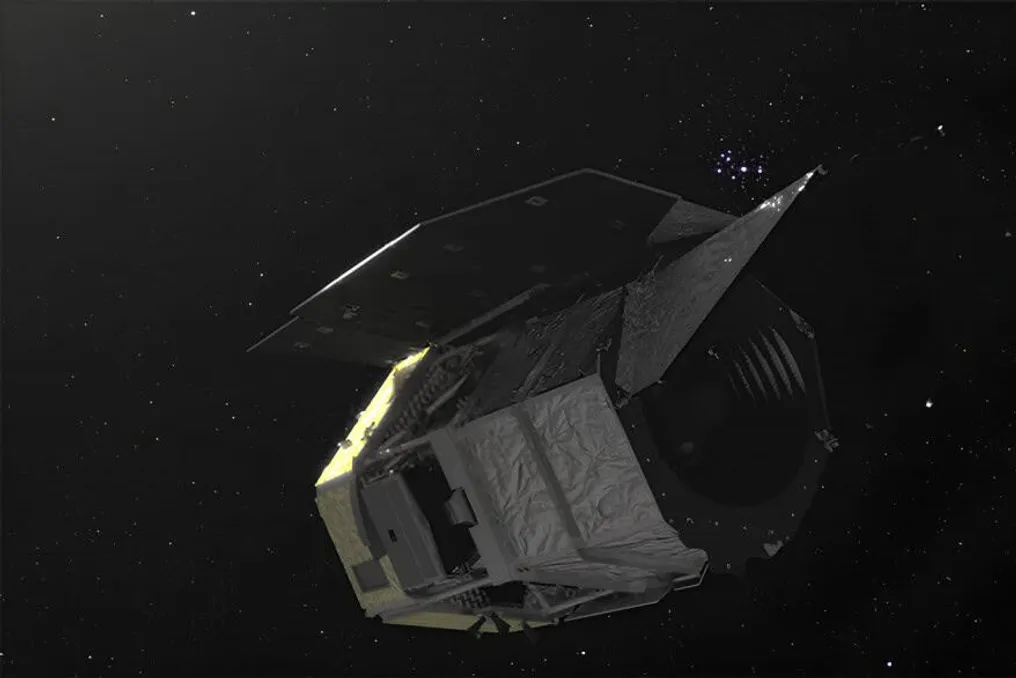
The launch of the Nancy Grace Roman Space Telescope, a NASA project, is approaching. This mission, which was once the target of cancellation attempts by U.S. President Donald Trump, is scheduled to lift off this Sunday (the 30th) at 8:26 AM Brasília time. The launch will be carried out aboard a Falcon Heavy rocket, provided by SpaceX, departing from the Kennedy Space Center in Florida, with live coverage by Olhar Digital.
After leaving Earth's orbit, the equipment will head to Lagrange Point 2 (L2), located approximately 1.5 million kilometers from the planet, on the side opposite the Sun. This location is considered crucial for astronomical studies as it provides ideal conditions for the instruments and ensures the observatory has a comprehensive view of the Universe.
Roman is among the main space observatories of NASA's new generation. The development of this project spanned almost two decades and received estimated financial contributions of about US$4 billion. The mission will focus on studying dark matter, dark energy, and exoplanets, in addition to investigating cosmic evolution.
A notable aspect of the telescope is its vast field of view. It will be capable of capturing a celestial area about fifty times larger than that recorded by the James Webb Space Telescope (JWST) in a single photograph. This will enable extensive astronomical surveys in both visible light and near-infrared.
Budgetary Uncertainty and Team Efforts
Despite its scientific relevance, the mission faced a period of instability. In 2025, a Trump administration budget proposal included significant reductions for NASA, including a cut of approximately 50% in the agency's scientific programs. These documents allocated funds for telescopes like Hubble and James Webb but did not account for other observatories.
The possibility of suspending Roman caused apprehension among scientists, engineers, and technicians, especially because the project was very close to completion. At that time, team members estimated that the telescope was about 95% complete. For the professionals who dedicated years to the mission, the prospect of interruption was extremely frustrating.
Jamie Dunn, who led Roman between 2018 and 2025 and currently heads the Goddard Space Flight Center, commented on the financial difficulties: 'Out of the eight years I worked on Roman, we were zeroed out in the president's budget in at least half of them,' he told Space.com.
Although the official proposal did not mandate total cancellation, it maintained a scenario of great concern. The government would allocate US$156.6 million to the development of Roman in the 2026 fiscal year, which represents less than half of the amount previously received.
Staff reduction also impacted the work. In a sector related to the telescope, two of the three specialized technicians left their positions, increasing the workload during a critical testing phase.
Nevertheless, despite the scarcity of resources and personnel, the team managed to keep the schedule. Professionals began working double shifts and weekends to finalize the planned stages.
The situation changed when the United States Congress vetoed the most severe cuts proposed for NASA, restoring the agency's budget to previous levels. Even so, the team chose to advance the mission to mitigate the risk of future budgetary changes. The scheduled date was initially moved to September and then to the end of August. This effort culminated in a success: in April, NASA announced that Roman was finished about eight months ahead of schedule and under budget.
Currently, the main challenge lies in the launch. After years of development, testing, and budgetary uncertainties, the team must await the performance of the rocket, a phase that is outside the control of those responsible for the telescope.
After leaving Florida, Roman will take approximately thirty days to reach L2. During this journey, the spacecraft will execute maneuvers to adjust its course and reach the designated position. One of the most crucial moments will occur about twenty-four hours after launch, when a course correction is scheduled, an essential procedure for positioning the spacecraft on the correct trajectory to its destination.
Advanced Capabilities of the Roman Telescope
The Nancy Grace Roman telescope is equipped to drastically change the count of exoplanets in the Milky Way, using two complementary and highly sophisticated detection methodologies. One will allow for direct imaging of certain worlds, while the other will reveal smaller and more distant planets through the effects they exert on starlight.
The first technique employs a coronagraph, an instrument designed to block the light of the observed star. This feature is indispensable because stellar brightness is much greater than that of a planet. Without this blockage, the star's luminosity would obscure the surrounding planet, making identification difficult.
During its participation in the Space View program, presented by astronomer Marcelo Zurita, astrobiologist Raíssa Estrela, a researcher at NASA's Jet Propulsion Laboratory, detailed the operation. She explained that 'this technology we call a coronagraph is basically an instrument that blocks the light of the parent star. And why do we want to block this light? Because when we block the light of the parent star, we can see the light reflected by the planets inhabiting that star. The star's brightness is so strong that it overwhelms the entire image. So, we need to block it to see the light reflected by the orbiting planets. With this type of observatory, we will be able to perform imaging of the planetary system.'
Raíssa also highlighted the difference compared to current approaches. 'It will stop being an indirect measurement, as is the case with what we do today with James Webb, to also have actual imaging of the planets.'
The coronagraph will be more effective for giant gaseous planets, comparable to Jupiter. For smaller bodies, Roman will use another strategy: gravitational microlensing. This phenomenon occurs when the light from a distant star passes close to a massive object. The gravitational attraction of this body curves spacetime and deflects the path of light, creating a kind of natural lens.
If the object has a planet in its orbit, the gravity of that world can also cause a slight variation in the detected light. This effect allows for the identification of planets that would be difficult to find by other methods.
Researcher Leandro de Almeida, from the Astrophysics Division of the National Institute for Space Research (INPE), explained the principle during Space View. 'Light travels straight in curved spacetime. When light passes near a very massive object, the beam is deflected and changes its path. The observer does not know this, so they will see the star in another position, which is the position we call the image.'
By integrating both techniques, Roman will be able to investigate different populations of exoplanets and help scientists understand the number of worlds in the Milky Way and which types of planetary systems are most prevalent.
After almost twenty years of development, Roman is about to leave Earth. For the team, the apprehension caused by budget cuts and changes gives way to the expectation of witnessing the start of a mission that was on the verge of being interrupted before even reaching space.