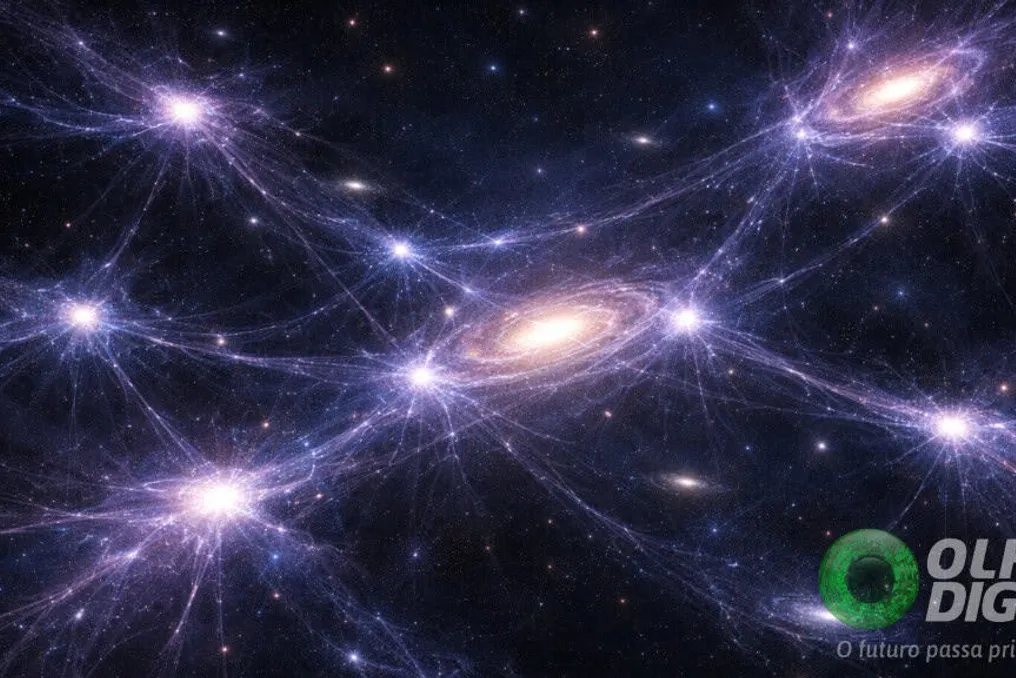
Astronomers have discovered that the gravitational force of the Milky Way itself is capable of generating signals previously associated with dark matter. Simulations conducted by the University of Washington demonstrated that streams of stars can develop curvatures, breaks, and other irregularities even without the presence of clusters of this mysterious substance.
This finding adds complexity to one of the methods used in the search for evidence of dark matter, but simultaneously offers astronomers a tool to distinguish between effects generated by the galaxy itself and those originating from the enigmatic substance.
Stellar streams form when groups of stars approach a galaxy and become captured by its gravitational attraction. As they orbit, these groups are stretched, resulting in a long band of stars.
Many of these configurations observed in the Milky Way are not homogeneous; they exhibit ripples and breaks that, according to a theory investigated by the scientists, could be caused by the attraction of small clumps of dark matter known as sub-halos. The University of Washington team decided to investigate the extent to which these characteristics could arise solely due to the action of the galaxy.
The researchers constructed four virtual galaxies in computational simulations with dimensions comparable to those of the Milky Way, excluding dark matter clusters, and distributed about 15 thousand stellar streams among them. The evolution of these models was monitored over five billion years.
Almost all the simulations ended up showing some type of modification. Arpit Arora, a postdoctoral researcher in astronomy at the University of Washington and lead author of the study, stated: 'In our simulations, the host galaxies themselves caused the same types of irregularities we observe in real stellar streams.'
The simulations revealed that only 70 of the analyzed structures remained completely smooth after five billion years. This occurrence is due to the arrangement of the galaxies themselves, since the stars are not uniformly distributed. There are denser areas, and a stream passing through these points undergoes changes induced by the gravitational field.