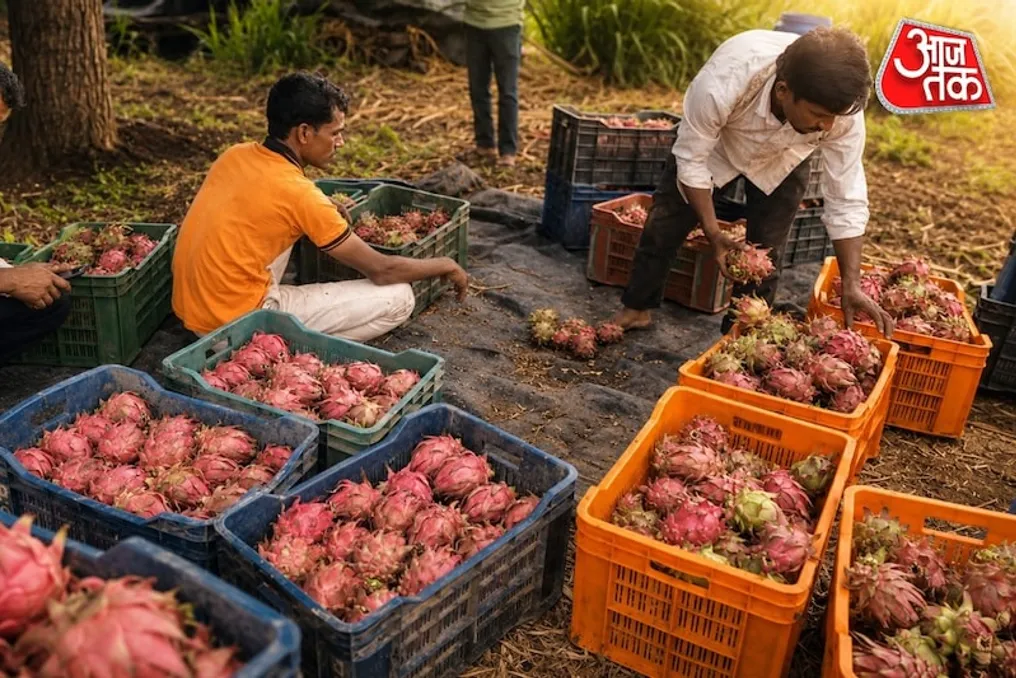
The Jalna district in Maharashtra state is often characterized as an arid area with water scarcity, which creates serious difficulties for traditional agriculture due to insufficient rainfall. Under these conditions, two farmers from the village of Pitori Sirsgaon, belonging to the Ambad district, decided to try a new approach to agriculture by starting to cultivate dragon fruit instead of traditional crops.
Farmers Sambhajji Ashok Kakade and Narayan Haribhau Gore chose the option of fruit gardening. They obtained information about growing dragon fruit through mobile devices, and also communicated with existing farmers and visited their plantations to collect data. After studying the information, they decided to start growing dragon fruit on their plots.
Sambhajji Ashok Kakade planted dragon fruit saplings on one and a half hectares of land on January 1, 2024, spending about 600 thousand rupees on it. He learned about the high demand and good prices for dragon fruit via his mobile phone, which prompted him to abandon traditional farming in favor of this crop. He ordered about five and a half thousand saplings from Pandharpur, located in the Solapur district, and planted them on one and a half hectares, maintaining a distance of about one foot between plants.
Sambhajji Kakade independently made the necessary supports and structures for growing dragon fruit, which allowed him to save on construction costs. According to him, this crop is less susceptible to disease outbreaks compared to others, and it tolerates heat well while requiring a relatively small amount of water, which is a critical factor for a water-scarce region.
Sambhajji Kakade expects to harvest about 15 tons from one and a half hectares in the first season, which could bring him an income of 1 to 1.5 million rupees. Considering market demand, he sells his produce in the markets of Solapur, Chhatrapati Sambhajinagar, and Pune. He is confident that after covering expenses, there will be a good profit and urges other farmers to consider cultivating dragon fruit together.
Narayan Haribhau Gore also started growing dragon fruit after preliminarily studying information from other farmers and inspecting their gardens. Like Kakade, he received knowledge about the crop via mobile phone. He ordered 6 thousand saplings from Pandharpur (Solapur) and planted about five and a half thousand. Narayan Gore also built the supports and structures for his plantation himself, which helped reduce operational costs by approximately 25–30 percent. About 150 thousand rupees was spent on transportation and other expenses for the 6 thousand saplings. He expects to earn between 700,000 and 800,000 rupees from five and a half thousand plants in the first season.
In both farmers' plantations, the plants are spaced at an interval of about 10 plants per two supports. The choice of dragon fruit as an alternative crop is due to the problem of water shortage and low rainfall. Since dragon fruit is considered healthy and has high market demand, both farmers hope for additional income due to its low water requirements and high price. Both farmers have not only focused on cultivation but also planned production and sales, understanding market demand, and reduced costs by building structures themselves and using mobile means to gain knowledge.
Thus, Sambhajji Kakade and Narayan Gore in Jalna, a region with limited rainfall and water resources, have successfully implemented fruit gardening as an alternative to traditional agriculture. Thanks to low water consumption, self-made structures, cost savings, and market demand, both farmers expect significant income. This experiment by farmers from Pitori Sirsgaon serves as an example for other agriculturalists seeking new options in agriculture.