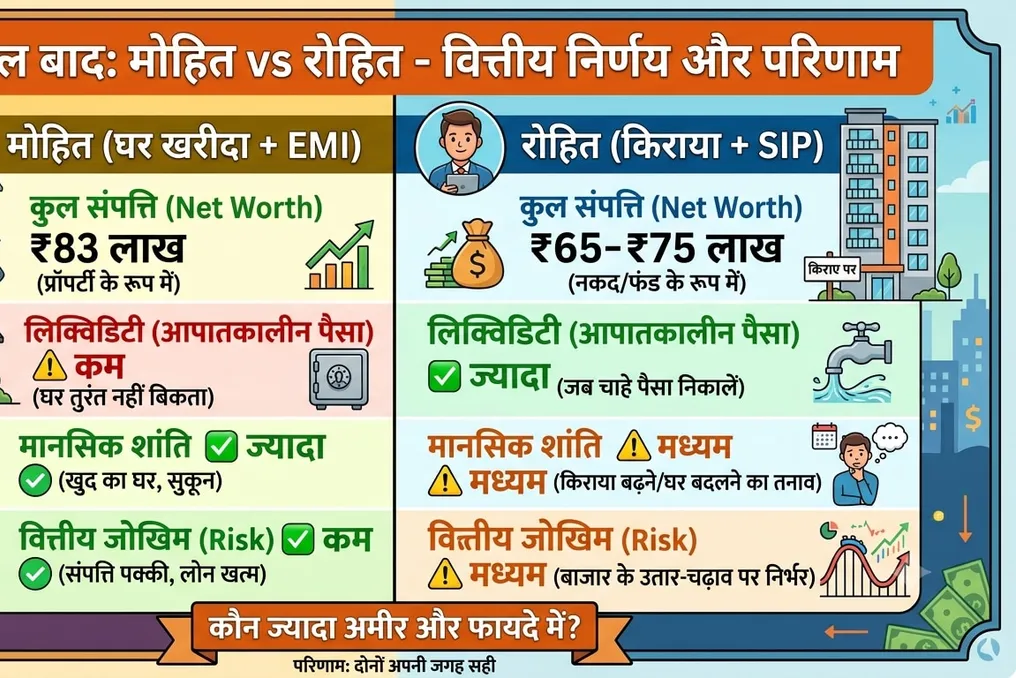
Two friends, Rohit and Mohit, started working at the same time with approximately equal starting salaries of 40 thousand rupees. However, they made different financial decisions: Mohit decided to purchase his own apartment, while Rohit chose to rent accommodation but continued to contribute funds to a SIP (Systematic Investment Plan).
While Mohit's income went towards repaying monthly mortgage payments, Rohit used the amount equivalent to the rent payment to top up his investment portfolio. The question arises: what will their financial situation look like after 15 years?
Most people face the dilemma: should they save money by paying rent, or build their own home by paying a mortgage? Mohit opted to take on the commitment of buying a home, whereas Rohit decided to invest the disposable funds received after paying rent into SIP.
The choice between these two approaches is a common problem among young people in India. To figure out who will be in a more advantageous position after 15 years, let's look at a practical example. Suppose both started with a salary of 40 thousand rupees per month, and their salary increased by an average of 8–10% annually.
Mohit's Decision (Buying a Home)
The cost of the apartment was about 30 lakh rupees. The down payment was 6 lakh rupees, and the mortgage loan was 24 lakh rupees at an interest rate of 8.5% for a term of 20 years. The monthly installment (EMI) was approximately 20,800 rupees. In the initial stage, a significant portion of Mohit's income, about 70%, went solely to covering this mortgage, leaving little for investments.
If the real estate value grows at an average of 7% annually, the 30 lakh rupee apartment will reach approximately 83 lakh rupees in 15 years. By that time, most of Mohit's loan will be repaid, and he will own his own home.
Rohit's Decision (Renting with SIP)
Taking an initial rent of 8 thousand rupees (corresponding to the approximate rent for a 30 lakh rupee apartment), Rohit could direct the remaining approximately 12,800 rupees monthly into a mutual fund (SIP). Furthermore, Rohit's rent also increased by 7% annually.
The question is what Rohit's situation will be after 15 years. If he can achieve an average annual return from mutual funds of 12% to 14%, his total SIP capital after 15 years will amount to approximately 65 to 75 lakh rupees.
In terms of raw figures, both friends will be roughly on the same level or one will have a slight advantage.
If the real estate value grows at an average of 7% annually, Mohit's 30 lakh rupee apartment will reach approximately 1.16 crore rupees in 20 years. By the end of the 20-year period, all of Mohit's loan will be fully repaid, and he will be able to live in his own home worth 1.16 crore rupees without any monthly payments.
Rohit's Decision (Renting + SIP)
In the first 15 years, the market yields a certain return, but thanks to the power of compound interest, the money starts growing very rapidly in the subsequent 5 years. If the average return is between 12% and 13%, then after 20 years, Rohit's SIP capital will reach approximately 1.30 crore to 1.50 crore rupees.
Stock market returns (12–14%) usually exceed real estate returns (6–8%). In the long term, such as 20 years, compound interest will put Rohit's funds significantly ahead compared to the value of Mohit's house. After 20 years, Rohit can buy a house similar to Mohit's house for cash amounting to 1.16 crore rupees, and he will still have an additional 20–30 lakh rupees in cash. Thus, the picture after 15 years differs from the picture after 20 years. After 20 years, Rohit can accumulate 20–30 lakh rupees more than Mohit thanks to SIP.
Home ownership carries an emotional value that cannot be measured in money. Mohit's monthly payments became a form of forced saving. If he hadn't bought the house, he might not have been able to save so much money.
Rohit's decision was also not wrong; he invested the remaining funds along with the rent. After 20 years, he can acquire a house similar to Mohit's house for a lump sum without a loan, and he will still have about 30 lakh rupees. Moreover, Rohit always maintained the freedom to change jobs or move to another city.