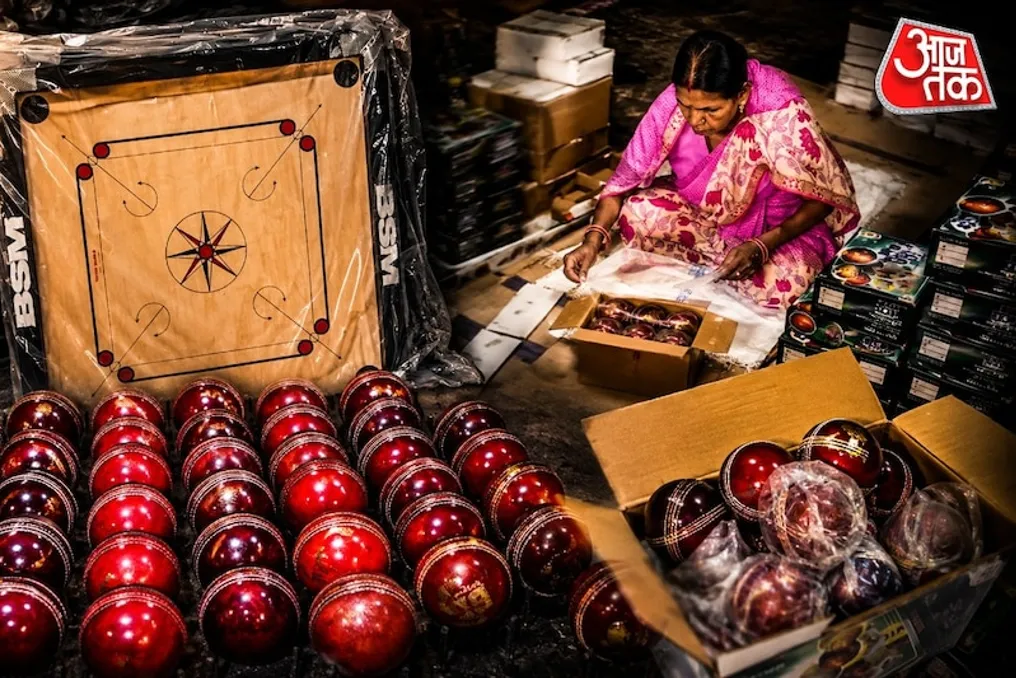
Merat, which gained fame for manufacturing cricket bats, is now known not only as a city specializing in bat production. The sports industry in this city has significantly expanded in recent years. If previously the sports goods manufacturing business started with four or five enterprises, it has now reached the level of about 5-7 thousand small and large production units. Products manufactured in Merat are supplied not only within the country but also to many foreign countries, with the annual export of sports equipment from the region estimated at approximately 975 crore rupees.
The history of Merat's sports industry spans about nine decades. According to data from the Department of Industries, some families began producing footballs between 1935 and 1940. Subsequently, in 1947, people displaced from cities such as Sialkot and Peshawar during the partition of the country continued to develop this business. Through perseverance, craftsmanship, and new experiments, Merat has become a major center for sports equipment manufacturing.
In its initial phase, Merat's sports industry was primarily focused on cricket bats and footballs. Over time, the scope of activity has continuously expanded. Today, it manufactures not only cricket bats, cricket balls, and sticks, but also hockey sticks, footballs, volleyballs, table tennis sets, tennis rackets and balls. Additionally, nets for games, athletic equipment, protective accessories, sports equipment bags, sportswear, indoor game items, boxing gloves, fitness equipment, and trainers, as well as shuttlecocks, are produced.
According to the Department of Industries, there is demand for sports goods produced in Merat abroad. Products from this region are sent to countries such as Australia, South Africa, England, America, West Indies, New Zealand, Zimbabwe, Bangladesh, Germany, France, Sri Lanka, and Russia, allowing Merat's sports industry to move beyond the local market and secure its niche on the international stage.
Charandjit Bhatia, owner of Buchi Sports, notes that the ODOP program has simplified the path for small entrepreneurs to expand their businesses. He emphasizes that previously there were only four or five sports enterprises operating in Merat, whereas now, including small and large ones, there are about 5-7 thousand units. This demonstrates the rapid growth of the industry over the past years.
According to Charandjit Bhatia, the ODOP program made it easier for small entrepreneurs to obtain loans. Receiving a subsidy of up to 50% for installing new equipment has also helped increase production capacity. He himself utilized the government program and recently installed machines for producing fiber-plastic cricket bats, indicating the business's shift towards products made using new technologies alongside traditional equipment.
Aditya Mahajan, owner of BDM Sports, asserts that the central and state government's 'Khelo India' policy has given new significance to Merat's sports industry. Previously, Merat was mainly known for cricket bats, but now large-scale production of badminton, tennis, table tennis equipment, carrom sets, and other sports goods is also taking place here.
Aditya Mahajan also states that the state's preferential interest-free loan program is a great support for small businesses. It allows entrepreneurs to expand their businesses and implement new technologies. Thanks to the support of government programs, small manufacturers are moving forward in increasing their production capacity.
The influence of Merat's sports industry is not limited to factories. Sports equipment production involves many jobs such as packaging, polishing, stitching, fitting, and kit preparation. Furthermore, small entrepreneurs and workers involved in supply and transportation are employed in this sector. With the expansion of the industry, the number of jobs in these sectors has also increased.
Emphasis is also placed on linking local products to the market and branding through the ODOP program. This has benefited Merat's sports goods, and now their recognition is not limited to the local market but reaches international buyers and major brands.
Merat's entrepreneurs are now combining traditional skills with the use of modern machinery and technology. This has led to an improvement in both quality and production potential. Entrepreneurs believe that if they continue to focus on design, quality, modern technology, branding, and exports, Merat can increase its share in the global sports goods market.
Today, Merat is not just a city producing cricket bats; it is shaping its identity as a multifaceted sports hub. The cooperation of government programs, the diligence of entrepreneurs, and the skill of local artisans contribute to the development of this industry. Sports goods produced in Merat reach sports fields in the country as well as stadiums and training centers abroad. This is why this business, which started almost nine decades ago, has today entered the international market, achieving an annual export of approximately 975 crore rupees.