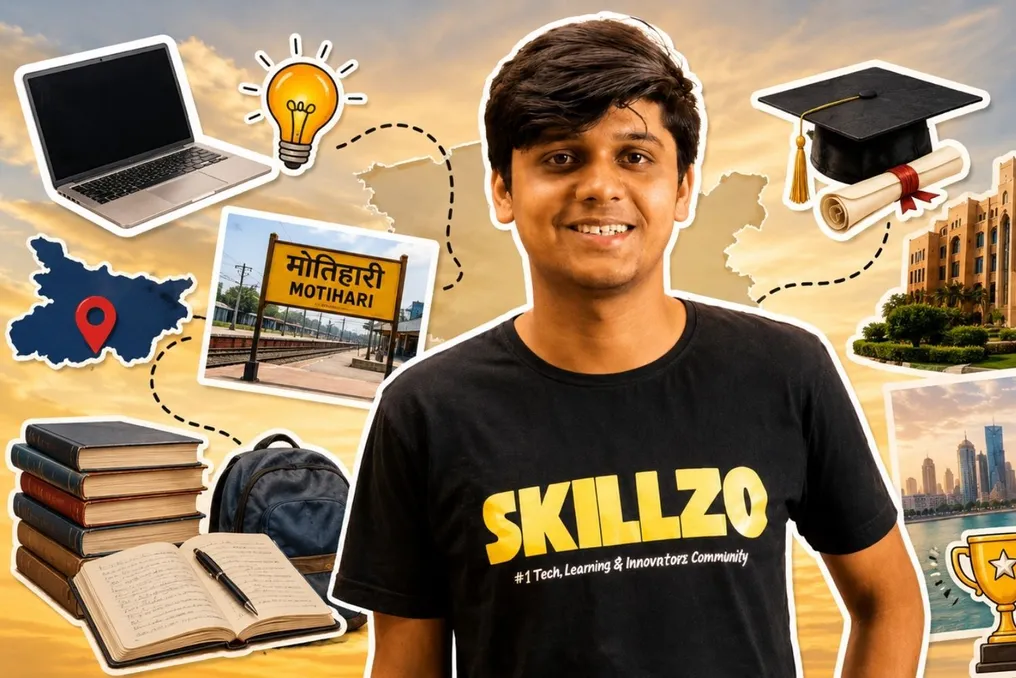
At the graduation ceremony for new students at Georgetown University in Doha, Qatar, last week, one student was selected to carry the class banner on behalf of the incoming Class of 2030. This honor went to Adarsh Kumar from Champaran, Bihar.
The class he represents is not easy to get into. According to Qatar Tribune, out of 150 accepted students, only 9.4% passed the selection process, and all of them are bilingual, with more than half speaking three or more languages. The group comprises forty-two nationalities.
Six years ago, Adarsh was only 14 years old, and he stood near a learning center in Kota that was inaccessible to him.
Adarsh grew up in Champaran amidst unstable electricity supply and weak internet. He was raised by a single mother who worked as a cleaner to pay for his education. At one point, she spent her savings on a laptop, which became a turning point in the whole story. He used this machine to independently study programming and begin his journey in the field of creation.
By the age of 13, during the pandemic, he co-founded Mission Badlao—a non-profit organization that helped secure land for a government school, organized over 2000 COVID-19 vaccinations, distributed hygiene supplies for women, and conducted tree-planting drives.
At 14, he traveled to Kota with a thousand rupees, following the standard path offered to all ambitious teenagers from Bihar: preparing for IIT, securing an engineering spot, and escaping a difficult situation. However, the preparatory courses proved prohibitively expensive. He did not return home; instead, he worked in a free library Wi-Fi network, sending cold emails to mentors until enough agreed to offer internships, programs, or time spent in the shadow of founders.
Afterward, he independently took his 10th-grade exams and received a full scholarship of 30 lakh rupees to Jayshree Periwal International School in Jaipur, one of India's strong IB schools. He became the first student to receive such support and later helped three other students achieve similar assistance.
This approach—leveraging opportunities and immediately expanding horizons—is the core of everything that has happened since. In 2023, at age 16, Adarsh launched Skillzo—a platform connecting underserved students with mentorship, scholarships, and skills training. It was created to address a specific gap he experienced: talent lacking access to the right circles.
Currently, Skillzo collaborates with over 20,000 students, many of whom have managed to secure scholarships, start businesses, and participate in national competitions. Concurrently, he served as the Marketing Director for Bihar Chhatra Sansad, the largest student-run forum in the state, where he interacted with over 1,500 young people and raised about $36,000 for student initiatives. He also became Google's youngest youth advisor.
In September 2025, this record earned him the Chegg.org Global Student Award, a $100,000 award jointly hosted with the Varkey Foundation, serving as the student equivalent of the $1 million Global Faculty Award. He was selected from nearly 11,000 applications from 148 countries and accepted the award in London.
He became the first Indian to receive this award. The award has been given out since 2021 and was previously awarded to Jeremiah Toronke from Sierra Leone, Igor Klimenko from Ukraine, Nial Dangu, a refugee from South Sudan in the Kakuma camp in Kenya, and Angela Elena Olazaran Laureano from Mexico. Indian students have repeatedly made it into the top 50 and shortlists for the top 10, but no one had won.
He stated that the funds would go towards SkillzoX—a low-bandwidth, AI-based mentorship platform designed for rural connectivity—and the Ignite Scholarship Program for young innovators.
None of this deterred rejections. Adarsh applied abroad and received 22 rejections. By the time he found Second Chance, a non-profit founded by Cornell alumna Joan Liu, which assists high-potential international students after the main application cycle closes, Georgetown's cycle had already ended.
Second Chance had an existing partnership with Georgetown University in Qatar related to supporting Palestinian students. Liu asked the university to consider his profile as an exception, and the university agreed.
In an interview with India Today, Adarsh noted that this experience taught him that talent is often not the problem; people need someone willing to open the door.
There is symmetry here. Nial Dangu, the winner of the 2023 Global Student Award, was also placed through Second Chance after his own admission attempts were unsuccessful. The organization claims that this way it has placed over a hundred international students on full or near-full scholarships at universities in ten or more countries.
The package from Georgetown covers tuition, housing, meals, airfare, visa, medical insurance, and other educational expenses. Adarsh sat with his mother when the letter arrived. She was the first person he told.
Adarsh plans to focus on political science, economics, and international relations. The Georgetown campus in Qatar offers the same Bachelor of Foreign Service degree as the campus in Washington, D.C., and this year added a specialization in science, technology, and international affairs. Students can also spend time on campuses in Washington and Italy.
His stated interest is in why some politicians succeed while others do not, and how this difference affects people in states like Bihar. This is a logical place for someone whose entire experience so far has been about navigating institutional failure.
Timing is also a factor. Indian demand for traditional fields is rapidly declining. According to a Rajya Sabha statement from April 2026, the intake of Indian students in US universities dropped by 6.9%. A Spring 2026 report by the Institute of International Education showed that 59% of American institutions reported a decrease in international applications for 2026/27, with 61% reporting a decline specifically from India. The education hub of Qatar, where Georgetown, Carnegie Mellon, Northwestern, and Weill Cornell are located, offers the same degrees with a lower risk of visa denial.
For a student from a small town in Bihar, this shift is not abstract. It changes what doors are even worth knocking on.
Adarsh carefully avoided in interviews having his story reduced to a personal triumph. After the Global Student Award, he met with the Governor of Bihar, Syed Ata Hasnain, the Minister of States, Samrat Choudhary, and the Minister of Education Mithilesh Tiwari, and believes this recognition opened dialogues about running Skillzo in collaboration with institutions, rather than around them.
His advice to students who feel that places like Georgetown are not meant for them is very direct. He told India Today that rejections will happen, but students should not reject themselves, and that one rejection is not a sentence on a person's potential.
Then comes the phrase that summarizes six years of seeking alternatives: finding the door is hard, but that doesn't mean it doesn't exist.