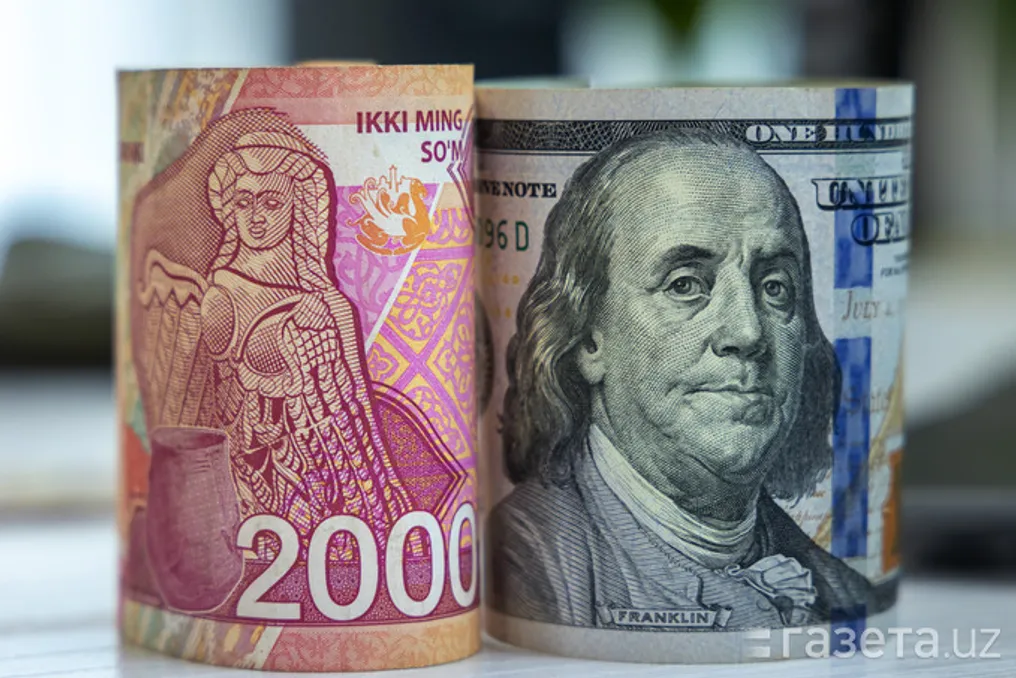
Uzbekistanis traditionally expected an annual depreciation of the sum against the dollar, basing their financial plans on this trend. However, the last two years have shown a significant deviation from this norm, as the sum has stopped showing a constant decrease in value.
Mirkomil Kholboev, a master's student in 'International Trade' at Chonbuk National University in South Korea and author of the Telegram channel Mirkonomika, presented an analysis explaining the reversal of the national currency-dollar ratio.
In the first half of 2026, the country's trade deficit reached $9.3 billion, meaning import volume exceeded exports. This trade deficit increased by 2.75 times compared to the same period last year. Despite this, since early June last year, the sum has strengthened against the dollar by 7.3%.
The expert emphasizes that the formation of the currency market cannot be reduced solely to the difference between exports and imports. In addition to the trade deficit, there are other elements affecting the inflow of foreign currency into the country, such as investments, remittances, and external debt.
Even with an increasing trade deficit, currency inflow can rise through other channels, which affects the exchange rate. However, investments, external debt, and remittances were flowing into Uzbekistan even before 2025. Therefore, the fact that the sum's strengthening began specifically in 2025 is particularly noteworthy.
In 2025, the trade deficit, according to balance of payments data, reached $19.9 billion, which is 14% more than in 2024, becoming the highest nominal figure for the foreign trade deficit in the country's history. Nevertheless, there was a noticeable increase in funds received into the country. For example, the net inflow from primary and secondary income, where remittances play a key role, amounted to $14.1 billion, exceeding the previous year's figure by 21.7%, outpacing the growth rate of the trade deficit.
Despite the increase in remittances, the overall balance of foreign trade, primary and secondary incomes—that is, the current account balance—remained negative, at minus $5.7 billion, which is almost unchanged from 2024. While the sum depreciated against the dollar by 4.7% in 2024, in 2025, it, conversely, strengthened by almost 7%.
There are several reasons for this discrepancy. Firstly, remittances, investment income, and foreign trade represent only one aspect of the situation; the other side is the inflow of debt and investment capital. Secondly, analyzing data for the entire year may hide internal trends, so examining indicators by quarter provides a more accurate picture.
The strengthening of the sum in 2025 primarily occurred in the first nine months. In subsequent months, the dollar rate fluctuated around the 12,000 sum mark, without a significant change in trend. For instance, on October 2, 1 dollar cost 12,084 sums, and in the last trading session of 2025, it was 12,025 sums.
More specifically, from January to September, the sum strengthened by 6.5%, while in October-December, this increase was only 0.5%. The current account situation during this period also differed from the annual figure. Over the first nine months of 2025, the foreign trade balance deficit was $10.5 billion, which is 14% less than in 2024. Simultaneously, the aggregate balance of primary and secondary income, dominated by remittances, improved by 16.9%.
Thus, in the first nine months of 2025, the foreign trade deficit, which creates the main demand for the dollar, decreased, while the inflow of currency from factors of production, including labor and capital, noticeably increased. As a result, the aggregate balance of foreign trade and factor income formed a surplus of $3 million. A current account surplus is a rare phenomenon for Uzbekistan; for comparison, the deficit for the same period in 2024 was $3.2 billion. This allowed Uzbekistan to function as a net exporter of goods and factors of production during the first nine months of 2025, contributing to a higher supply of foreign currency and the strengthening of the national currency.
The growth in gold prices played a significant role in improving the foreign trade balance. Gold exports in the first nine months reached $9.8 billion, an increase of 70% compared to the previous year. Furthermore, the currency strengthening and favorable labor market conditions in Russia accelerated the growth of remittances.
In addition to foreign trade and remittances, investments and external debt influence the inflow of currency into the country. In 2025, the net inflow of direct investment into Uzbekistan reached $4.3 billion, a 53% increase compared to 2024. The volume of portfolio investments, mainly Eurobonds, was $4.4 billion, and other investments, including external debt, deposits, and trade credits, grew to $2.5 billion, corresponding to a 40% increase and 2.5 times increase, respectively.
The total net inflow from these three components in 2025 reached $11.2 billion, setting a historical high. Meanwhile, the deficit in foreign trade and factor income amounted to $5.7 billion. Consequently, the net financial inflow was about twice this deficit. Such a large positive difference between the net inflow from the financial account and the current account deficit had not been observed in any year after 2018, indicating a substantial increase in the supply of foreign currency in the domestic market.
In previous years, the inflow of borrowed and investment capital was lower, and the deficit in foreign trade and factor income was higher, which contributed to the weakening of the sum. It is also important to consider global changes that affected the structure of the balance of payments, including rising gold prices and accelerating investment flows linked to global factors.
One of the key events of 2025 was the beginning of Donald Trump's second presidential term in the USA. His decisions increased uncertainty and volatility; for example, the repeated imposition of trade tariffs caused disruptions and reduced confidence in American assets. In the first half of 2025, the dollar index fell by 11.1%, and in the second half of the year, the exchange rate stabilized, with the annual dollar depreciation amounting to 10%.
Thus, the dollar's weakening had a global character: in 2025, 31 out of 39 analyzed currencies strengthened against the dollar, while only four weakened, making the sum's strengthening part of a global trend.
Another factor supporting the sum was the rise in gold prices, which was largely driven by Trump's actions. The average monthly price of gold in 2025 more than doubled, leading to a sharp increase in foreign currency revenue for Uzbekistan, where gold is an important export commodity.
A third factor was the strengthening of the Russian ruble against the dollar in 2025. From the beginning to the end of the year, the ruble strengthened by 23.2%, stimulating a higher-than-expected growth in remittances from the main labor market for Uzbekistan. In 2025, the volume of remittances reached $18.9 billion, an increase of 27.2% compared to 2024, although an initial growth of about 10% was projected.
In 2025, the combination of the weakening of the dollar globally, the strengthening of the currency of the main labor market, the sharp rise in gold prices, and the acceleration of investment and debt obligations led to an unprecedented situation in the Uzbek currency market and the first nominal strengthening of the sum in a new period.
However, the situation changed in 2026: gold prices began to fall, and the volume of gold exports from Uzbekistan significantly decreased. Conditions in the main labor markets are also deteriorating. Nevertheless, the sum continues to strengthen against the dollar. Since the beginning of the year, the sum has strengthened by 1.9%. This is happening against the backdrop of falling gold prices compared to February peaks and minimal gold exports from Uzbekistan—exports for January-June amounted to $1.5 billion, four times less than the previous year.
Furthermore, the currency of the main labor market weakened by 9.8% since the beginning of the year, and the dollar itself in 2026 no longer shows such a sharp decline relative to most world currencies as it did in 2025. For example, since the beginning of the year, 20 of the analyzed currencies have weakened against the dollar, while the dollar index has risen by approximately 1%.