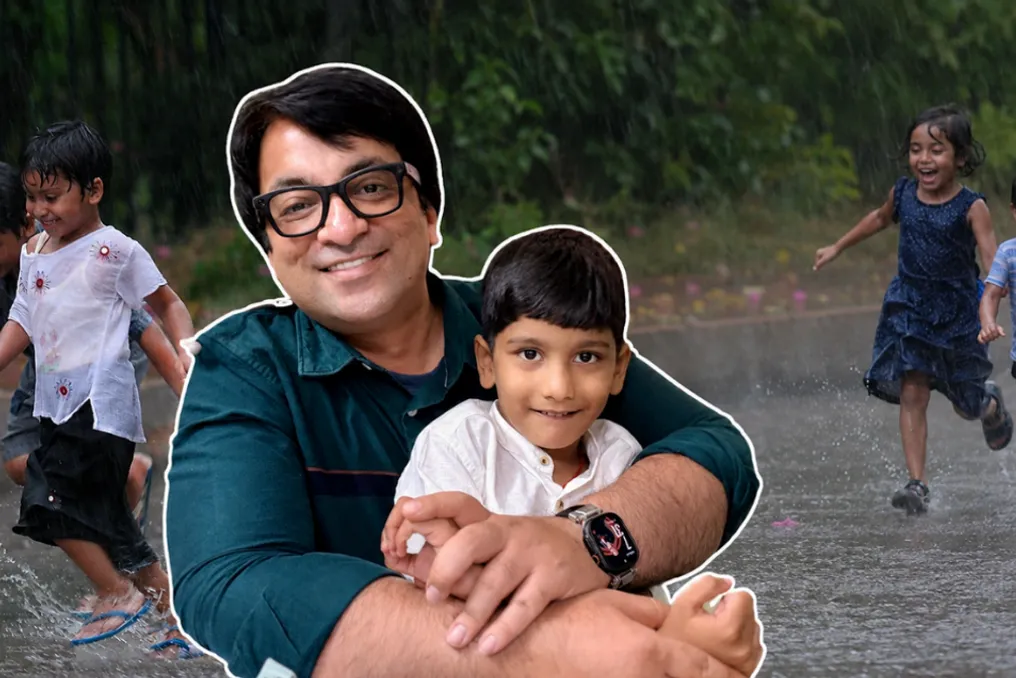
The first drops of rain can elicit completely different reactions within a family. While children might want to run outside, jump in puddles, and feel the rain on their faces, parents often rush to say, 'You'll catch a cold' or 'You'll get a fever.'
But does getting wet really cause illness in children? Can playing in the rain weaken their immune system? And should parents immediately bring the child indoors as soon as it starts raining?
There are many perceptions regarding children and rain, but science draws a clearer line between real dangers and common misconceptions.
In an interview with The Better India, Dr. Shravan Krishna Reddy, a pediatrician, neonatologist, and pediatric nutritionist who co-founded The Family Tree Hospital in Tirupati, discusses some of the most frequent myths associated with the monsoon season. He shares what parents need to know before denying their child any adventures on a rainy day.
Myth 1: Playing in the rain causes colds
The fact is that the rain itself is not the cause of a cold. Dr. Reddy explains that 'the common cold is caused by respiratory viruses, not raindrops, wet clothes, or cold water.'
So why do these two phenomena seem so closely linked? During the rainy season, children may spend more time in crowded school buses or poorly ventilated classrooms where viruses spread more easily. Furthermore, the child might already be incubating a virus when playing in the rain. If symptoms appear the next day, it is easy to attribute it to the last event.
Dr. Reddy notes that he hears phrases like 'He played in the rain yesterday. Today he has a fever' almost every week during the monsoons. He emphasizes: 'Time may be related, but rain is not an infection. Somewhere along the way, the child picked up a virus—or another illness.'
In other words, getting wet does not equal infection.
Myth 2: Children should never play in the rain
The fact is that healthy children can sometimes enjoy playing in light rain if conditions are safe. Dr. Reddy asserts that 'a healthy child can occasionally play in light, clean rain under adult supervision.'
Rain gives children the opportunity to move, play outdoors, and experience nature for the first time, from the sound of drops to the feeling of water underfoot. It can also become a happy childhood memory. However, the surrounding conditions are important. One should avoid stagnant puddles by the roadside, open drains, construction sites, slippery terraces, flooded areas, and thunderstorms.
Additionally, children should wear shoes with good treads. Dr. Reddy clarifies that 'the benefit does not come from a magical boost to immunity thanks to the rain. It comes from movement, outdoor play, self-confidence, sensory experience, and happiness.'
His advice is simple: 'Allow your child to enjoy 10 sensible minutes of clean rain instead of spending childhood in fear of the weather.'
Myth 3: Getting wet weakens the immune system
The fact is that one rainy downpour does not damage a child's immune system. Dr. Reddy says: 'Immunity is not a battery that runs out because a child got their clothes wet.'
A child might feel cold, discomfort, or fatigue after wearing wet clothes for a long time. Children with asthma may also experience symptoms caused by cold air, humidity, mold, or an existing respiratory infection. But this is different from claiming that rain weakened their immune system.
According to Dr. Reddy, parents should focus on things that truly support immune health: adequate sleep, balanced nutrition, timely vaccination, physical activity, clean air, and avoiding tobacco smoke.
Myth 4: Fever after the rain means the child needs antibiotics
The fact is that rain does not cause fever, and fever itself does not automatically mean the need for antibiotics. Dr. Reddy states: 'Getting wet does not directly cause fever—fever is the body's reaction to infection or inflammation, and rain is neither.'
A child who develops a fever after playing in the rain may have a respiratory viral infection or another illness, depending on the symptoms and local epidemiological data. He has seen parents come to the hospital having already started taking several medications at home simply because their child played in the rain and then developed a fever.
He criticizes this, saying: 'This is where unnecessary treatment begins: antibiotics for a viral illness, cough syrup that might have gone away on its own, and a family convinced that the rain is to blame.'
His advice is to observe the child, not just the thermometer. Pay attention to their behavior between fever episodes: are they drinking enough fluids, urinating normally, responding to you, and breathing comfortably?
Medical help should be sought if the child is breathing fast or with difficulty, vomiting frequently, unusually sleepy or disoriented, urinating significantly less, experiencing abdominal pain, rash, seizures, or if the fever lasts longer than three days.
'Rain is not a diagnosis. A fever after the rain deserves the same careful evaluation as a fever on any other week.'
So when should parents really say 'no'?
Dr. Reddy believes that conditions matter more than the calendar. Light drizzle, clean surroundings, good visibility, and a healthy child are very different from heavy rain accompanied by flooding, strong winds, thunder, lightning, exposed wiring, or overflowing drains.
'Parents do not have to choose between recklessness and excessive fear. There is a reasonable middle ground.'
This middle ground looks different depending on the child. A healthy school-aged child who wants to jump might manage a few controlled minutes in the rain. However, greater caution should be exercised with newborns, small infants, or premature babies. The same applies to cases where the child is already ill, wheezing, or has certain chronic or immunocompromising conditions, says Dr. Reddy.
And during a thunderstorm, the rule is simple: go indoors immediately. 'When thunder is heard, children move indoors immediately—and outdoor activity is not resumed for at least 30 minutes after the last thunder.'
What parents should really pay attention to
According to Dr. Reddy, many real risks associated with playing during the monsoon season stem from the environment around the rain. Sewage and standing water can contain sewage waste, animal waste, chemicals, and sharp objects. Mosquito breeding can increase the risk of diseases such as dengue fever and malaria, and contaminated water can contribute to diarrheal diseases and infections.
Slippery surfaces, open drains, fallen branches, electrical hazards, and fast-moving water can also pose immediate threats.
'The rain itself is not the villain. The real problem is contaminated water, unsafe environments, and delayed recognition of illness.'
Ultimately, Dr. Reddy believes that children must be protected, but they should not be afraid of normal childhood experiences. 'Over the years of treating children and interacting with thousands of parents, I have realized that childhood needs both protection and freedom.'
Light rain can become part of childhood if parents teach children when it is safe to jump outside and when it is time to go inside.