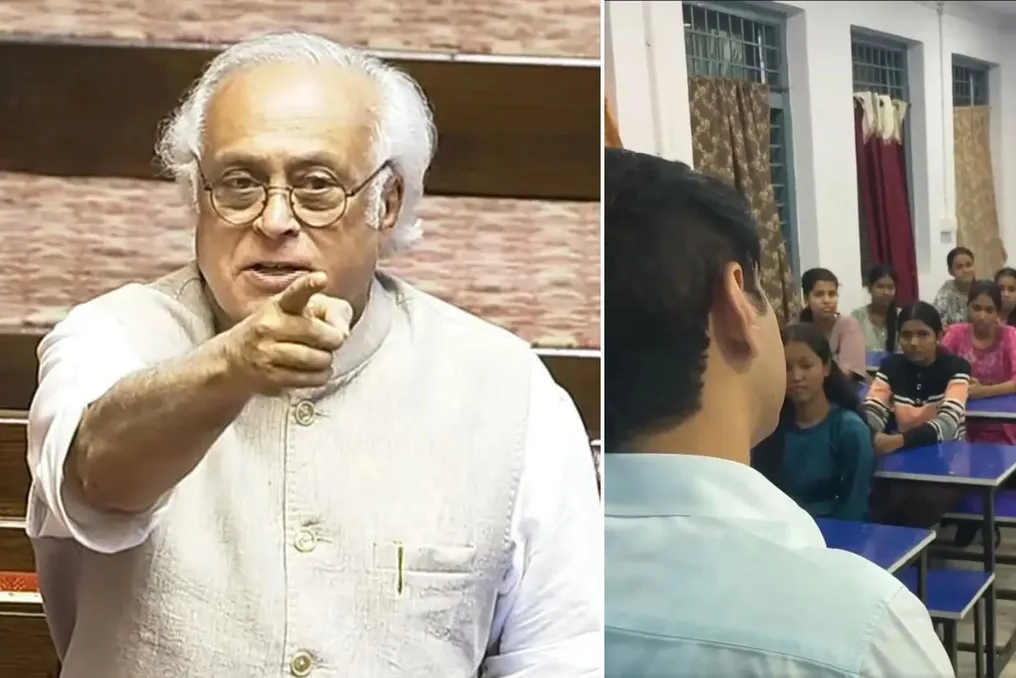
Congress Member from the Congress party, Jairam Ramesh, sharply criticized the government on Friday for recent initiatives in digital education. He stated that the government was forced to announce free online courses after Rahul Gandhi highlighted the growing burden of private tutoring for Indian families.
Ramesh questioned the Central government's ability to implement such programs, citing a parliamentary committee report which showed that the existing free education program reached only 26 percent of the planned number of participants.
Ramesh criticizes free online course plan
In a post on social media platform X, Ramesh accused Prime Minister Narendra Modi's government of trying to divert attention from deeper issues in India's education system by resorting to online learning instead of strengthening public education.
Rahul Gandhi, the opposition leader in the Lok Sabha, raised one of the most crucial educational topics at the 'Chhatron Ki Gunj' event in Kota on June 17, 2026: the private tutoring industry has displaced the public education system, and Indian families now spend 2.5 times more on coaching centers than the Government of India invests in education.
Ramesh asserted that following this statement by Rahul Gandhi, the Prime Minister announced free online courses for students on August 15. He noted: 'It was this revelation that forced the Prime Minister, in a desperate attempt to avoid growing public pressure, to announce free online courses for students on August 15. But his government's track record is hardly reassuring. Its existing free education scheme has lagged behind its target for 3 years.'
Existing free education scheme fails to meet targets
To cast doubt on the government's performance regarding the current free education scheme, Ramesh referred to the latest report by the Standing Committee of Parliament of the Ministry of Social Justice and Empowerment, presented on August 10. He wrote: 'The Ministry of Social Justice was supposed to enroll 10,500 candidates in free education over 3 years, but it only enrolled 2,790 students—just 26% of the target. The budget for this scheme is being cut annually, and last year's expenditure was less than half the budget. These staggering facts were revealed in the latest report of the Standing Committee of Parliament of the Ministry of Social Justice and Empowerment, presented on August 10, 2026.'
The Congress leader insisted that the government's focus should be on addressing structural deficiencies in the education system, rather than expanding digital learning initiatives. Ramesh concluded: 'Instead of fundamentally fixing India's broken education system or reinvesting in public education, the Prime Minister chose to direct state resources towards online learning. This is a tactic to evade responsibility, and this government has already demonstrated a limited capacity to successfully implement this scheme.'
Rahul Gandhi's campaign for students
Ramesh's criticism followed a broader campaign by Rahul Gandhi, during which he highlighted the problems faced by students, including rising education costs, examination irregularities, material leaks, and employment challenges. The Congress leader launched the 'Chhatron Ki Gunj' campaign in 2026 to bring student issues into the national political discourse. This campaign took place in Kota, Dehradun, Prayagraj, among other locations.
During a recent 'Chhatron Ki Gunj' program in Maharashtra, Rahul also spoke about the role of women in India, calling them the country's greatest strength. He stated: 'Women are the strength of India—its foundation, its present, and its future.' In an X post, he added: 'You belong to no one but yourself. Be loud. Be proud. Fight for your place. Destroy patriarchy!'
Addressing the program, Rahul Gandhi emphasized that India's greatest strength lies in the aspirations and potential of its women. He said: 'People often ask me: 'What is the biggest strength of India?' You get many answers when you ask this question. Someone will say our economy. Someone will say our army. Someone will say our healthcare system. Someone might even say our people, but I know very clearly what the biggest strength, our greatest asset, is, and that strength is the 700 million unique journeys, unique imaginations, unique dreams lived by Indian women.'