During a trip through the Rif Mountains in Morocco, traversing off-road terrain, Oliver Keohan spotted the city of Chefchaouen, which resembled a blue iris amidst the lower folds of the mountains. Equally impressive was walking through the city's streets, exploring its character and cuisine.
On a plateau located at approximately 2000 meters above sea level is a place called Plaza España. This name is borrowed from Spanish and refers to a dining spot within the winding, coniferous network of the Rif Mountains in northern Morocco. There, travelers sat on Berber carpets, enjoying kefta (meat skewers), roasted peppers, and bread (similar to pita), while studying local botany.
A local chef explained that this is the Moroccan fir (Abies marocana), pointing towards the horizon covered with firs on limestone slopes. He added that there is another species of this genus in the Sierra de Grazalema natural park in Spain, called the Spanish fir (A. pinsapo), but the Moroccan fir is endemic to this region and grows only above 1500 meters above sea level.
Reaching this forest massif in the sky was made possible by the low torque and all-wheel-drive systems of double-cabbed Volkswagen Amaroks. This demonstrates Volkswagen Group's intention to remind the global market of the magnificent engineering represented by the double-cab truck in this day and age. The modern Volkswagen Amarok, alongside the Ford Ranger, with which it shares a platform, sets the standard for luxury and comfort combined with capability in this segment.
In less than 24 hours, travelers journeyed from Tangier Ibn Battouta International Airport, learning traffic rules, and ascended into Talassemtane National Park, in the western Rif Mountains, near Chefchaouen. The park, established in 2004 and recognized by UNESCO as part of the Mediterranean Intercontinental Biosphere Reserve, covers about 590 km² of rugged terrain, deep gorges, and dense forest. Its main objective is the protection of the Moroccan fir (A. marocana).
Before beginning the surreal ascent into this endangered mountain forest, before the gravel turn that directed the convoy inward and upward, a bird's-eye view of Chefchaouen, known as the 'Blue Pearl,' opened up, its roofs brightly gleaming under the harsh daylight. It resembled lapis lazuli in a limestone sea.
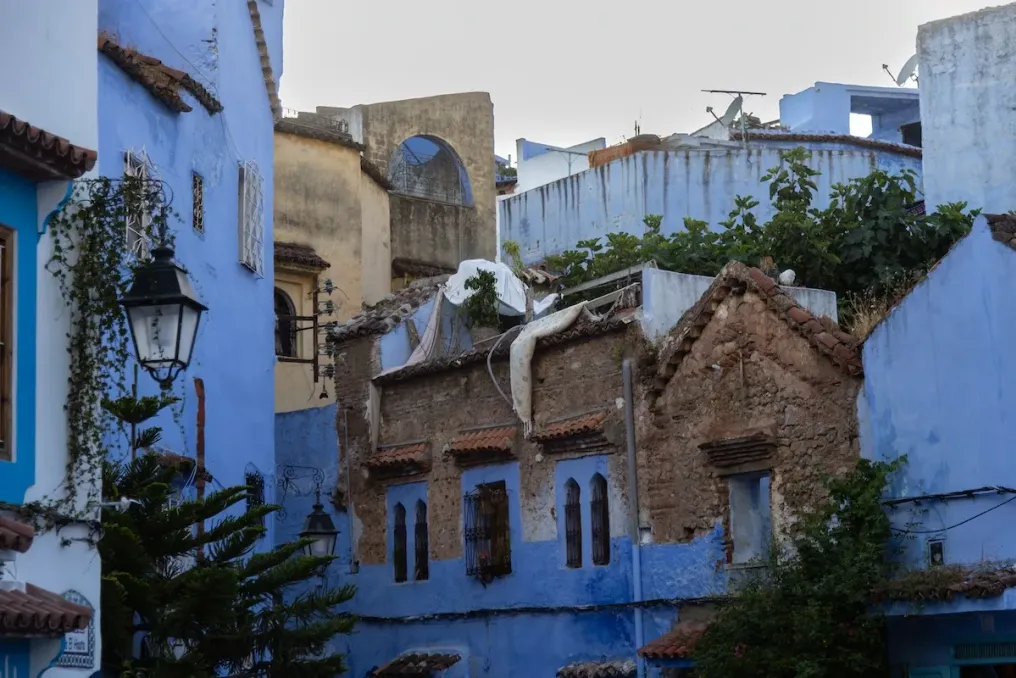
Chefchaouen has deservedly earned its nickname. Every wall, staircase, and doorway in the old medina is painted in some shade of blue, from pale powder blue to deep cobalt, creating a disorienting effect, as if you are walking through a city faded by the sun. The reasons for this are still debated: some link it to Jewish refugees who arrived in the 1930s, who painted the city blue as a reminder of the sky and a means of protection against mosquitoes. Others point to older Andalusian traditions brought by Muslim and Jewish families fleeing the Reconquista, who settled here after the city was founded in 1471 as a mountain fortress against Portuguese invasions.
Regardless of its origin, maintaining this color is a common ritual, as residents repaint their section of the wall before the rains arrive annually.
Thanks to the nature of the trip—an extreme off-road adventure through the Rif Mountains, culminating in dinner in the city itself—the visual wonder was experienced twice: first from the mountains, and then at eye level. From afar, the city looks like a striking blue iris among the lower mountain folds; up close, in the valley, its individuality unfolds. The knowing gaze of the locals accompanies you as you navigate the labyrinth of azure alleys, narrow staircases, and knee-high doors. A certain mystery lies within the blue walls.
Observing the mountain range from the peaks of the Rif was as impressive as viewing it from below, watching evening descend upon the rock in a dance of yellow light. The best view was obtained from the terrace of the Triana cafe and restaurant, located on the roof of the upper medina, which serves tagines, grilled fish, and mint tea characteristic of Moroccan and Andalusian cuisine.
The beauty of the vehicle, especially an elite double cab like the Amarok, lies in the access it provides to the world. One evening, during a two-hour direct flight from Tangier to Chefchaouen, the narrator and his co-pilot Calvin Fisher praised the Amarok's V6 engine, perfectly paired with the 10-speed automatic transmission and the silence inside the cabin. The next morning, they engaged four-wheel drive and only switched it off after experiencing the miracle of ascending one of the world's most fascinating mountain ranges. Although this could be done on foot, it certainly would not have taken just one day!
The base for the trip was Dar Ba Sidi & Spa, a maison d’hôtes style establishment located about 12 km from Chefchaouen along the N2 road. It was close enough for easy access to the medina, yet far enough to serve as a refuge. The architecture leans towards Andalusian-Moroccan tradition: rooms are arranged around a central courtyard in classic riad style, the walls share the same blue color as the city below, and the roof tiles are in terracotta tones, a direct nod to the city without attempting to replicate it. The interiors are filled with mosaic tiles, carved stucco decoration, and richly patterned fabrics, and the garden opens onto a pool framed by the Rif foothills. The hammam and spa are located next to the main restaurant, which adheres to a similar architectural line: properly prepared Moroccan dishes with rare Mediterranean accents. The hotel is a deliberate extension of Chefchaouen's visual language, built on a scale that the medina itself cannot contain.