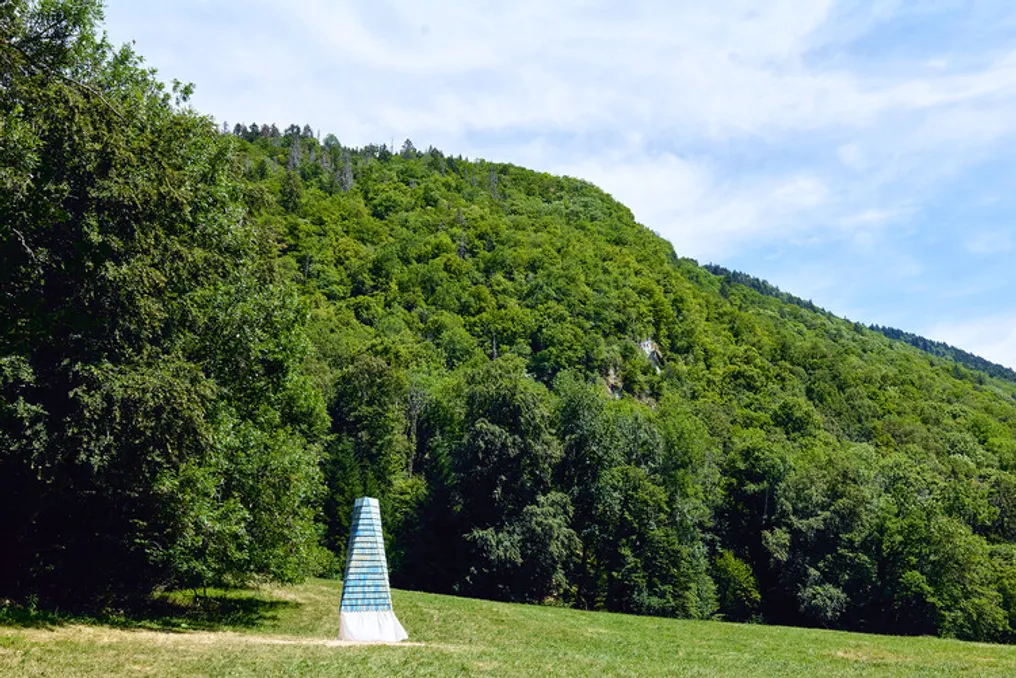
The Cabana KATŪVU project, designed by the studio HUT atelier d'architecture, is located near the village of Le Pier, on the road to the Col de Tamié pass. This pass separates the departments of Savoie and Haute-Savoie. The site is situated at the edge of the forest and has a slight southwest slope, which naturally directs the gaze towards the summit of the pass and the Abbey of Tamié, a Cistercian monastery founded in the 12th century.
The extensive surrounding landscape creates a unique atmosphere that inspires elevation—first physically, through the ascent to the pass framed by the majestic peaks of the Bauge massif, and spiritually, due to the presence of an important religious site and places with symbolic names.
The lower part of the hut, where the roof rests, is made of a translucent cotton voile, which allows only small glimpses of the interior when the wind blows. To visually stand out against the forest, which turns bright green in summer, the tiles forming the roof have been painted blue.
From a distance, KATŪVU appears as a strong floating mass. Upon closer inspection, the unified whole reveals numerous details, where each wooden tile invites the visitor to pause and examine its unique combination of material and color.
The roof of colored wooden tiles thus seems to rest on a light cotton covering that softly filters the light. The base of the structure follows the rhythm of the wind while remaining impenetrable. Only by walking around the hut can one notice the invitation to enter through a thin opening of the curtain on one of the four sides, but this requires bending down and crossing the threshold.
At first glance, KATŪVU presents itself as a closed space with no view of the landscape. The hut's interior is designed with monastic simplicity, showing only the structure and the roof. Reflecting the secluded life of the abbey's monks, the initial gaze is directed inward. Only the upper hatch draws the eyes upward, where the sky stands out against the interior. A rope hangs from the ceiling, differing from all other parts of the space in its shape, material, and color.
Curious visitors can try pulling it: using a simple pulley system, this gesture opens one of the 1020 tiles making up the roof. Although this is only a tiny part of the hut, the opened tile redirects the gaze to the horizon. The landscape, previously seen only fleetingly upon approach, is now revealed: framed, clear, unique. The Abbey of Tamié with its bell tower and towers appears as a sacred mirage. When the rope is released, the view disappears, plunging the visitor once again into the austere interior of the shelter. Nevertheless, it is upon exiting that the space invites further exploration of the surrounding landscape, revealing it in its entirety.
HUT atelier d'architecture received an award at the Cabanes festival in 2026, held near Lake Annecy. The hut, named KATŪVU, was built in June and will remain on site until November 6.