Rating of Banks in Uzbekistan by Cards, Terminals, and ATMs as of August 1, 2026
Read more
UzDaily
uzdaily.uz

Rating of Banks in Uzbekistan by Cards, Terminals, and ATMs as of August 1, 2026

According to data from the Central Bank of Uzbekistan, as of August 1, 2026, there were 75,686,915 bank cards in circulation in the country, 453,471 POS terminals installed, and 47,009 ATMs and info kiosks. During the period from January to July 2026, 387.4 billion UZS passed through the country's payment terminals.

Bank Cards in Circulation

Xalq banki is the leader among banks in terms of the number of issued bank cards, having issued over 12.1 million cards, which accounts for more than 16% of the total number in circulation in the country, which reached 75.7 million cards. Uzum Bank is in second place with 7.2 million cards, and Agrobank is third with 6.8 million cards.

Among the five banks holding top positions by the number of issued cards are also Ipoteka-bank (5.7 million) and Hamkorbank (5.2 million). Among the banks with the fewest cards are Soderot bank (3,020 cards), Madad Invest bank (15,183), and APEX BANK (38,765).

Payment Terminals

Hamkorbank leads in the number of installed POS terminals with 68,301 devices. Following them are Milliy bank (42,523), Xalq banki (34,176), O'zsanoatqurilishbanki (31,834), and Ipoteka-bank (26,445). The lowest number of terminals was registered by Soderot bank (27 terminals), TBC bank (41), and Open Bank (106).

ATMs and Info Kiosks

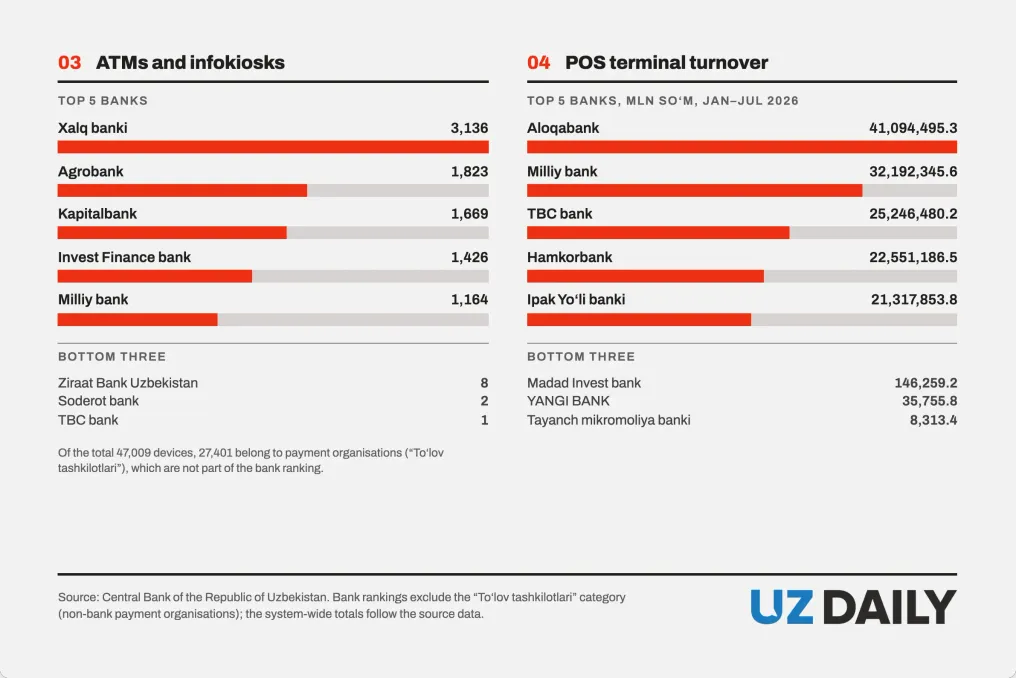
In the segment of ATMs and info kiosks (excluding non-bank payment organizations), Xalq banki ranks first with 3,136 units. It is followed by Agrobank (1,823), Kapitalbank (1,669), Invest Finance bank (1,426), and Milliy bank (1,164). TBC bank (1), Soderot bank (2), and Ziraat Bank Uzbekistan (8) have the minimum number of devices.

Turnover via Payment Terminals

Aloqabank became the leader in turnover through payment terminals for the period from January to July 2026 with an amount of 41.1 billion UZS. The top five leaders also include Milliy bank (32.2 billion), TBC bank (25.2 billion), Hamkorbank (22.6 billion), and Ipak Yo'li banki (21.3 billion). The lowest turnover was recorded by Tayanch microfinance bank (8.3 million UZS), YANGI BANK (35.8 million), and Madad Invest bank (146.3 million).
Similar stories

Turnover volume of payment terminals in Uzbekistan reached 387.35 trillion soms
Read more
uzdaily.uz

Turnover volume of payment terminals in Uzbekistan reached 387.35 trillion soms

According to data from the Central Bank of Uzbekistan, the turnover volume of payment terminals in Uzbekistan for the first seven months of the current year amounted to 387.35 trillion soms. As of August 1, 2026, nearly 75.7 million bank cards were in circulation in the country.

The country's payment infrastructure includes 453,500 installed terminals and 47,000 ATMs and information kiosks. Of the total number of ATMs and kiosks, 27,400 are operated by non-bank payment organizations, while the remainder is distributed among 36 commercial banks and the state cashier association UzInkassatsiya Birlashmasi DUK.

Leaders in transaction turnover

During the seven-month period, Aloqabank led the market in transaction turnover through terminals, processing over 41 trillion soms, which accounted for 10.6 percent of the total volume in the country. The National Bank of Uzbekistan (NBU) ranked second with a turnover of 32.2 trillion soms, corresponding to an 8.3 percent market share. The trio was completed by TBC Bank, which showed 25.2 trillion soms, or 6.5 percent.

In the top ten banks by terminal turnover, Hamkorbank was also featured with 22.55 trillion soms (5.8 percent), Ipak Yuli Bank with 21.32 trillion soms (5.5 percent), Uzum Bank with 21.19 trillion soms (5.5 percent), Ipoteka-Bank with 20.67 trillion soms (5.3 percent), Xalq Banki with 20.18 trillion soms (5.2 percent), Microcreditbank with 17.10 trillion soms (4.4 percent), and Agrobank with 16.53 trillion soms (4.3 percent).

Distribution of issued cards

The situation regarding the distribution of issued cards looks different. Xalq Banki remains the leading issuer, having issued over 12.1 million cards, accounting for 16 percent of the total number of bank cards in the country. It is followed by Uzum Bank with 7.2 million cards (9.6 percent), and Agrobank ranks third with 6.8 million cards (9 percent). Among other major issuers were Ipoteka-Bank with 5.67 million cards (7.5 percent), Hamkorbank with 5.24 million cards (6.9 percent), Anor Bank with 5.16 million cards (6.8 percent), NBU with 4.32 million cards (5.7 percent), Ipak Yuli Bank with 3.83 million cards (5.1 percent), TBC Bank with 3.64 million cards (4.8 percent), and Uzpromstroybank with 3.06 million cards (4.0 percent).

Terminal network density

Hamkorbank leads in terminal network density, having more than 68,000 installed devices. It is followed by NBU with 42,500 terminals and Xalq Banki with 34,200. Regarding ATM infrastructure, Xalq Banki ranks first among commercial banks, serving over 3,100 ATMs and information kiosks.

});
Nearly a third of Uzbekistan's borrowers have multiple active bank loans
Read more
uzdaily.uz

Nearly a third of Uzbekistan's borrowers have multiple active bank loans

According to data from the Central Bank of Uzbekistan's pilot financial accessibility index, about a third of borrowers in Uzbekistan have more than one active bank loan, with the average number of active loans per borrower being 1.7.

The report highlights that access to credit products is well developed: credit bureau records cover 98 percent of the adult population, and 80 percent of new retail loans are processed through automated credit channels.

Overall, 20 percent of adults have an active bank credit account, and another 7 percent use loans from microfinance organizations.

Key findings of the report

The Central Bank noted that 29 percent of individual borrowers currently service several active loans. While this trend indicates an expansion of access to credit, it also points to a gradual increase in debt obligations among clients already participating in the credit system.

The retail credit usage index received a score of 47 out of 100, while the credit availability indicator scored 64 points.

As retail lending continues to grow, the Central Bank emphasized the need to create tools to monitor overall debt burden, ensure timely data exchange between creditors, and enable early detection of repayment difficulties. The regulator also presented plans to transition from loan approval decisions based on stop factors to risk-oriented scoring models that include additional and alternative information.

Uzbekistan residents sold banks significantly more foreign currency than they bought in the first seven months of 2026
Read more
podrobno.uz

Uzbekistan residents sold banks significantly more foreign currency than they bought in the first seven months of 2026

In the first seven months of 2026, an acceleration in the growth of foreign currency supply compared to demand was observed in the Uzbek currency market. According to information from the Central Bank, the volume of currency sales increased by 28%, reaching $33 billion, while demand grew by 17.7%, reaching $38.2 billion.

Despite the resulting deficit of approximately $5.2 billion between demand and supply, the national currency maintained its stability. Over the period from January to July, the sum showed a slight strengthening against the US dollar—about 0.4%, and the dollar exchange rate remained within a narrow range of 11,910 to 12,320 soms.

Structure of Demand and Supply

The main driver for demand was the business sector, as legal entities acquired $30 billion out of the total amount. The population, conversely, became a net seller of currency, selling $14.6 billion to commercial banks while only buying $8.2 billion. Additionally, enterprises contributed to the supply by selling $18.4 billion to the bank.

Against this data, exchange rate volatility slightly increased compared to the previous year, averaging 32 soms, or 0.27 percent, whereas last year it was 28.2 soms, or 0.22 percent. Nevertheless, the market as a whole demonstrated a high degree of stability. Previously, Uzbekistan had decided to allow citizens to purchase up to $500 in cash foreign currency without needing to provide documents.

Popular