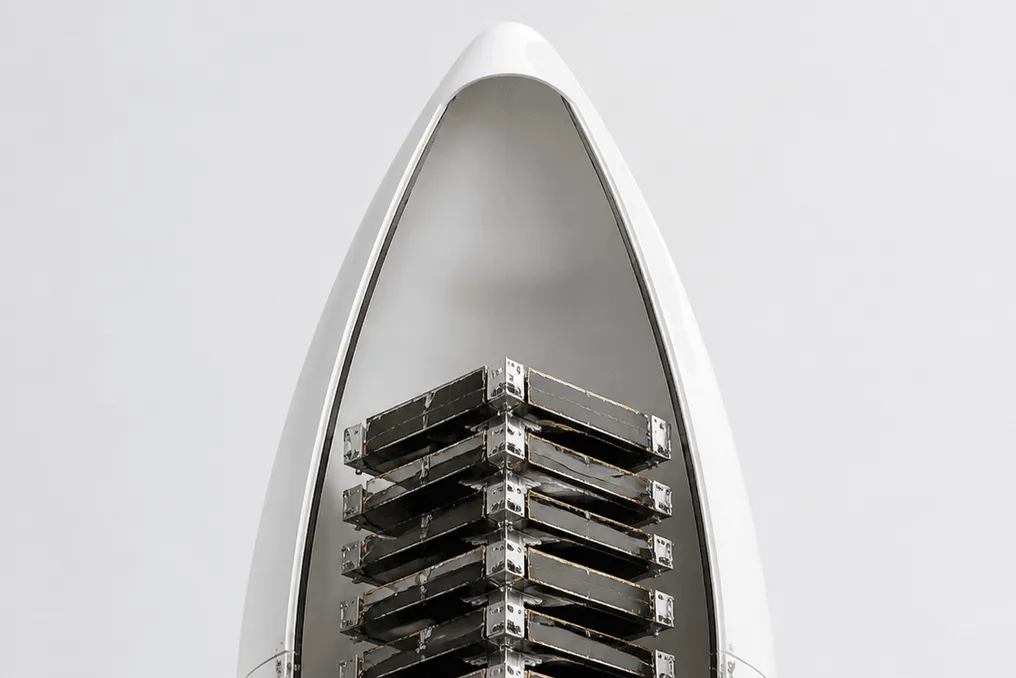
China has published a national standard that unifies the mechanical connection between flat-panel satellites and their carriers. This step aims to bring low Earth orbit (LEO) constellations to an industrial level, rather than relying on individual developments for each batch.
Standard GB/T 47811-2026, which concerns the requirements for mechanical interfaces of flat-packed satellites and rockets, was released on July 2 and will come into effect on November 1, according to data from the Beijing Institute of Aerospace Systems Engineering. It was developed jointly with the China Satellite Network Group, the China Aerospace Industry Standardization Institute, CAS Space, and MinoSpace.
This document establishes general rules for placing multiple satellites inside a rocket fairing, securing them before launch, and subsequently deploying them one by one in orbit.
The main goal of this standard is to achieve a level of compatibility that has historically been lacking. Previously, when satellites used proprietary payload trajectories, mounting sizes, and stacking heights, every new mission required redesigning the rocket. With a common interface, the same batch of satellites can theoretically use various carriers, and rocket manufacturers no longer need to develop a new installation scheme for every task.
These changes are happening amid rapidly accelerating pace. On August 6, 2024, the Long March 6A rocket placed the first 18 Qianfan satellites into orbit, marking the first launch in China with 18 flat satellites deployed. In July of this year, the Long March 6A rocket raised the Qianfan fleet to 218 satellites, and the following day, the Long March 8A conducted a flight with 20 satellites—this was the first transition from 18 to 20 deployed satellites in a single mission. As of August 27, the Qianfan constellation had placed a total of 238 satellites into orbit.
The new interface rules take into account lessons learned from these launches, as well as from the China Satellite Network Group program. The logic is simple: conduct enough launches to gather real engineering experience, and then convert that experience into a reproducible rule so that production and delivery can become continuous.
CAS Space, one of the standard developers, will be an early tester of this approach. Its Lijian-2 rocket made its first flight on March 30, and a second Lijian-2 flight is scheduled for October to deploy 18 satellites. This mission, ordered for the Qianfan program under the guidance of Shanghai Spacecom Satellite Technology, has not yet been confirmed to use the new standard, as it launches before the rules come into effect. Nevertheless, it follows the same path toward building industrial-scale constellations that are intended to accelerate this standard.