As the Raksha Bandhan festival approaches, markets are filled with various types of rakhis: from bright and colorful ones to children's with cartoon drawings, as well as models designed according to brothers' preferences. However, in the Nimch district of Madhya Pradesh, one artist presented a rakhi that combines art, religious beliefs, and the cultural identity of the Malwa region.
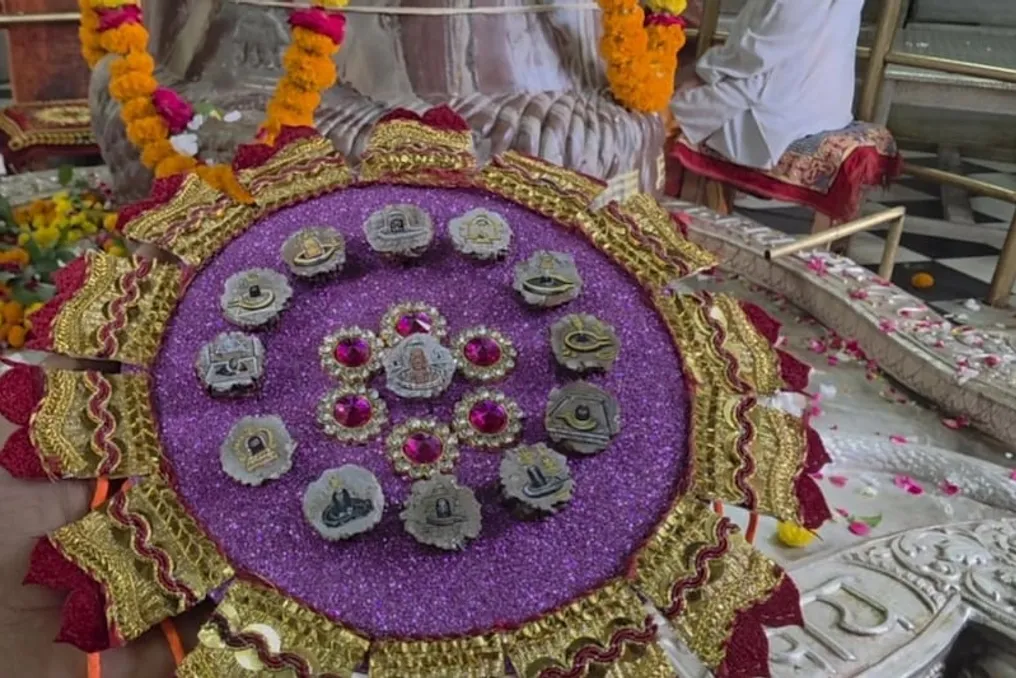
This special rakhi was created by artist Rahul Kumar Lohar from the village Kucharod in the Nimch district. Instead of using a large canvas, he chose small Rudraksha beads. A total of 13 Rudrakshas were used to create this exclusive rakhi, 12 of which featured miniature images of the 12 sacred Jyotirlingas.
Among the depicted shrines are Mahakaleshwar, Mallikarjun, Somnath, Kedarnath, Kashi Vishwanath, and Vaidyanath, covering all twelve Jyotirlingas.
Creating these images on the surface of the Rudraksha was a serious challenge because the stone's surface is not perfectly smooth, having bumps and curves. Nevertheless, Rahul transformed this small area into his own canvas.
The most striking aspect of the work is the size of the drawings. The artist did not use ordinary brushes; instead, he used extremely fine brushes, having only one or two hairs, to engrave these images. This required not only artistic skill but also immense patience, concentration, and exceptional attention to detail so that every detail on the tiny surface of the Rudraksha could be discerned.
The most unique part of this rakhi lies in its arrangement. The twelve Rudrakshas depicting the Jyotirlingas are arranged in a circular pattern. However, in the very center of these twelve Rudrakshas is another stone featuring the famous eight-headed god Pashupatinath Mahadeva from Mandsaur. Thus, the rakhi unites the religious significance of the 12 Jyotirlingas with the spiritual heritage of the Malwa region, where Rahul himself originates.
Rahul explains that as an artist, he constantly strives to create something new. When the Raksha Bandhan festival arrived, he decided to create something original dedicated to Lord Shiva. After selecting the Rudraksha, the experiment began to recreate the images of the 12 Jyotirlingas. Since he is from Malwa, and the famous Pashupatinath temple is in Mandsaur, he placed Pashupatinath at the center of the composition among the 12 Jyotirlingas.
Traditionally, a rakhi serves as a symbol of love and trust between a brother and sister, worn on the wrist. But the rakhi created by Rahul tells an additional story related to art and faith. At a quick glance, it is just a Rudraksha rakhi, but upon closer inspection, the 12 Jyotirlingas become visible, and in the center, the deity Pashupatinath from Malwa can be seen.
Thus, the small rakhi contains the 12 Jyotirlingas, Pashupatinath Mahadeva, Rudraksha, and miniature painting. Although millions of rakhis are sold for Raksha Bandhan, Rahul Lohar's piece from the village Kucharod in Nimch stands out because it cannot simply be worn—it must be examined very closely. The main charm of this rakhi is that the artist managed to fit an entire world of his finest work and deep faith into a small item worn on the wrist.