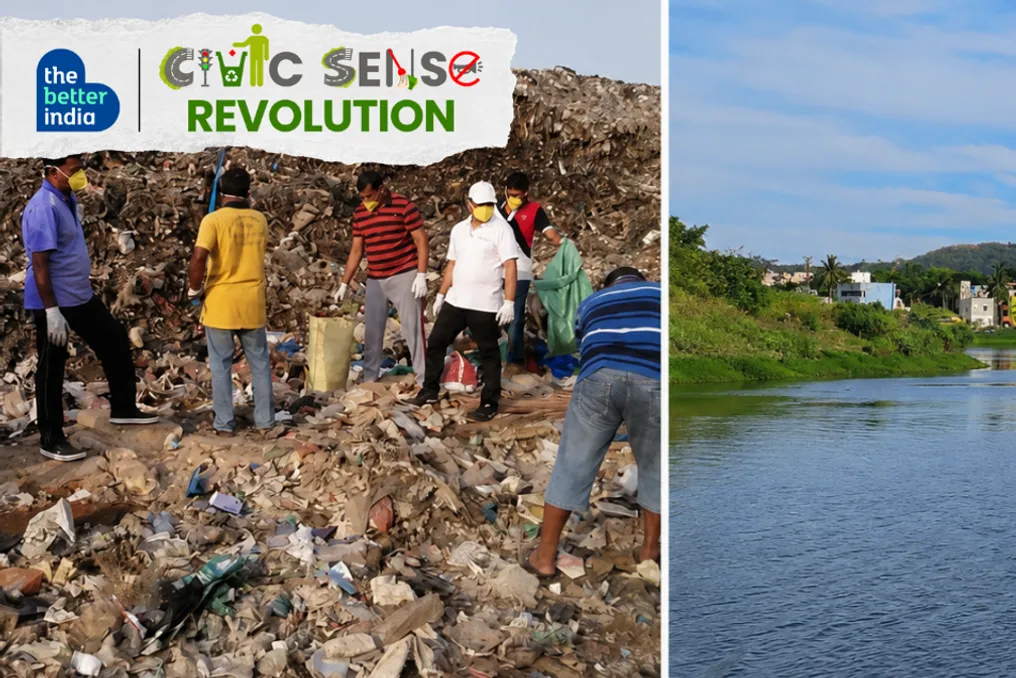
Imagine a fifty-acre lake right behind your house. Now imagine that you still have to buy water in canisters for drinking, cooking, and bathing because the lake outside is too clogged with sewage and trash to provide even a drop. This was the daily life in Chitlapakkam, a residential area near Chennai, for many years.
Today, the same lake replenishes groundwater beneath the city, and residents walk around it every evening instead of queuing for water tankers. The transition from one state to another took seven years thanks to the volunteer group Chitlapakkam Rising and their persistent refusal to let the 'dying lake' remain in that condition.
The crisis quickly became noticeable. By 2016, wells throughout Chitlapakkam began to dry up, and those that remained operational yielded water resembling mud.
Dayanand Krishnanan, a civil engineer who later consulted for Chitlapakkam Rising, recalls: 'There wasn't even a drop of water in our homes. Some people noticed contaminated black water in their well. Despite several protests, the government took no action. I had to pay for water while having a lake right in my backyard.'
The lake itself, which is believed to be about a hundred years old, bore witness to this neglect. One side had turned into a dump, while the other was choked with water hyacinth. Local residents stopped calling it by its real name and started calling it Saakadai Eri — Sewage Lake.
Chitlapakkam did not start from scratch. Citizen welfare associations have existed here since the late 1980s and have already proven their ability to win important battles, once forming a human chain to stop a state housing corporation from building on part of the lake.
However, it was the devastating floods in Chennai in December 2015 and the grim realization that the neglected lake exacerbated the flooding that prompted decades of civic activity to transform into one focused campaign. In 2017, the tactic remained patient: postcards, petitions, street performances, songs—anything that could make the government pay attention.
Two years of such efforts yielded almost no results.
Therefore, in 2019, residents stopped waiting for permission and took matters into their own hands. Sunil Jayaram, one of the founders of Chitlapakkam Rising, says: 'The lake was inaccessible due to years of neglect. Despite years of efforts in the form of postcards, petitions, protests, and candle vigils, the government paid no attention. That is when we planned the mass cleanup.'
On June 2, 2019, more than 2000 people gathered. And this was not for one weekend, but for several, under the hashtag #SavingChitlapakkamLake, until the information spread widely enough on social media that the state could no longer ignore the problem. The following year, the then Chief Minister personally visited the site and allocated 25 crore rupees for the lake's restoration.
L Sundararaman, president of the Chitlapakkam Muthulakshmi Nagar Welfare Association, who has observed the neighborhood's fight for this lake since moving here in 1987, notes: 'Social activity is in the DNA of the people of Chitlapakkam.'
Money alone is not enough to restore an ancient lake. Scientific restoration required a method, and Chitlapakkam Rising prepared it: a four-stage process that the team called the 4D model.
Firstly, sluices were built at each water intake point to divert incoming sewage to treatment facilities instead of into the lake. Then, the sewage that had been inside for years was drained through a drainage outlet, leaving the lakebed dry.
After this, the contaminated soil was completely dried out, and then the lake was deepened by 2.5 meters, based on soil studies, so that it could hold more rainwater and prevent the area from flooding again.
Step by step, the waterway clogged with sewage was transformed back into a functioning lake, not just a cleaner-looking body of water.
Water restoration was never the final goal. What the residents of Chitlapakkam achieved was the return of water security and the creation of a livable neighborhood.
Therefore, residents were asked via a Facebook poll to decide what should be built around the rejuvenated lake. Today, the answer is clear: around the water that once forced people to buy their own supply, there is a pedestrian path, an open sports hall, an amphitheater, a basketball court, and green strips.
In the morning and evening, the same lake is now full of pedestrians, children, and elderly people, not trash. Since October 2023, Chitlapakkam Rising has begun conducting lake tours for residents of other areas, hoping to achieve the same transformation where they live.
A fifty-acre lake lying dead behind your house is easy to pass by every day. But the people of Chitlapakkam managed it in seven years.