Albert Vasquez, a data science student from UC Berkeley, remains impressed by the pace of development of the country's transportation system during his third trip to China. He noted that while visiting Shanghai, Guangzhou, Shenzhen, and Chengdu, he was amazed by the speed of transformations occurring.
Vasquez is one of nearly 40 young delegates participating in the China-US innovation exchange camp, 'Bridge for the Future.' This camp took place in Hainan from July 26 to August 1. The program was organized by the American Friends Association 'Flying Tigers' and aims to allow young US talents in science, technology, and business to personally experience the innovation ecosystem of the Hainan Free Trade Port.
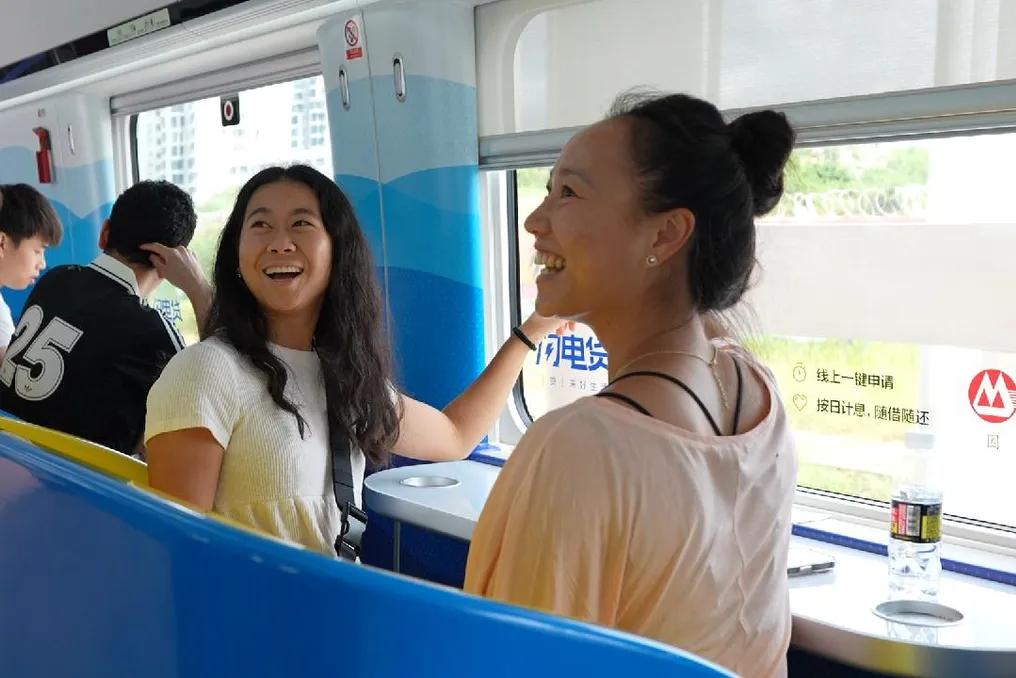
On July 30, the group utilized the high-speed railway in Sanya. For Albert, this was his first experience traveling on such transport. He was struck by the cleanliness of the carriages, the fast security checks, and boarding using digital identification without paper tickets, which strongly contrasts with practices common in some parts of the United States. Vasquez emphasized that because the United States lacks a high-speed rail system, this experience sparks a desire for such a system to exist there. He suggested that the available high-speed transport services would significantly facilitate long-distance travel for American students, and smart railway infrastructure could lower barriers to youth intercultural exchange.
On the same day, July 30, the delegation toured the Yuzhou Science and Technology City, a key hub of the Hainan Free Trade Port for deep-sea research, breeding innovations, and artificial intelligence industry development. Participants visited laboratories and the Youth Innovation Valley, gaining firsthand insight into China's achievements in deep-sea equipment and scientific research. Together with other US participants, including Guan Guhe, a project manager from the Los Angeles Department of Water and Power, and John Sebastian Cubillos, an architecture student from Northeastern University, they discussed the model of integrating industry, universities, and research in China, as well as the potential for academic and talent exchange between China and the US.
The following day, July 31, the US youth visited the Sanya International Duty-Free Trade Complex. They were able to examine and sample goods made available through the policy of the Hainan Free Trade Port. The young delegates noted that Hainan serves as a key pilot region in the Asia-Pacific for open trade, which can promote regional openness and cooperation in digital circulation, promoted by APEC. Many participants stated that such immersive field visits can change perceptions formed solely from online information. Increased youth exchange between people can strengthen mutual understanding between Chinese and American youth, and foster bilateral cooperation between China and the US in areas such as marine science, artificial intelligence, and trade dialogue.