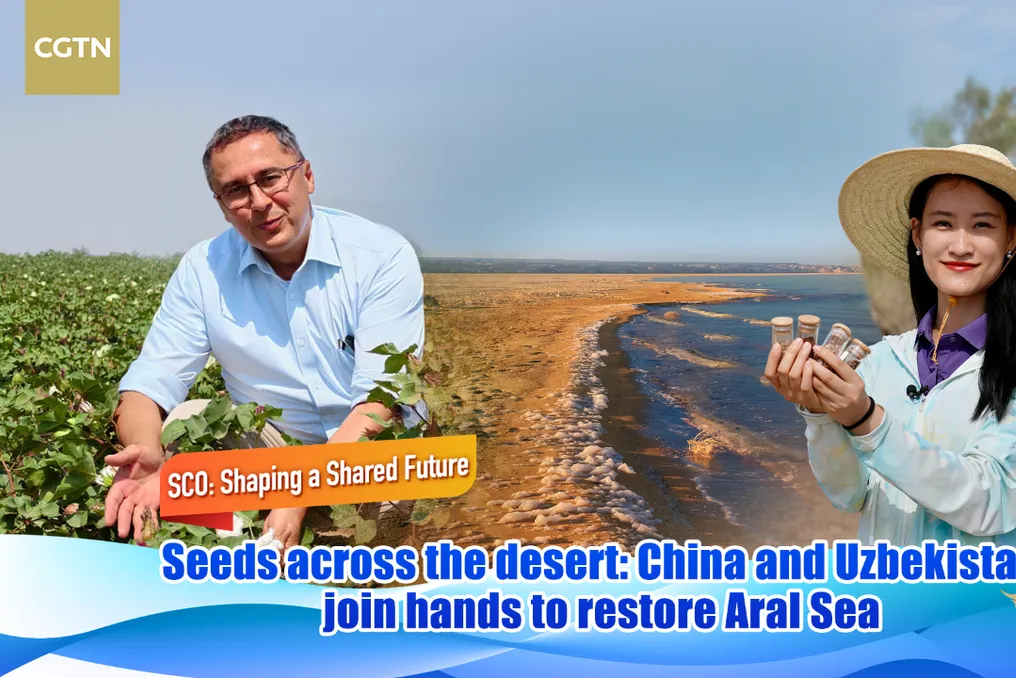
The Aral Sea, once the fourth largest lake in the world, has shrunk by more than 90% since the 1960s, turning into a vast salt desert.
As part of the Shanghai Cooperation Organisation's green agenda, scientists from China and Uzbekistan have joined forces to restore this ecosystem. Researchers from Xinjiang, a region where over 40% of China's saline and alkaline lands are located, have developed water-saving technologies and salt-tolerant plants.
Since 2018, the Chinese side has provided over 1.3 tons of seeds and drip irrigation systems to the dried-up basin of Uzbekistan. These joint efforts have led to the reclamation of approximately two million hectares of land, reduced dust storms, and tripled cotton yields while decreasing water consumption by 40–50%.
CGTN correspondents, Liu Jiaxin and Aljosa Milenkovic, cover this cross-border green cooperation between China and Uzbekistan, examining the process of Chinese seed rooting and the renewed hope in the Aral Sea region.