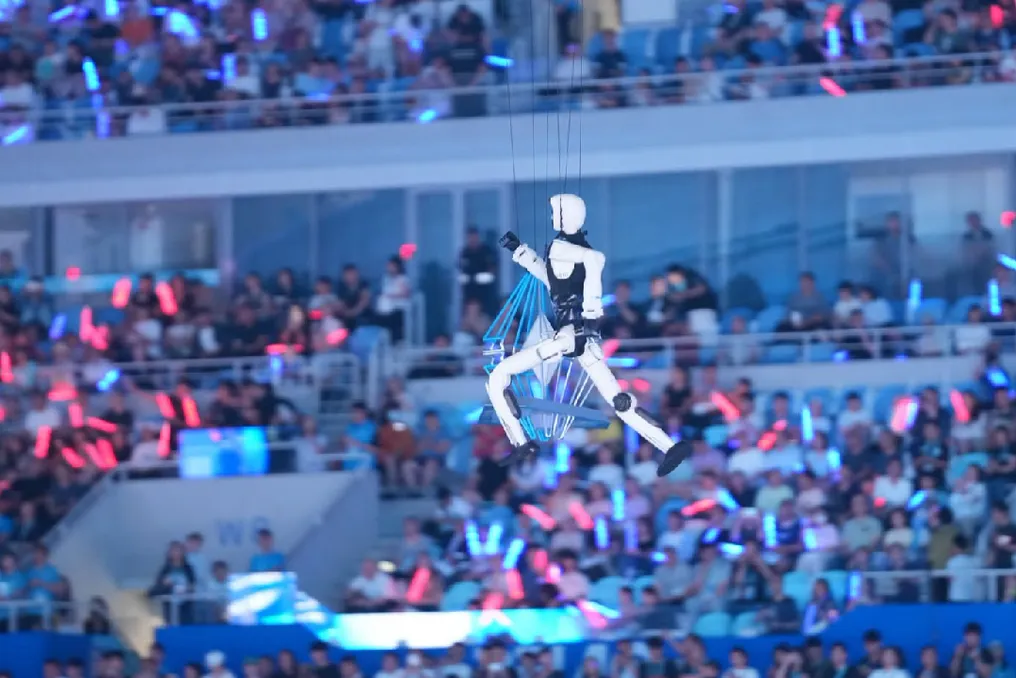
At the 2026 World Humanoid Robotics Games in Beijing, robots were supposed to be the main characters, demonstrating sprints, obstacle courses, scoring goals, and participating in dances. However, another spectacle was observed among the filled stands: a large number of children in the audience, enthusiastically crowding near the barriers, striving to see the robots up close.
The article's author questioned whether the message being conveyed to the next generation is not so much 'look what robots can do,' but rather 'look what you can create in the future.' Conversations with parents made it clear that for many Chinese families, Robotics Games are turning into a kind of job fair for the younger generation, offering them insight into the world they can help build.
The current edition, the second since its launch in 2025, took place from Saturday evening on the National Oval Skating Rink in Beijing and lasted five days. The event was organized under the slogan 'Intelligence Competing for the Future' and gathered 666 teams from 16 countries across six continents, participating in 51 disciplines with a total of over 2000 robots.
Before the games began, organizers noted that the most popular ticket options were packages for two and three people, indicating attendance by families, friends, and colleagues. Officials promoted multi-person tickets as a way to make watching the competition a family activity, describing the event as a combination of a science lesson and shared leisure time.
This approach was confirmed after the games opened. Interestingly, the audience increasingly consisted of primary school-aged children, attracted not only by the competitions themselves but also by the interactive exhibits at the venue—robots performing breakdancing, preparing food and drinks. This stimulated a constant demand for robot-themed toys and souvenirs.
The author personally observed a similar scene. One mother recounted that the trip was intended to give her seven-year-old son a tangible idea of the direction of technological development: 'I wanted him to see what technology is actually becoming, not just learn about it from books or the internet. He has been very curious since a young age, so we think he might one day be the person who creates these robots.'
This opinion resonated with other parents. Robotics, artificial intelligence, and STEM are not abstract national priorities for them, but topics for family discussions over dinner, planning extracurricular activities, and now, weekend outings. Another mother expressed a more competitive concern, fearing her child would fall behind peers already immersed in this field: 'So many children are studying programming and robotics now. If she is interested, I want to give her a chance to see what other children are doing and become part of it from an early age.'
The children themselves did not always think strategically. One boy, watching a robot try to climb onto a large box during the obstacle course, commented: 'I liked when they score goals and go into the net. It’s so funny!'
Not all parents perceived the visit as a strategic event. For some, it was simply pleasant and new entertainment that coincidentally turned out to be a source of inspiration. As they humorously watched children surround a cute robot in a shiny costume, another mother remarked: 'My daughter thinks robots are cute, so when we saw there were games going on, we thought, why not? It's something different from our usual weekend activities, and look how happy she is seeing them up close.'
Regardless of whether the visit was motivated by calculation or spontaneity, the pattern remains constant: throughout all the days, families were a noticeable and purposeful part of the audience at the Robotics Games. In a country actively investing in robotics and artificial intelligence as strategic industries, it is difficult not to view the presence of such a large number of young spectators as part of a much longer process—a generation being introduced, one enthusiastic weekend day at a time, not only to the machines they might one day help create but also to the idea that these machines will become part of their world.