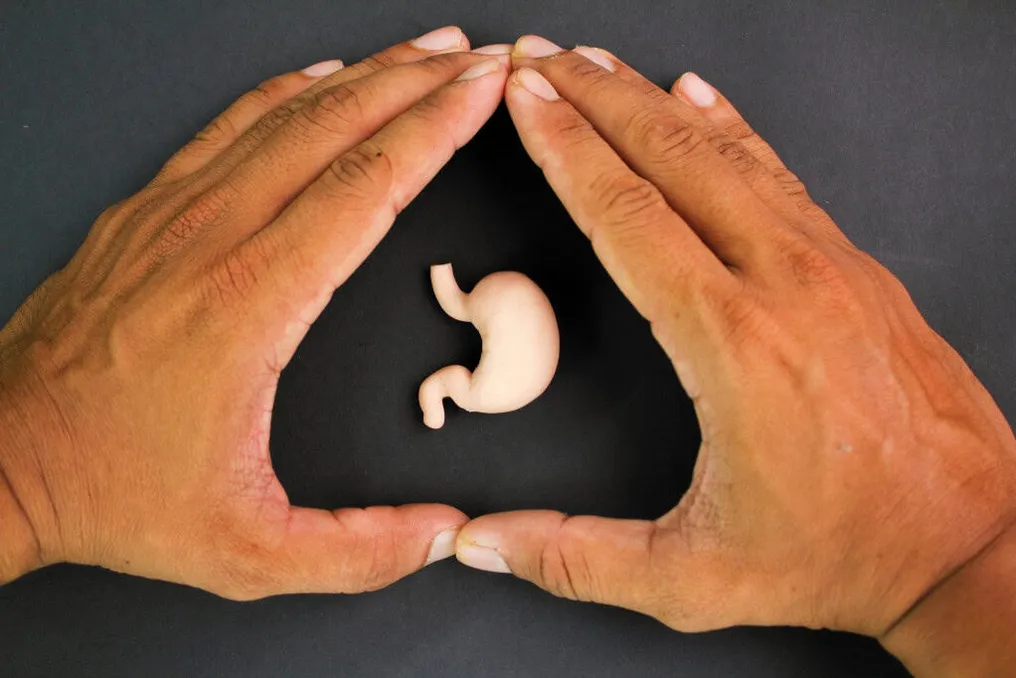
The stomach possesses complex self-protection mechanisms that prevent its own digestive juices from damaging the organ. This defense is structured in three main layers: a layer of mucus mixed with bicarbonate, resistant cellular junctions that keep cells together, and a very high rate of cell renewal, which replaces the entire lining every three to five days.
Without this protection, the gastric acid, produced to decompose food proteins, would be destructive. This hydrochloric acid maintains the inside of the stomach at a pH between 1.5 and 3.5, an acidity level comparable to lemon, capable of rapidly injuring living tissues.
Mucosal cells produce hydrochloric acid, which also serves as the first barrier against bacteria ingested with food. However, this acid does not differentiate between meat proteins and the proteins of the stomach cells themselves. To overcome this, the mucosa generates a thick layer of mucus in which bicarbonate is released, neutralizing the acid before it reaches vital cells.
This combination establishes a pH gradient: extremely acidic in the center of the stomach and almost neutral near the wall of the organ. Furthermore, the superficial cells are firmly connected by structures called tight junctions, preventing the leakage of acid between them. The system is complemented by the constant replacement of mucosal cells, ensuring that any damaged cell is replaced before causing major problems.
An ulcer manifests when this protective barrier is breached, allowing the acid to come into direct contact with deeper layers of the tissue, resulting in a wound. The most common factors for the development of ulcers are frequent use of anti-inflammatories, which decrease the production of mucus and bicarbonate, and infection by the bacterium Helicobacter pylori.
Historically, until the 1980s, the dominant belief was that ulcers were caused by stress, spicy foods, or excessive intrinsic acid. This conception was altered after a fundamental discovery that culminated in the Nobel Prize in Physiology or Medicine in 2005.
Discovery of the relationship between Helicobacter pylori and ulcers
Australian doctors Barry Marshall and Robin Warren identified that the bacterium Helicobacter pylori can thrive in the acidic environment of the gastric mucosa, causing chronic inflammation known as gastritis. Over time, this inflammation can progress to an ulcer and, in some cases, increase the risk of stomach cancer.
Given the initial low acceptance that a bacterium could resist stomach acid, Marshall chose to prove his theory directly. In 1984, he ingested a culture of the bacterium and, days later, developed gastritis, which was confirmed by biopsy. For this work, the duo received the Nobel Prize in 2005, recognized for the discovery of Helicobacter pylori and its role in gastritis and peptic ulcer disease.
In Brazil, the incidence of this infection is high. Data provided by the Journal of the Brazilian Federation of Gastroenterology (FBG) indicate that the estimated prevalence exceeds 70% of the population, with indices even higher in areas with less access to basic sanitation and treated water, since transmission occurs mainly through oral-oral or fecal-oral contact.
Although most infected people remain asymptomatic, when persistent stomach pain arises, testing for Helicobacter pylori—currently simple and accessible through the public health system (SUS) or in the private network—is the first step before starting any treatment for ulcers.