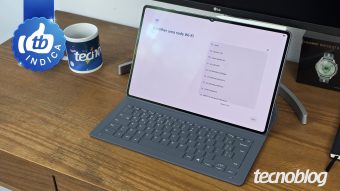
Purchasing a tablet with a large display is an alternative for users who require higher resolution for watching movies, more screen space for studying or working, or as a partial replacement for a laptop. The market features models from brands such as Samsung, Apple, Xiaomi, and Lenovo, ranging in size from 12.1 to over 14 inches, distinguished by screen technology, performance, and productivity-enhancing features.
Tecnoblog has prepared a guide presenting seven tablets available in the Brazilian market in 2026, analyzing their pros and cons.
Galaxy Tab S11 Ultra
The Galaxy Tab S11 Ultra model is equipped with a 14.6-inch Dynamic AMOLED 2X display with a resolution of 2960 x 1848 pixels. The screen features an anti-glare coating and a peak brightness of 1600 nits (1000 nits in high brightness mode). The 120 Hz refresh rate ensures smoother animation and multitasking, while AMOLED technology guarantees deep blacks and high contrast, making it ideal for watching movies and series in dark rooms.
The tablet runs on the MediaTek Dimensity 9400+ chip, has 12 GB of RAM, and supports Samsung DeX, bringing the user experience closer to that of a laptop. The package includes the S Pen and a keyboard case, although the weight of the entire set can be inconvenient.
13-inch iPad Pro
The 13-inch iPad Pro uses Ultra Retina XDR OLED technology with a resolution of 2752 x 2064 pixels and ProMotion, which adjusts from 10 to 120 Hz to balance smoothness and power consumption. The panel features include True Tone, anti-glare coating, and up to 1600 nits brightness when displaying HDR content, making it suitable for use in bright lighting. Thanks to dual-layer OLED technology with individual pixel control, it provides deep blacks and high contrast.
In terms of raw performance, the M5 chip is capable of handling video editing, illustration, and music production. For designers, the combination of OLED, P3, HDR, and ProMotion offers advantages not found in the iPad Air. The visible nano-texture glass is only available in 1 TB and 2 TB configurations; this feature can be useful in poorly controlled lighting conditions as it reduces screen reflections.
13-inch iPad Air
The 13-inch iPad Air is equipped with a Liquid Retina IPS LCD display with a resolution of 2732 x 2048 pixels. It supports the wide P3 color gamut, True Tone, and anti-glare coating, along with a base brightness of up to 600 nits. Although the LCD display provides good clarity, it does not achieve the contrast of the iPad Pro's OLED display. Drawbacks include a fixed 60 Hz refresh rate and the absence of ProMotion. This limitation is especially noticeable during fast scrolling and animation, particularly for those accustomed to 90 Hz or 120 Hz screens.
The M4 chip lags behind the M5 in overall performance but is still powerful enough for tasks such as photo, video, and audio editing, as well as illustration and content creation.
Galaxy Tab S10 FE+
The Galaxy Tab S10 FE+ features a 13.1-inch TFT LCD display with a resolution of 2880 x 1800 pixels and a 90 Hz refresh rate. The panel reaches a brightness of 600 nits and up to 800 nits in high brightness mode, which facilitates comfortable viewing outdoors. The 13.1-inch area is sufficient for working with documents, spreadsheets, and multitasking, although it is smaller than the S11 Ultra. The 90 Hz refresh rate is a compromise between animation smoothness, falling between 60 Hz and 120 Hz of other models. Like other LCD displays, it lacks AMOLED contrast. The S10 FE+ is a reasonable choice for those who want a large screen without overpaying for a more expensive model, especially for reading, studying, and productivity. The hardware includes the Exynos 1580 processor for daily tasks and productivity, and the included S Pen allows for note-taking and working directly on the screen. IP68 certification provides protection against dust and water.
Redmi Pad 2 Pro
The Redmi Pad 2 Pro is equipped with a 12.1-inch LCD display with a resolution of 2560 x 1600 pixels and a 16:10 aspect ratio. It features an adaptive refresh rate up to 120 Hz, which is higher than the 60 Hz of the iPad Air and the 90 Hz of the Galaxy Tab S10 FE+. The 120 Hz refresh rate improves navigation smoothness but does not make the device suitable for heavy gaming. The panel supports Dolby Vision and reaches a brightness of up to 600 nits in high brightness mode. The Snapdragon 7s Gen 4 chip is sufficient for navigation, streaming, productivity apps, and casual games, but it lags behind the top processors from Apple and Samsung in overall performance. A drawback is the USB-C port, which does not support video output, limiting its use with an external monitor.
Lenovo Idea Tab Plus
The Lenovo Idea Tab Plus has a 12.1-inch IPS LCD display with a 2.5K resolution and a 16:10 aspect ratio, along with a 90 Hz refresh rate. The combination of 12.1 inches and 16:10 provides a comfortable workspace for reading, watching videos, and navigating, and 90 Hz makes the interface smoother compared to 60 Hz screens. The panel reaches a brightness of 800 nits in high brightness mode and covers 96% of the DCI-P3 color space, which is important for content consumption and visual work, although this is not enough to classify the display as suitable for professional work. The MediaTek Dimensity 6400 processor with 8 GB of RAM is aimed at everyday use and productivity, providing adequate performance for standard tasks, light editing, and casual gaming. Nevertheless, there are limitations for more demanding applications and heavy games. Lenovo includes a stylus, but the keyboard is sold separately.
The VAIO TL 12 uses a 12.6-inch AMOLED display with a resolution of 2560 x 1600 pixels and a fixed 60 Hz refresh rate. AMOLED technology ensures high contrast and deep black, which is ideal for movies, series, and images with dark areas. The 2.5K resolution also guarantees good pixel density for reading and documents. However, the 60 Hz refresh rate lags behind most competitors in smoothness. The tablet runs on the Unisoc T820 processor, supports productivity, has 5G connectivity, 8 GB of RAM, and up to 256 GB of storage. The package includes a keyboard, case, and stylus, bringing it close to a touchscreen laptop.
The choice of a large-screen tablet depends not only on the display size. Size affects weight and portability, while screen technology, performance, battery life, and accessory compatibility determine its functionality in various tasks. Before purchasing, consider the following points:
The main advantage of a large screen over small tablets is the extra space for viewing content and performing tasks. A 12 or 13-inch screen facilitates reading documents, working with spreadsheets, and splitting the screen between applications, while 14-inch models are closer to the laptop experience.
The Redmi Pad 2 Pro is considered the best value for money option for those looking for a large tablet. It offers a 12.1-inch display with a 2.5K resolution and up to 120 Hz refresh rate, powered by the Snapdragon 7s Gen 4 chip, which is suitable for navigation, streaming, studying, and multitasking, and it is equipped with a 12,000 mAh battery.
The Galaxy Tab S11 Ultra is the most comprehensive option among stylus-supported tablets. Its 14.6 inches provide more space for drawing, note-taking, and multitasking, and the inclusion of the S Pen in the box is a plus. For those looking to reduce costs, the Galaxy Tab S10 FE+ also comes with a stylus and has a large screen (13.1 inches).
The 13-inch iPad Air is the best choice for reading among large tablets. It has a high-resolution display with an anti-glare coating, which provides a better experience in bright light, and the True Tone feature adapts color reproduction to the ambient light. As an alternative, the Huawei MatePad Mini PaperMatte is mentioned.