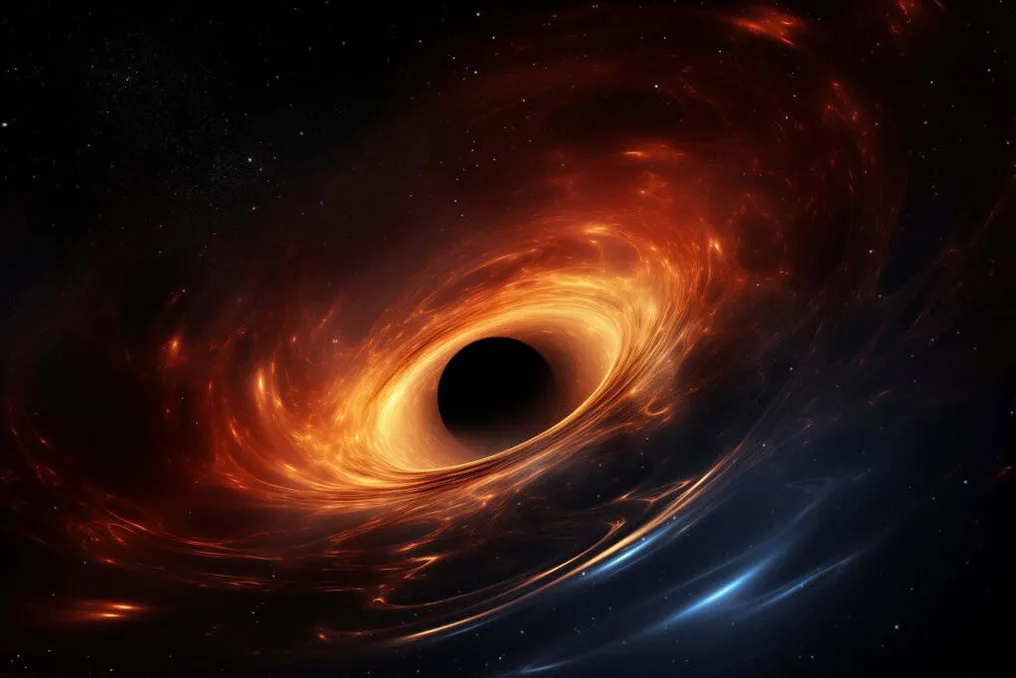
The fate of a body falling into a black hole depends primarily on the mass of that object. In the case of a stellar black hole, tidal forces can stretch and compress the body even before reaching the event horizon. This process is known as spaghettification.
However, in a supermassive black hole, the gravitational gradient between the head and feet near the horizon can be significantly smaller. In an idealized scenario, one might cross this boundary without feeling strong effects at that moment. Nevertheless, this does not guarantee safety: there is no known way to return outside after the event horizon.
Spaghettification is caused by so-called tidal forces, which arise because gravity does not have absolutely uniform intensity at all points of an object. Imagine a person falling feet-first toward a black hole; the feet will be closer to the center of the object than the head, and therefore feel a stronger gravitational pull.
As the person approaches the black hole, this difference intensifies. At some point, it may become sufficient to stretch the body toward the black hole and compress it in other directions. This is where the name spaghettification comes from: matter is pulled in one direction and squeezed in others, becoming increasingly deformed. In a stellar-mass black hole, this process can occur before crossing the event horizon, according to NASA.
The situation also depends on the surrounding environment. Some black holes are surrounded by an accretion disk formed by moving gas and other materials. This material can reach very high temperatures and emit intense radiation, which could lead to lethal conditions before reaching the horizon.
The size of the black hole significantly changes the experience. Supermassive black holes can have masses ranging from hundreds of thousands to billions of solar masses. Since the event horizon of a supermassive black hole is much larger, the gravitational difference between two points separated by a human height can be relatively small in that region. Therefore, in an idealized scenario, someone might cross the event horizon of a supermassive black hole without immediate tidal destruction. NASA uses this contrast to explain why passing through the event horizon of a supermassive black hole might be much less dramatic than in the case of a stellar black hole.
This does not make the horizon a safe zone. The event horizon is a boundary from which nothing, not even light, can return. What happens beyond this boundary is more complex to describe. General relativity predicts a central region called a singularity in certain black hole solutions, but modern physics does not provide a complete description of these extreme conditions.
Therefore, claims about what a person would feel in the deepest regions should be viewed as predictions based on current theories, rather than anything directly observable. The fall will also be perceived differently by those observing from afar. This is due to gravitational time dilation, an effect predicted by general relativity. For the falling person, their own clock will continue to run normally; they can cross the horizon in a finite amount of their own time, provided the scenario conditions allow it.
However, for a distant observer, the light signals sent by the person will take longer to arrive. The light will also undergo a shift to lower frequencies, becoming gradually redder and fainter. Thus, to this observer, the person will appear to slow down as they approach the horizon. Their image may appear frozen and gradually fade near this boundary. This does not mean the person actually stops at the horizon. The apparent freezing is a consequence of how light and time are perceived by someone remaining far from the black hole. The difference between these two perspectives is one of the most well-known consequences of general relativity: for the falling person, crossing the horizon can happen in a finite time, while for the distant observer, the fall appears to slow down indefinitely.
Ultimately, there is no single scenario for such a fall. The mass and conditions of the black hole matter. In a stellar-mass object, tidal forces can deform the body before the horizon. In a supermassive black hole, the crossing can initially be much gentler. In any case, there is no known way back after the event horizon.