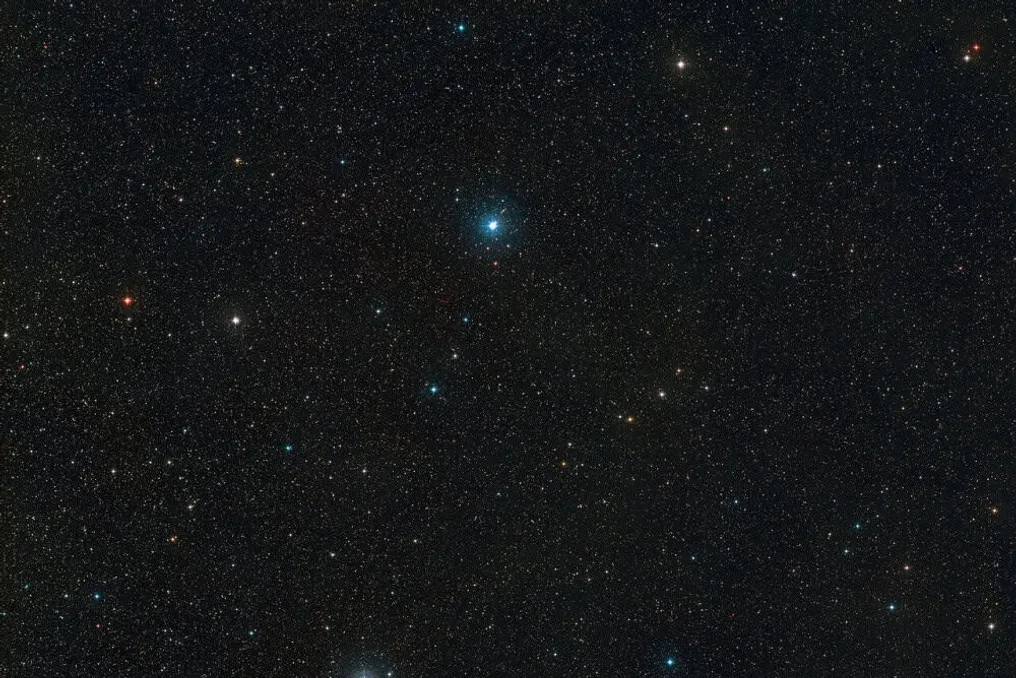
The closest known black hole to Earth currently is Gaia BH1. This object is located approximately 1,560 light-years away, in the direction of the constellation Ophiuchus, also known as the Serpent Bearer. For reference, a light-year is the distance light travels in one year, which is equivalent to about 9.5 trillion kilometers. Although it is far from the immediate vicinity of the Sun, it represents the nearest neighbor of this type of entity ever identified.
The discovery of Gaia BH1 was made possible by data collected by the Gaia mission, a satellite of the European Space Agency (ESA). This satellite performed an extremely precise mapping of the position and movement of billions of stars in the Milky Way during the period between 2014 and 2025.
The results were published in November 2022 in the scientific journal Monthly Notices of the Royal Astronomical Society. The study was led by astrophysicist Kareem El-Badry, who belongs to the Center for Astrophysics | Harvard & Smithsonian.
Most black holes are detected when they are actively consuming matter; they suck gas from a nearby star, and this material forms a disk that radiates intensely in X-rays. In the case of Gaia BH1, this situation does not occur, as it is classified as a dormant black hole, meaning it is not absorbing matter visibly, which prevents the emission of detectable light or radiation.
Scientists used the technique of astrometry to locate it, a method that accurately measures the positioning and deviation of stars in the sky. It was noted that a Sun-like star in the same area exhibited a slight oscillation in its orbit, indicating gravitational attraction by something invisible. This star orbits the hidden object at a distance comparable to that separating the Earth from the Sun, completing an orbit every 185.6 days.
If the object were another star, it would emit considerable light due to its large mass. However, since no corresponding brightness was recorded, even with the help of telescopes such as Gemini North and Keck, it was concluded that it was a black hole with an estimated mass ten times that of the Sun.
More information about black holes
It is important to clarify that a black hole does not function as a 'cosmic vacuum cleaner' that attracts everything around it. Its gravitational influence behaves like that of any other body with equivalent mass; the extreme intensity only manifests near the event horizon, which is the impassable limit from which not even light can escape. At a distance of 1,560 light-years, this gravitational force has an insignificant impact on the Solar System.
Furthermore, the vast distance makes any attempt at travel impractical with current technology. The fastest spacecraft ever built would take tens of billions of years to reach it, a period longer than the age of the Universe itself.
However, there is a theoretical hypothesis, also published in the Monthly Notices of the Royal Astronomical Society and led by Stefano Torniamenti, suggesting the possibility that stellar-mass black holes are hidden in the Hyades cluster, being only about 150 light-years away—ten times closer than Gaia BH1. Despite this, none of these objects have been confirmed through direct observation so far, unlike Gaia BH1.
Astronomers estimate that the Milky Way may contain approximately one hundred million black holes, but most remain invisible. Those without a companion star to signal their gravitational effect simply provide no detectable clues.
For those who wish to observe the celestial region where the current record holder resides, it is recommended to look for the constellation Ophiuchus on clear nights, as it is also visible in the Southern Hemisphere. Although the black hole itself will never be visible to the naked eye, the curiosity is accessible for free, as each new set of data from missions like Gaia has the potential to redefine this record in the coming years.