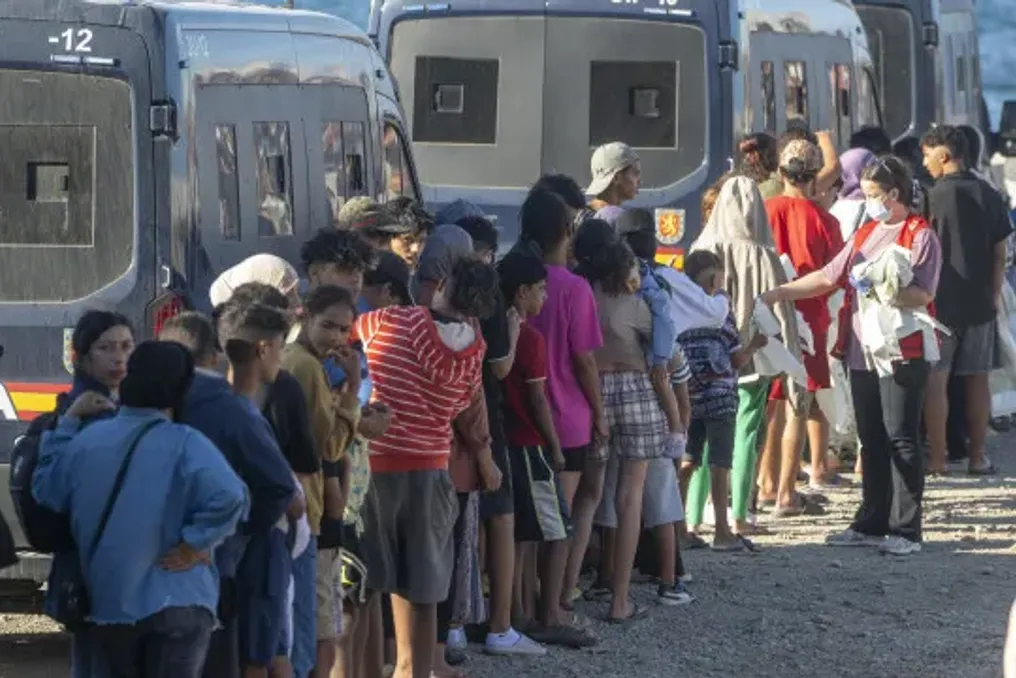
Hundreds of protesters held a peaceful demonstration in the Spanish autonomous city to pressure the Government to find a solution to the local crisis. Participants chanted slogans such as 'They will not move us from this road' and expressed dissatisfaction with the persistence of a situation that, they alleged, is affecting the daily lives of residents and increasing feelings of insecurity.
The gathering took place without any incident, and the protesters maintained their position even with police presence. During the event, criticisms were heard directed at the Spanish Red Cross, with calls for the organization to stop providing support to illegal migrants at various points in the city.
The protesters argued that their mobilization aims to claim the right of Ceuta's inhabitants to restore normality. They questioned why, almost a month after the massive arrival of immigrants on July 30th, solutions have not yet been implemented to alleviate the city's overcrowding and respond to the needs of its residents.
One participant stated that it is necessary to resume routine and that children should be able to go out, wishing for Ceuta to return to how it was before. Another protester emphasized that the needs of local inhabitants must also be met, mentioning that 'there are many people from Ceuta facing difficulties.' This same person argued that assistance to migrants cannot come at the expense of city residents.
During the protest, criticisms arose regarding the presence of migrants at El Trampolin beach, accompanied by requests for them to be transferred outside Ceuta, following established legal procedures. The Police requested the protesters to allow passage to the Red Cross vehicle, which continued its route.
Later that same day, Ceuta residents caused disturbances at Benítez beach, leading to police intervention. The disturbances occurred after protesters entered migrant camps where people were staying overnight in the area and caused damage, including burning belongings.
The protesters displayed a giant Spanish flag and joined other demonstrations at that location, heading towards El Trampolin beach, where food distribution takes place.
These protests, which have been ongoing for several days, followed the Government finally designating a single command this week to coordinate the response to the crisis, a demand the autonomous city had made since the beginning of the crisis.
On Tuesday, the Executive's intention was communicated to designate locations to temporarily concentrate migrants who are in public areas, facilitating their identification and corresponding screening. This initial step aims to determine the individual situation of each person and activate, if applicable, the return or expulsion processes provided for in legislation.
Ceuta, a small territory with approximately 83,000 inhabitants, is located in the northern extreme of Morocco and is bordered by the Strait of Gibraltar. It is one of the two land borders between Africa and Europe, along with Melilla, another Spanish enclave.
At the end of July, in just 24 hours, about 72,000 people entered the Spanish autonomous city. At least 82 people died while trying to reach Ceuta by swimming. Almost a month later, there is still no precise data on the number of migrants remaining in Ceuta, although some estimates point to up to 8,000 undocumented individuals.