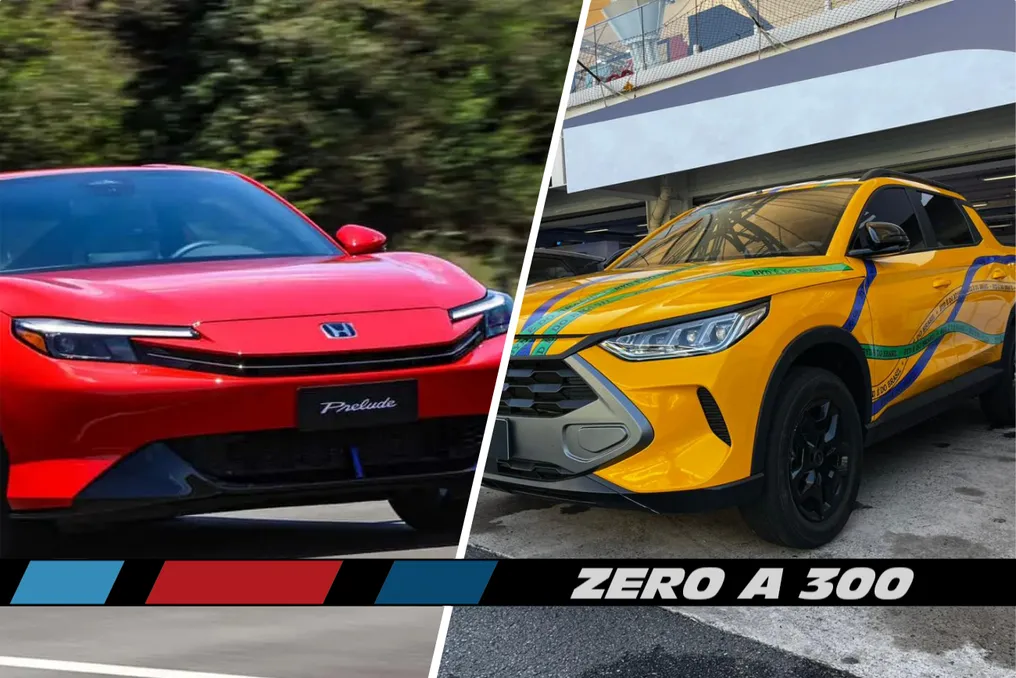
The Honda Prelude has returned to the Brazilian market, launched with a price of R$ 380,000. This sixth generation coupe, which had its international launch in August 2025 after an almost 25-year hiatus, is positioned about R$ 50,000 below the Civic Type-R.
Unlike the Type-R, which focuses on visceral driving with a four-cylinder turbo engine and manual gearbox, the new Prelude has a more technological approach. It uses a hybrid system that generates 203 hp, coupled with an e-CVT electric transmission with simulated gears. The suspension is shared with the hot hatch, promising good handling in curves.
The Prelude employs the same hybrid system as the Honda Civic, producing 203 hp and 32.1 kgfm of torque. The S+ Shift system simulates eight speeds, allowing the coupe to reach 100 km/h in 8.2 seconds. Similar to the hybrid Civic, the Prelude operates mainly in electric mode, using the combustion engine as a power generator, except in situations like highway cruising, when it can engage the front wheels.
With fuel consumption of 17.9 km/L in the city and 15.7 km/L on the highway, the model can be seen as the successor to the Civic coupe, which discontinued the two-door body style in the 11th generation. Measuring 4.67 meters in length, 1.80 m in width, 1.43 m in height, and 2.73 m in wheelbase, its trunk accommodates 264 liters, indicating it was not designed for family use.
Honda has already started accepting reservations, offering benefits such as a personalized protective cover, anti-theft nuts, a car miniature, and access to track events for the first 50 buyers in the pre-sale.
Presentation of the BYD Mako at the Interlagos Festival
During the Interlagos Festival, the BYD Mako was displayed at the José Carlos Pace Autodrome, marking the brand's entry into the competitive Brazilian scene, especially after Volkswagen presented its rival to the Fiat Toro.
This is the first BYD model developed specifically for the Brazilian market. The monocoque pickup shares design characteristics with the Song Pro SUV, notably at the front, and presents a typical SUV silhouette, with inclined C-pillars and a raised bed. Although the interior was partially covered, it was suggested that the cabin would have a more robust look, distinct from the floating elements of the Song Pro.
It is expected that the Mako will use the SUV's powertrain, consisting of a 1.5 naturally aspirated engine paired with an electric motor and CVT transmission. The Song Pro delivers 219 hp and 30.6 kgfm of torque, but BYD has not yet confirmed changes for the Mako. Production of the BYD Mako will take place in Camaçari (BA), with an expected debut in the coming months, possibly November.
GWM Tank 400 Highlighted at the Interlagos Festival
The GWM Tank 400 was also a highlight at the Interlagos Festival, with sales expected to begin before the end of the year. Unlike the more affordable Tank 300, the 400 aims to compete with the top versions of the Toyota SW4, targeting a price range around R$ 400,000.
The vehicle maintains the traditional chassis-on-frame body structure and utilizes GWM's Hi4-T architecture. Its mechanical setup is a flex plug-in hybrid (PHEV), combining a 2.0 four-cylinder turbocharged direct injection internal combustion engine capable of generating 251 hp, and an electric motor. Together, they provide 421 hp of power and 76.5 kgfm of torque, managed by a nine-speed automatic torque converter transmission. According to factory data, the 0 to 100 km/h acceleration time is 6.8 seconds.
The electric battery has a capacity of 37.5 kWh and supports fast charging up to 103 kW, offering a declared range of 105 km in pure electric mode, according to the NEDC cycle. In terms of off-road capability, the Tank 400 differs from urban hybrids by using mechanical 4x4 traction through a driveshaft, instead of a dedicated electric motor to the rear axle. The system includes low range and electronic differential locks on the front and rear axles.
Aesthetically, the design incorporates fluted fenders with visible rivets and an external spare tire, following the line of the Tank 300, although the headlights and grille have a more modern look. Inside, the Tank 400 features a 12.3-inch digital dashboard and a 15.6-inch central screen. The elevated center console contains physical controls and rotary selectors for drive modes. Planned options include electrically adjustable seats, ventilation and massage, electrically retractable side steps, and a 5.4-liter mini-freezer integrated into the console. For safety, the ADAS Coffee Pilot Ultra package is equipped with radars, LiDAR sensors, and cameras, enabling Level 2+ semi-autonomous driving.
Renault Kardian Receives New Entry-Level Version Below R$ 100 Thousand
Renault recently launched the Renault Kardian Vibe, its new entry-level version for the compact SUV. Priced at R$ 99,990, it establishes itself as the most affordable turbocharged car available in Brazil currently. However, to achieve this price point, the French manufacturer had to make certain modifications.
One of the changes was replacing the dual-clutch transmission, present in other versions, with a six-speed manual. Additionally, several equipment items were removed to reduce costs. The alloy wheels were replaced with stamped steel wheels with black hubcaps, and silver details on bumpers and roof rails were eliminated, as were the colored door handles, which now feature a glossy black finish. The LED headlights and chrome strip on the grille were retained.
Inside, the Kardian Vibe does not have a digital instrument panel or push-button start, featuring simpler seat and door trim finishes. The 8-inch floating multimedia system is the same as that in the immediately superior Evolution AT version. A positive point is that the Kardian Vibe is 43 kg lighter than the other versions, assisting the 125 hp and 22.4 kgfm torque engine. Unlike many competitors who reduced power to 115 hp due to special taxation, the Kardian maintained its original power.
Display of Peugeot Rally and Racing 208 at Interlagos
Peugeot used the Interlagos Festival to display competition models, such as the Peugeot 208 Rally4 and the TC6, which were presented in Brazil for the first time. These vehicles represent Peugeot's current racing lineage, which includes icons like the Peugeot 205 T16 and the Peugeot 406.
The Peugeot 208 Rally4, homologated by the FIA for the Rally4 category, is a front-wheel-drive rally car that competes in WRC4, ERC, and the Peugeot Rally Cup Iberica single-make trophy. It is equipped with a 1.2 turbo engine producing 212 hp and 29.6 kgfm of torque, a 5-speed SADEV sequential gearbox, weighs a minimum of 1,080 kg, and uses 15-inch wheels.
The 208 Racing TC6, on the other hand, was developed for asphalt, following the FR6/TC6 regulations of the FFSA, competing in events such as the Trophée 208 Racing. This model features a 1.2 turbo engine with 145 hp and 240 Nm, a competition Marelli ECU, and a reinforced 6-speed manual gearbox with short ratios. Weighing only 1,000 kg, it has lowered suspension, 17-inch wheels, and white paint with Peugeot Sport graphics.
For visitors, Peugeot opened registrations at its booth to participate in rides with professional drivers in high-performance maneuvers (Wednesdays at 1 pm and 4 pm; Friday to Sunday at 10 am, 1 pm, and 4 pm) or to drive karts at the Peugeot Arena. Karting requires a minimum height of 1.32 m. The booth also offered a simulator of the 9X8 hypercar, an exhibition of driver Jean-Éric Vergne's equipment, and test drives of the 208 GT Hybrid and 2008 GT Hybrid models, including a 2008 customized by Mopar.