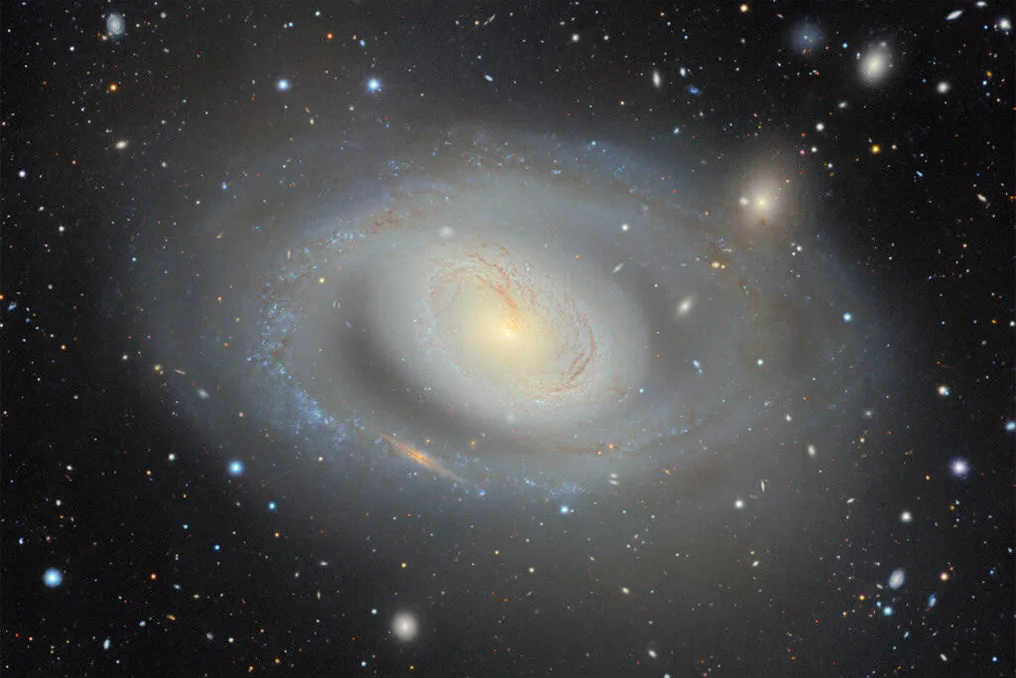
The coldest natural place in the Universe is not outer space vacuum, but the Bumerangue Nebula, which contains the coldest natural object ever identified in the cosmos. A portion of the gas in this nebula reaches temperatures close to 1 kelvin, which is equivalent to approximately -272.15 °C. This temperature is lower than the 2.7 kelvin of the cosmic background radiation, which is the luminous residue of the Big Bang that fills the entire Universe.
This extreme cold is not merely caused by the distance between the nebula and the stars. The gas is expelled by the central star and disperses into space at high speed; as it expands, it cools. This principle is analogous to what happens with an aerosol can: when pressurized gas is released rapidly, the can can cool down.
The Bumerangue Nebula is associated with a star in an advanced stage of its evolution, which releases large volumes of gas into space. This material forms the structure observed as two large lobes, giving the nebula its characteristic boomerang shape. The rapid expansion of the gas causes its particles to occupy an increasingly larger area, and some of the energy spent in this expansion process results in a drop in its temperature.
Scientists call this phenomenon adiabatic cooling. Although the term sounds complex, the idea is simple: when a gas expands rapidly without absorbing enough heat from the surrounding medium, it decreases its temperature. This mechanism helped explain the extreme temperature of the Bumerangue Nebula.
In 1997, a study published in The Astrophysical Journal by Raghvendra Sahai, from the Jet Propulsion Laboratory, and Lars-Åke Nyman, from the European Southern Observatory and the Onsala Space Observatory, concluded that adiabatic cooling was the dominant factor in the energy balance of the ultra-cold gas. The analogy with the deodorant can helps illustrate the process: when it leaves the container, the compressed gas expands and causes the container to cool. In the nebula, a similar event occurs on a colossal scale, with the gas spreading through space.
Comparing it to the cosmic background radiation makes the temperature even more remarkable, since this remnant radiation from the dawn of the Universe reaches us at about 2.7 K. In other words, there is an area of gas within our own galaxy that is colder than the glow permeating the entire Universe.
It is important to note that not all of the Bumerangue Nebula is at 1 K; this value specifically refers to its ultra-cold gas region. Subsequent observations confirmed the presence of this material and solidified the nebula's position as the coldest known natural object.
Furthermore, the gas exhibits movements at notable speeds. The study conducted by Sahai and Nyman identified an approximate speed of 164 km/s in the molecular wind, which is equivalent to about 590 thousand km/h. The combination of the vast amount of gas and the extremely rapid expansion justifies the region's ability to reach such a low temperature, functioning as a gigantic natural refrigerator created by the nebula itself.
Despite being the coldest known natural object, the Bumerangue Nebula does not hold the absolute record for minimum temperature, as scientists are able to generate even more extreme conditions in laboratory environments.
More information
In 2021, researchers from the QUANTUS project in Germany achieved the mark of 38 picokelvins. A picokelvin represents one trillionth of a kelvin, meaning that 38 picokelvins is only 0.000000000038 K above absolute zero. In this experiment, scientists worked with a Bose-Einstein condensate, a state of matter obtained by cooling atoms to extremely low temperatures. The result measured the internal kinetic energy of the condensate on a scale corresponding to approximately 38 picokelvins.
This achievement was published in the journal Physical Review Letters in 2021. The Guinness World Records recognizes 38 picokelvins as the lowest recorded artificial temperature. The experiment, conducted in Bremen, began in 2018, and the scientific finding was published three years later.
The disparity in scale is difficult to conceive: the ultra-cold gas of the Bumerangue Nebula is on the order of 1 K, while the human experiment reached the equivalent of only 38 trillionths of a kelvin. In space, extreme cold can arise from a seemingly simple phenomenon: the rapid dispersion of a gas, similar to what explains the cooling of an aerosol can, but on a cosmic dimension.