Partial lunar eclipse will be visible in several Brazilian cities with public observation events
Read more
Olhar Digital
olhardigital.com.br

Partial lunar eclipse will be visible in several Brazilian cities with public observation events

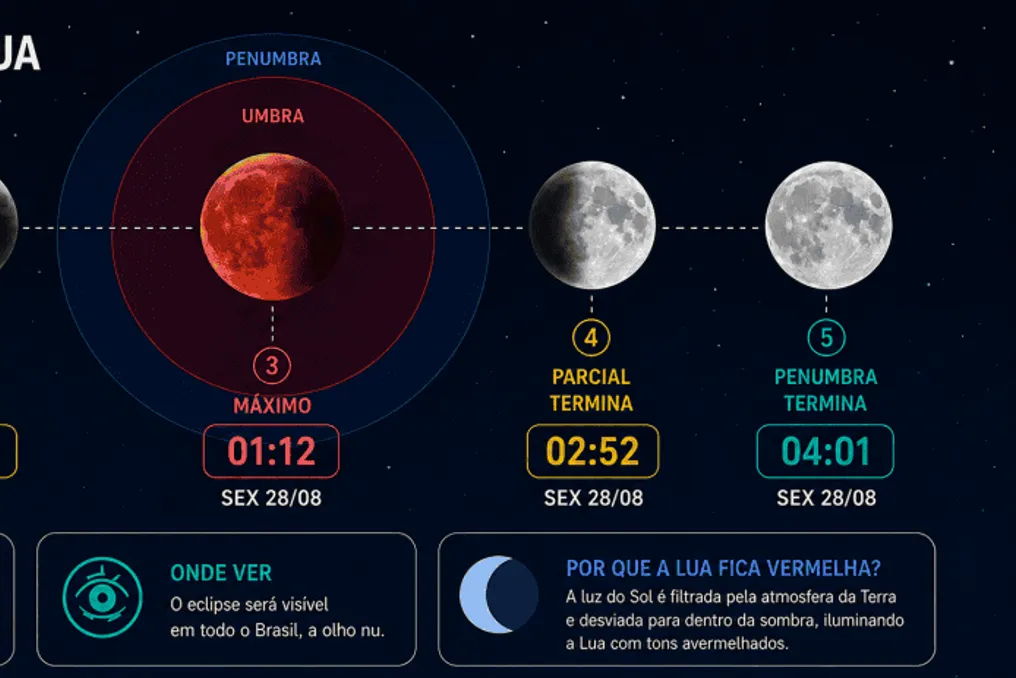
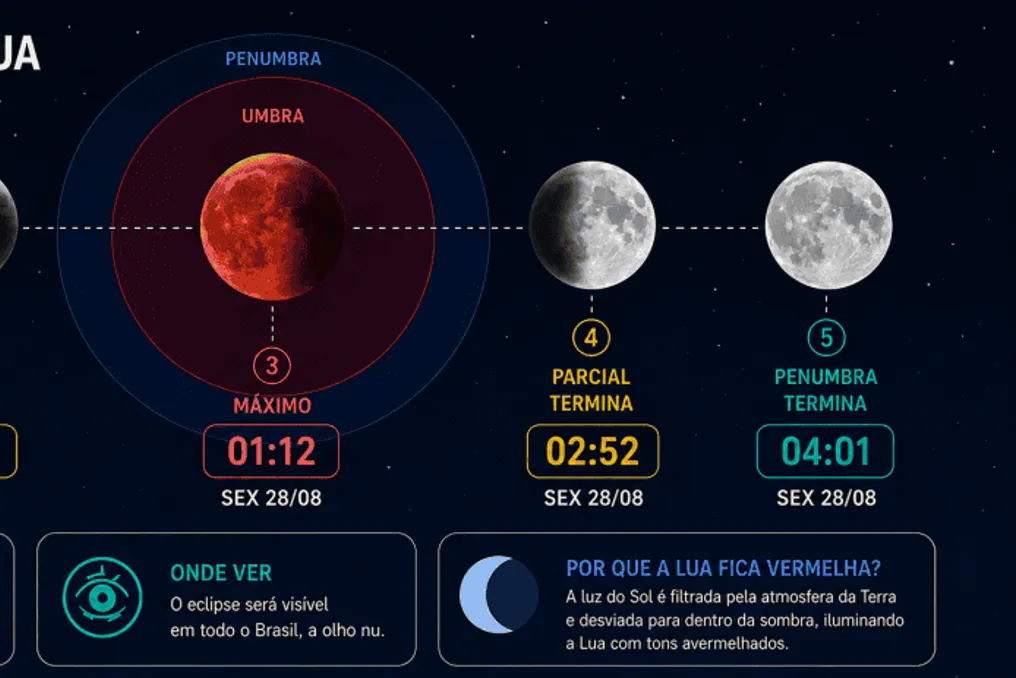
A large magnitude partial lunar eclipse will occur this Thursday (27th), extending into the early morning of Friday (28th). Although it is not a total eclipse, the phenomenon will be nearly complete, with approximately 96.2% of the lunar disk entering the umbra, the darkest part of Earth's shadow.

This event will cause the Moon to take on a reddish hue, simulating the appearance known as the 'Blood Moon.' Brazil has a favorable position to witness this spectacle, which can be seen throughout the national territory without the need for specific equipment.

The partial phase of the eclipse should begin around 11:33 PM, reaching its peak around 1:12 AM. Since it is a safe phenomenon for the eyes, observation can be done with the naked eye, although using telescopes and binoculars offers greater detail.

Observation events in different cities

Various planetariums, observatories, and astronomy groups have organized activities in several cities across the country to monitor the eclipse. Among the available options, the following stand out:

The Rio Planetarium, located in the Gávea neighborhood, offers an extensive schedule starting at 9 PM (Brasília time). Activities include celestial observation with telescopes, special dome sessions led by astronomers, visits to the Universe Museum, and live musical performances. Entry is free, but subject to capacity and weather conditions.

In Maricá, in the Itaipuaçu neighborhood, the Planetarium will operate from 9 PM to 4:30 AM. The public can observe the eclipse using telescopes and participate in dome sessions focused on the Moon and eclipses, in addition to other activities. If the weather prevents direct viewing, the program will feature simulation resources.

Belo Horizonte will host an event at the Natural Sciences Museum of the Pontifical Catholic University of Minas Gerais (PUC Minas), with programming from 6:30 PM to 3 AM. In addition to available telescopes, the Planetarium will offer four explanatory sessions at 7 PM, 8 PM, 9 PM, and 10 PM. Participation is restricted, and the entrance fee is R$20.00.

In the São Paulo capital, the Principia Institute will promote the 'Moon Bath: A Night of Eclipse!', from 9 PM to 3 AM. This free event includes a guided tour, astronomical workshop, activities in the Digital Dome, and an immersive 360-degree dome, in addition to telescope observation. In case of bad weather, direct observation will be replaced by a live projection of the eclipse in the Digital Dome.

The Jean Nicolini Municipal Observatory, located in Serra das Cabras, will open at 11 PM and operate until 3 AM. The eclipse will be monitored by space telescopes. Participation is limited to 200 people and requires prior registration. Tickets cost R$10.00, or R$5.00 for students, accepting cash payment.

In Salvador, the Amateur Astronomers Association of Bahia organized a program starting at 9 PM. There will be a special session in the dome onSelenography and eclipses at 9:15 PM. After a social gathering, telescope observation will begin at 10:20 PM, ending at 1:20 AM.

The Astronomical Studies Center of Alagoas (CEAAL) will receive the public at Usina Ciência, in the Farol neighborhood, for a free observation, without the need for scheduling.

Other observation locations

In São Roque, on Morro do Saboó, the Sirius Astronomy Nucleus, belonging to the Federal Institute of São Paulo (IFSP), will be present starting at 6:30 PM, offering telescopes and observation activities. Participation is free, but there is a limit of 30 spots and registration is mandatory.

Goiânia will feature the Pleiades of the South Astronomy Club, which organized a public observation at the Municipal Palace, in Park Lozandes, starting at 10 PM. This activity is free, open to everyone, and does not require prior registration, with the goal of monitoring the eclipse under the group's guidance.

Regardless of the chosen location, the primary condition for seeing the phenomenon is a clear sky. Since the Moon will remain visible during much of the early morning, even those who cannot attend an organized event can find a place with little artificial light and an open horizon to observe the eclipse.

Alternatively, if physical presence is not possible, it is possible to follow the live broadcast of Olhar Digital from anywhere.
Similar stories

How to find the best time to watch a lunar eclipse in your city
Read more
olhardigital.com.br

How to find the best time to watch a lunar eclipse in your city

One of the most interesting astronomical sights of the year will take place this evening: a partial lunar eclipse that will occur on the night from Thursday to Friday (27th to 28th). According to Olhar Digital, this will be the last eclipse of 2026.

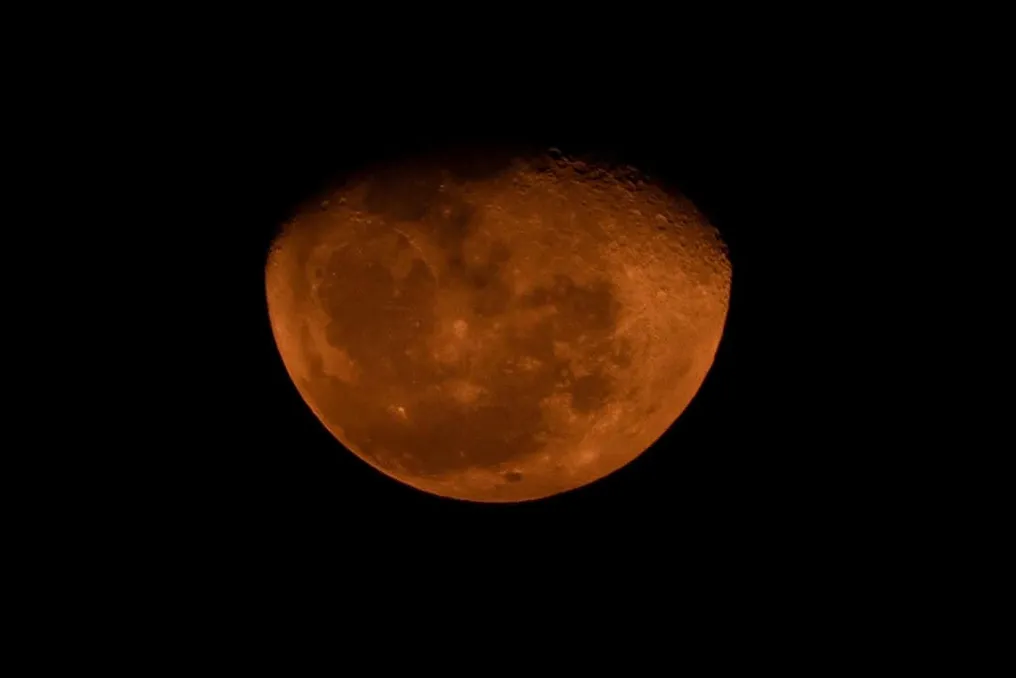
The phenomenon promises to attract attention due to the high degree of darkening of the Moon's surface, which may take on dark shades ranging from brown to reddish-copper, resembling an almost total lunar eclipse.

The good news is that this 'total-looking' partial lunar eclipse will be visible from anywhere in Brazil, provided there are favorable meteorological conditions and clear skies. Since the eclipse will happen early in the morning, the Moon will be high in the sky, which will facilitate observing the Earth's shadow covering part of the lunar disk.

In addition to South America, this event will also be well visible across North America, Europe, and Africa.

How to find out when the lunar eclipse can be seen in your city

To find out the exact time to observe the lunar eclipse in your locality, you can use specialized astronomy websites and applications. For example, the Time and Date platform provides information on the start and end times of the eclipse, as well as the precise moments of each phase. You just need to enter the city name or coordinates of the location to get the relevant time frames.

Sky observation apps can also help. Programs such as Star Walk 2, Stellarium Mobile, and Sky Tonight allow you to check eclipses and other astronomical phenomena based on the user's location. These tools enable you to find out not only the time of the event but also the exact position of the Moon in the sky during the eclipse.

The visibility of the eclipse will depend solely on the weather. However, even if cloud cover prevents direct observation, you can follow the event live online. Olhar Digital is broadcasting this spectacle from 11:00 PM Brazilian time on Thursday, using images from the National Observatory.

1504 Lunar Eclipse Used by Christopher Columbus to Secure Supplies in Jamaica
Read more
olhardigital.com.br

1504 Lunar Eclipse Used by Christopher Columbus to Secure Supplies in Jamaica

There are growing expectations regarding the partial lunar eclipse that will occur early on Thursday (27) and Friday (28), with live coverage available through Olhar Digital. This event will be particularly notable in Brazil, as the Moon will present good viewing conditions across all its regions.

Although it is not a total eclipse, the phenomenon will be quite intense, as more than 96% of the lunar disk will remain within the umbra, the darkest area of the shadow cast by the Earth. Consequently, almost the entire Moon may take on a reddish color during the peak of the event.

A lunar eclipse occurs when the Earth is positioned between the Sun and the Moon, obstructing some of the sunlight that would otherwise be directed at the satellite. The Earth's shadow is then projected onto the lunar surface, causing the visible darkening of the Moon.

The reddish hue appears because a portion of the sunlight manages to pass through the Earth's atmosphere before reaching the Moon. The atmosphere acts as a filter, retaining most of the blue colors and allowing the predominant passage of orange and reddish tones, which indirectly illuminate the satellite.

More than five hundred years ago, a lunar eclipse played a significant role in the history of an expedition. In 1504, during his fourth transatlantic voyage, Christopher Columbus and his crew were stranded in Jamaica in a progressively worsening situation.

The journey was already facing difficulties; two ships were lost, and the remaining ones were so damaged they could no longer sail. With no possibility of departure, the Europeans had to wait for aid in an area little known to them.

Initially, the island's native peoples, identified in historical records as Arawak, welcomed the visitors kindly, establishing an exchange of food for objects, which ensured the crew's survival for a period.

However, as months passed, the relationship began to deteriorate. Due to the risk of food shortages, Columbus opted to use his astronomical knowledge to persuade the local inhabitants to continue providing provisions.

Read more:

Columbus analyzed astronomical records and identified that a lunar eclipse was scheduled for March 1, 1504. According to historical accounts, he warned the local leaders that a sign of divine dissatisfaction would appear in the sky if food was not provided.

When the Moon began to darken and acquire a reddish tone, the Arawaks were supposedly terrified. Columbus then used this phenomenon to strengthen his narrative and manage to get more food delivered to the crew.

This episode illustrates how knowledge of celestial movements was already capable of predicting eclipses with considerable advance notice. However, for those unfamiliar with the scientific explanation, a suddenly dark and red Moon could have been interpreted as something supernatural.

2026 Partial Lunar Eclipse will be visible across all of Brazil, with online broadcast
Read more
olhardigital.com.br

2026 Partial Lunar Eclipse will be visible across all of Brazil, with online broadcast

The night between Thursday (27th) and Friday (28th) will feature the last eclipse of 2026, which will be a partial lunar event. This phenomenon is expected to attract significant attention due to the high level of darkness that will cover the lunar surface, potentially giving it dark hues ranging from brown to coppery red, resembling almost a total lunar eclipse.

The good news is that this partial lunar eclipse, with characteristics similar to a total one, can be observed anywhere in Brazil, provided weather conditions are favorable and the sky is clear. If there is cloudiness or other obstructions to direct viewing, the public can follow the spectacle in real-time online, as Olhar Digital will broadcast starting at 11 PM Brasília time, using images provided by the National Observatory.

According to the platform Starwalk.space, the coverage of the lunar disk will exceed 96%. In technical assessments, the event is also registered with a magnitude of 0.93. This discrepancy between 96% and 93% is attributed to different calculation methods, but both indicators point to an event very close to a total eclipse.

It is important to note that despite the reddish coloration and high coverage, this is not a 'Blood Moon' (popular term for a total lunar eclipse). This occurs because a small portion of the Moon will remain outside Earth's densest shadow, continuing to receive direct sunlight, although this difference is subtle to the naked eye during the peak of the event.

Eclipse Schedule

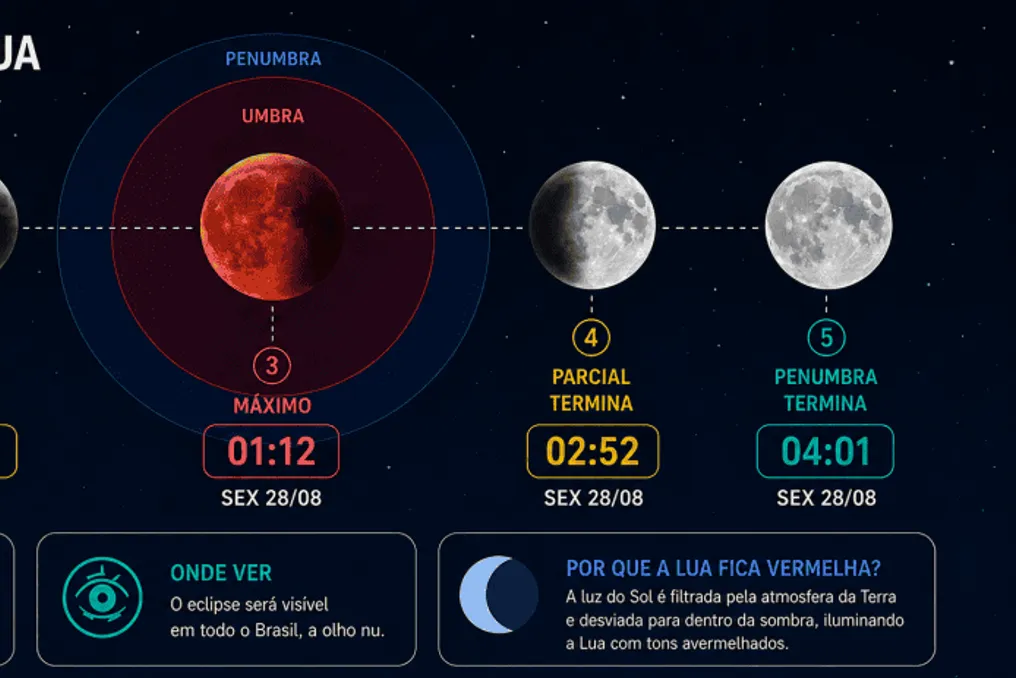
The eclipse will begin discreetly at 10:23 PM on Thursday, when the Moon enters the penumbra, the outermost area of Earth's shadow, without major perceptible changes in the celestial body's brightness. The partial phase, characterized by the darker shadow beginning to cover the Moon directly, will start around 11:33 PM. The moment of maximum coverage will occur at 1:12 AM on Friday, when approximately 96% of the lunar disk is obscured. The partial phase should end around 2:52 AM, and the penumbral stage will continue until shortly after 4 AM.

Brazil is well positioned to observe the phenomenon, as the Moon will remain high in the sky for much of the early morning hours, benefiting observation in various regions. The Moon's altitude will fluctuate between 59 and 85 degrees relative to the ground. In the North, Northeast, and Central-West areas, the satellite will be nearly at the zenith of the celestial dome during the early morning. In the Southeast and South states, the practical suggestion is to look north to locate the bright and high satellite.

Cause of Reddish Coloration

The reddish coloration is a result of the Earth's atmosphere. During the eclipse, sunlight must pass through the planet's gaseous layer before reaching the Moon. Along this path, the atmosphere scatters blue light more easily, allowing orange and red tones to penetrate the air and reach the shadowed region of the Moon. Some of this light is then reflected by the lunar surface and returns toward Earth. This same principle explains why the sky takes on reddish tones during sunrise and sunset. However, the appearance of the Moon can change depending on the presence of dust, smoke, pollution, and atmospheric humidity, making a clear sky ideal for a clearer view and to enhance the coppery tones of the satellite.

Popular