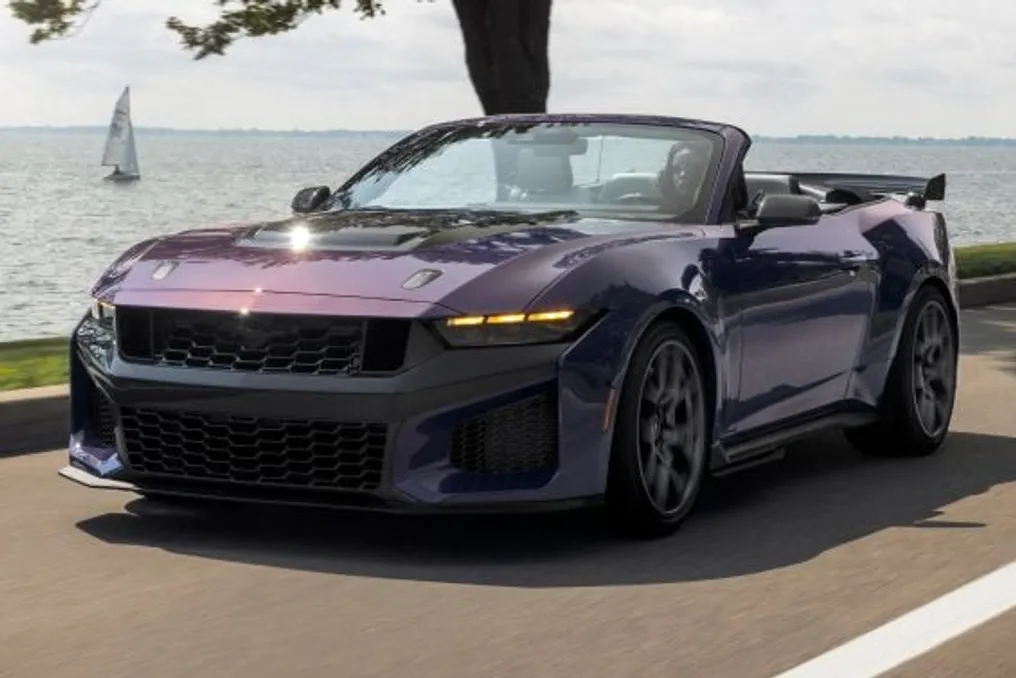
There are distinct approaches to experiencing a Mustang. One occurs on closed circuits, where there is space, safety, and the presence of an experienced driver. The author had this opportunity with the Mustang GT Performance, in an experience organized by Ford, as ordinary drivers would hardly be able to take full advantage of that vehicle's potential.
The author, who describes himself as a technology portal journalist and a good driver, dedicated time to the new Mustang Dark Horse. His main question was how it would be to drive a Mustang with 507 hp in the context of São Paulo traffic, and he realized this could be the biggest surprise of the Dark Horse.
Technical Features and Design
The Dark Horse belongs to the seventh generation of the sports car but has received several modifications focused on elevating its dynamic capability. In the Brazilian market, it uses the naturally aspirated 5-liter Coyote V8 engine, which generates 507 hp at 7,250 rpm and 567 Nm of torque at 4,900 rpm. The transmission is mandatorily a ten-speed automatic, with the option of selection via paddles on the steering wheel, maintaining rear-wheel drive.
The improvements go beyond a simple increase in power or a change of badges; the Dark Horse features a Torsen rear differential with its own cooling system, adaptive MagneRide suspension with specific calibration, robust Brembo brakes, and wider rear tires (275/40 R19 versus 255/40 R19 in the front).
Aesthetically, the car has striking features, such as darkened headlights, dark-finished 19-inch wheels, a rear spoiler, four exhaust outlets, and the exclusive version badges, maintaining the traditional horse but with a unique visual identity.
With a weight of 1,832 kg, a length of 4.82 meters, and over 2 meters in width with open mirrors, the Dark Horse demands respect due to the available power. The author observed that, using Normal mode with all electronic controls active and without abrupt accelerations, the car remained controlled during a week of use, reinforcing that he is a driver, not a racer.
Technology and Driving Dynamics
Various technological features are present, including electronic stability and traction control, forward collision warning, autonomous emergency braking, lane keeping assist, blind spot monitoring, and adaptive cruise control with Stop & Go function. The dynamic system consists of five basic driving modes—Normal, Sport, Slippery, Track, and Drag Track—in addition to customizable settings. The steering can be adjusted between Normal, Sport, and Comfort, and the suspension offers four configurations, as does the exhaust, which presents four profiles: Normal, Sport, Track, and Silent.
Even on narrow roads and in heavy traffic, the author did not feel like he was constantly fighting the vehicle. The 5.0-liter naturally aspirated V8 engine is highlighted as a special and almost anachronistic aspect, contrasting with the industry trend towards smaller and electrified engines. The power delivery of this naturally aspirated engine has its own personality, and the active exhaust complements this experience, allowing for discretion or the characteristic roar.
In São Paulo, it was common for drivers to ask the author to lower the window and listen to the sound of the engine. However, when there was space to accelerate, it became clear that maximum performance could not be exploited on common urban roads.
In Brazil, the offering is only with a ten-speed automatic transmission. Although the absence of a manual gearbox might disappoint purists, the automatic proves advantageous in traffic, eliminating an effort that would be exhausting. In situations where space opens up, the paddles behind the steering wheel allow for greater driver participation in gear changes.
An international test by Car and Driver pointed out a weakness of the automatic transmission in extreme track use, mentioning fluid temperature increase and hesitation in shifts during Lightning Lap sessions, suggesting that a manual version might be superior for repetitive exploration of limits on a circuit.
Urban Coexistence and Comfort
In the city, the logic of use is inverted. The adaptive MagneRide suspension surprised positively, providing firmness without transmitting excessive discomfort on normal streets. Despite this, the car remains a sportscar with 19-inch wheels, and imperfections such as potholes and speed bumps require attention.
A relevant technology for the Brazilian urban environment is the Pothole Mitigation system, which detects impacts indicative of potholes and adjusts the damper response to minimize wheel movement and impact on the vehicle. This illustrates how the Dark Horse blends traditional mechanics (naturally aspirated V8 and rear-wheel drive) with discreet electronic processing.
The car's dimensions (4.82m in length, 2.71m wheelbase, and 2.08m in width with open mirrors) are notable. While this is not a problem on wide avenues, the size of the coupe is felt on narrow neighborhood streets, requiring additional corrections in maneuvers, even with the help of a rearview camera and rear sensors.
Another point raised is the limitation of interior space. Although technically capable of accommodating four passengers, the rear seat is restricted. With the author seated at his height (1.85m), it was not possible to sit comfortably in the back, even for the shortest people.
In terms of front comfort, the seats are upholstered in leather and suede, offering electric adjustments, heating, and ventilation. The steering wheel is also covered in leather and suede and heated. The vehicle has seven airbags (two front, two front side, two curtain, and one for the passenger knee).
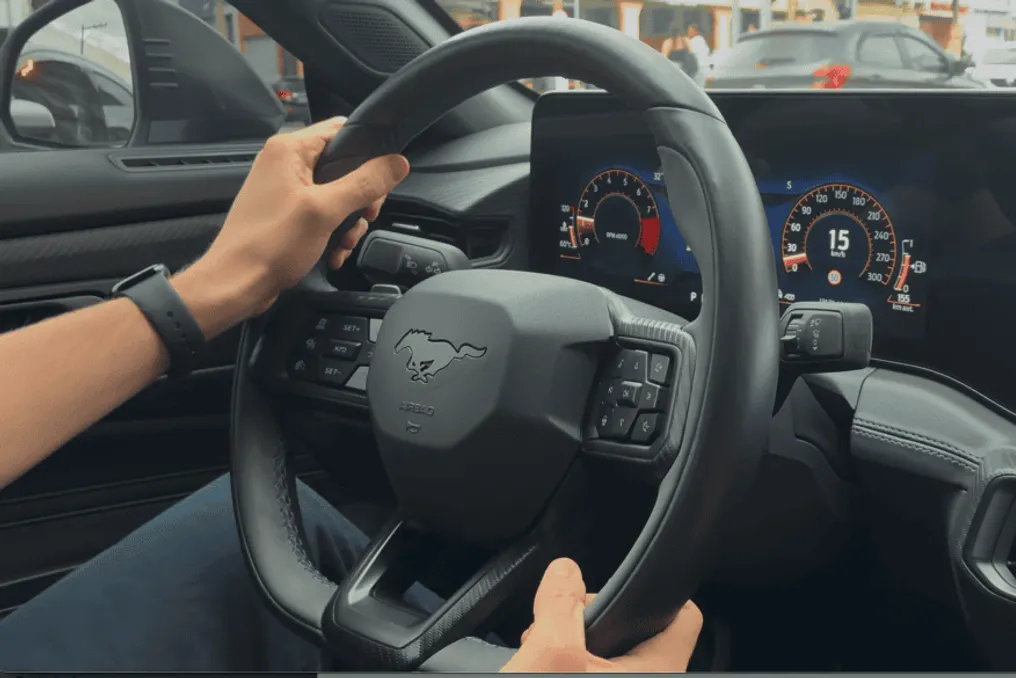
Internally, there is a major modernization: the 12.4-inch digital dashboard and the 13.2-inch multimedia center create a vast digital area. The system includes wireless Android Auto and Apple CarPlay, integrated GPS, and Bang & Olufsen audio with 11 speakers and a subwoofer. This fusion between the classic architecture of the naturally aspirated V8 and the modern interface is seen as a matter of opinion.
The center console houses the Drift Brake, a high-performance electronic parking brake intended for drifting maneuvers in appropriate locations. Additionally, there is the Line Lock, which allows locking the front brakes while the rear wheels spin, useful for warming up tires before launches.