A significant transformation is taking place in the villages of Bihar, where the focus is shifting from simply seeking employment to establishing one's own business. The JEEViKA initiative by the Bihar government has played a crucial role in these changes and is now receiving a new direction.
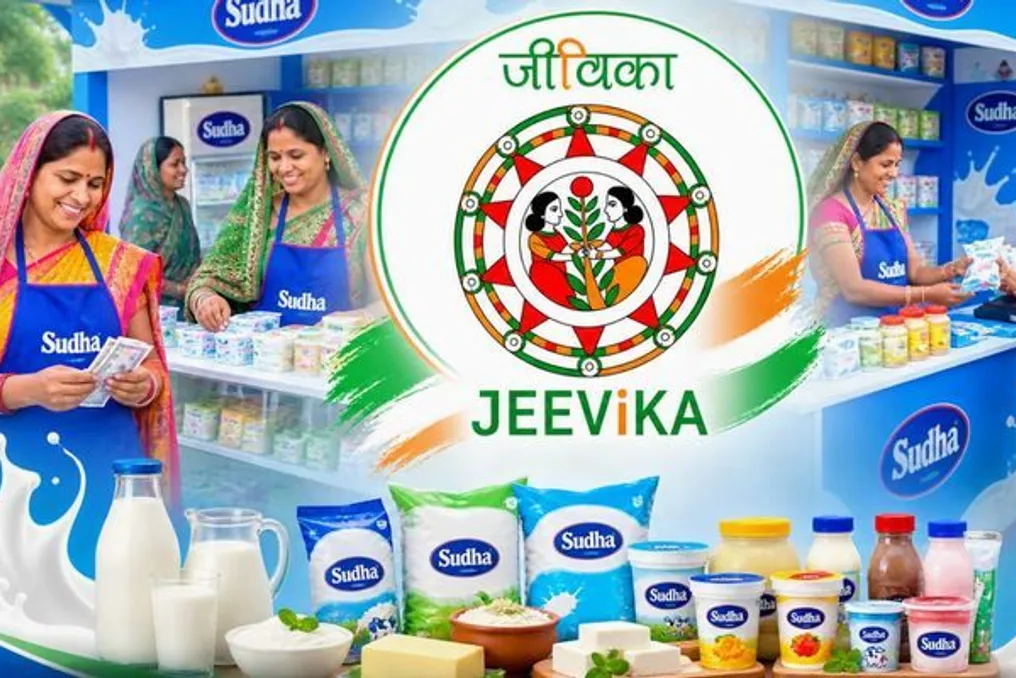
Under this program, the Bihar Rural Livelihoods Promotion Society (BRLPS) issued an order on July 6, 2026. According to this document, JEEViKA Sudha Bikri Kendras (Sudha booths) will be opened in all 8053 gram panchayats of Bihar. This initiative will be implemented in collaboration between JEEViKA and COMFED under the Mukhyamantri Mahila Rojgar Yojana scheme.
A key feature of this program is that rural women are provided not only with financial support but also with assistance in connecting to a ready-made business model. They will receive their own sales point, be able to work with Sudha Dairy products, undergo business training, and the entire process will rely on the extensive network of women created by JEEViKA.
The scale of this scheme is vast: opening retail centers in all 8053 gram panchayats of Bihar will allow the Sudha Dairy network to reach the villages, providing local residents with more convenient access to milk and dairy products. Simultaneously, it opens up a new source of income for women.
As per the BRLPS order, the selected beneficiary woman will be provided with financial assistance of up to ₹60,000 to launch a Sudha booth. These funds can be used for necessary needs such as deep freezers, display refrigerators, branding, shop setup, and inventory purchase. Furthermore, a beneficiary contribution of ₹15,000 has been set, which she must contribute herself. Thus, up to ₹75,000 can be spent on one center.
In this model, personal activity is considered alongside government support. Therefore, it is viewed not merely as a welfare scheme but as a small business creation project. The woman will manage the store, handle sales, and interact with customers, and as the business grows, she will have the opportunity to increase her income.
Application and selection procedures have also been defined. Interested and eligible women must apply through a special online portal, after which documents and criteria compliance will be verified. To ensure transparency in the selection process, the possibility of conducting an online lottery has been provided.
JEEViKA was launched in 2006 as a pilot project supported by the World Bank. At that time, poverty and economic isolation were widespread in Bihar, and female participation was extremely low. In 2011, the program was expanded to the entire state under the National Rural Livelihoods Mission (NRLM), now known as DAY-NRLM. Today, the scheme covers every block and every panchayat in Bihar.
A unique aspect of the scheme is its three-tiered structure: Self-Help Groups (SHGs) comprise 10 to 15 women. These SHGs then form Village Organizations (VOs), and VOs, in turn, form Cluster Level Federations (CLFs).
Himanshu Sharma (IAS), the Director of BRLPS who also serves as the CEO and State Director of the mission, took charge of managing and developing this scheme. In an interview with YourStory's founder and CEO, Shraddha Sharma, he explained how this scheme, which began as an experiment, has transformed into a rural economy worth over 1 lakh crore, all under the guidance of women.
Himanshu Sharma stated: 'This is not a welfare scheme. It is a story of self-respect, economic power, and collective trust.'
The most unique feature of JEEViKA is its trust-based lending system. No paperwork, collateral, or credit rating is required here. Himanshu Sharma continued: 'A woman comes to the SHG meeting, asks for ₹5,000, and receives immediate approval because the group trusts her. This is a model independent of subsidies or corporate social responsibility. Women do not ask for handouts. They ask for loans and repay them with pride. This is real empowerment.'
According to BRLPS data, the loan repayment rate is 99.5%, indicating that women view these funds not as government money but as their group's capital, which they protect.
The main strength of JEEViKA lies in its grassroots network of women. Over nearly two decades, this initiative has become the primary means by which rural women of Bihar connect with economic activity through Self-Help Groups (SHGs).
According to the 74th quarterly progress report of BRLPS, 11,88,130 SHGs were formed in Bihar by March 2026. Women from 1.40 crore families joined these groups. Additionally, a network of 73,515 VOs and 1,684 CLFs has been built.
These figures demonstrate that JEEViKA possesses not only an administrative structure to implement the scheme but also a large and active network of women in the villages. This network itself can become a powerful advantage when implementing an initiative like JEEViKA Sudha Bikri Kendra. The organization also focuses on promoting enterprises led by rural women and socially oriented businesses. In other words, the story of new Sudha booths does not start from scratch; it is backed by a socio-economic structure built up over many years.
Among the programs aimed at women by the Bihar government, the role of JEEViKA has steadily increased. Through the Mukhyamantri Mahila Rojgar Yojana, the emphasis was placed on providing women with financial aid to start their own employment. Now, JEEViKA Sudha Bikri Kendra connects this same idea with a structured business opportunity.
The significance of this initiative increases because women are not just receiving capital to start their ventures; they are getting a chance to work with a well-known brand. Sudha Dairy has long been a familiar name to the residents of Bihar. COMFED, the Milk Cooperatives Federation of Bihar State, began working to develop the dairy industry in Bihar in 1983 under the Operation Flood program. Today, it sells milk and numerous dairy products under the Sudha brand.
According to COMFED, its network includes a large number of cooperative institutions and retail points for collecting and selling milk. This can create a solid supply and market foundation for JEEViKA Sudha Bikri Kendra. COMFED's plans also include expanding its marketing network in both rural and urban areas.
Thus, the combination of JEEViKA and COMFED is like a merger of the strengths of two institutions: on one side, an extensive network of women, and on the other, a strong dairy brand and supply system.
The true strength of JEEViKA Sudha Bikri Kendra may manifest in its local impact. When Sudha Dairy products, such as milk, paneer, ghee, ice cream, and others, become easily accessible in a panchayat, customers gain local convenience. At the same time, the woman managing the store gains the opportunity for daily sales and regular income.
This means that the retail centers will not be limited to small shops selling only milk. With proper placement, good sales, and competent management, these centers can become small but important retail hubs for dairy products in the rural market.
The official BRLPS order also mentions prioritizing locations with good traffic and easy product sales. Training sessions for beneficiaries and monitoring of the center's operation after its establishment have also been organized.
This is what makes the initiative special: the government is not just talking about opening shops; it is also paving the way for providing women with the infrastructure, training, and institutional support necessary to run a business.
Ultimately, JEEViKA Sudha Bikri Kendra should not be viewed solely through the lens of 8053 new shops. It is an example of promoting entrepreneurship among women in the rural areas of Bihar. The extensive network of women created by JEEViKA over the years is now being linked to new business opportunities, which is an important step in this direction. The Sudha brand from COMFED anchors this model to the market, while the Bihar government's Mukhyamantri Mahila Rojgar Yojana scheme provides the economic base, and the gram panchayat network delivers it directly to the people.
If this model succeeds, a new picture may emerge in the villages of Bihar: on one hand, a woman responsible for the home and family, and on the other, the same woman owning her own shop and having the ability to grow her income. These are precisely the changes that the women-focused schemes of the Bihar government aim to implement. JEEViKA Sudha Bikri Kendra could be the next major step in connecting these changes with daily village life.