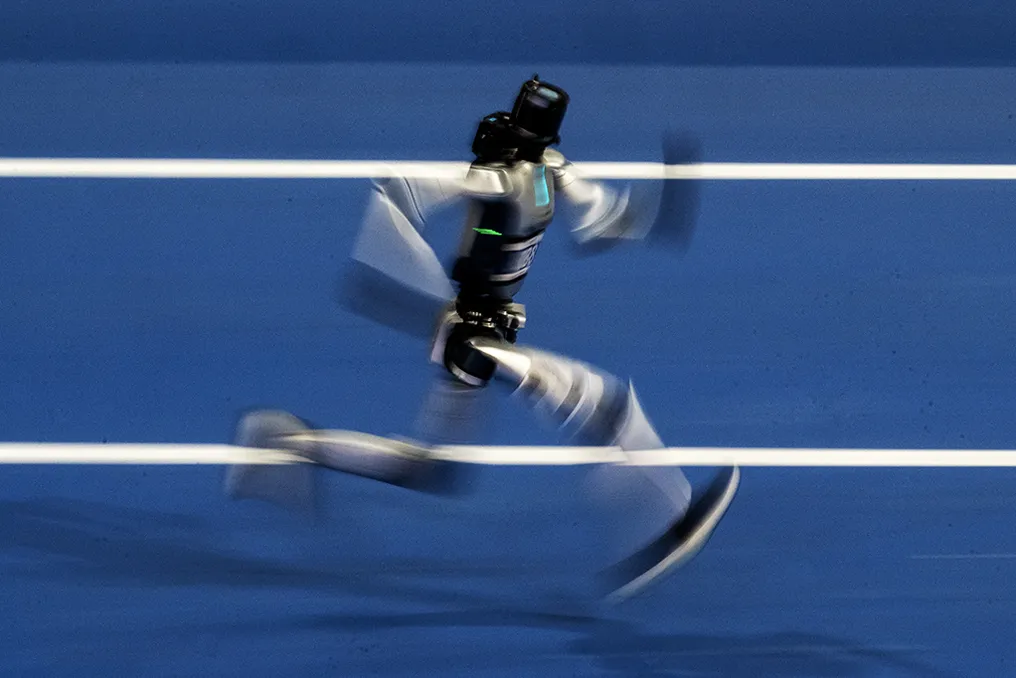
At the opening of the World Humanoid Robot Championship on the 22nd, the Chinese machine Tiangong Ultra set a world record by running the distance in 9.39 seconds. This result surpassed the performance of athlete Usain Bolt, who finished in 9.58 seconds in 2009.
However, immediately after crossing the finish line, Tiangong Ultra collided with a soft wall at high speed, fell, and required human assistance to be extracted. Three days later, in the semi-finals of the competition, the robot improved its result again, completing the run in just 8.86 seconds. This time, organizers decided to prevent a hard impact by installing an inflatable barrier at the finish line, but the attempt was unsuccessful: after the robot fell, a small fire broke out in its chassis.
Last year, Tiangong won with a slower time—21.50 seconds. Among the achievements of this X-Humanoid brand machine was also the final of the first humanoid robot half-marathon in Beijing last year, where the time was at the amateur class level—2 hours and 40 minutes.
Innovations of this kind, capable of participating in high-level competitions, are classified as humanoid robots because they are designed to imitate human physical structure and behavior.
China is a leader in the production of such technologies. Consequently, the World Humanoid Robot Championship has been held in Beijing since 2025 and demonstrates China's highest level of development in robotics. Germany, Japan, and the United States, which are significant players in the market, also participated in the competition.
The event in Beijing was not limited to the 100-meter sprint. The contests also included football, tennis, humanoid boxing, martial arts, and weightlifting, among others. Organizers accounted for 51 sports, 1000 competitions, two thousand robots, and 666 different teams for team events.
In some disciplines, human records were also broken. According to Reuters, four records have been set so far: Tiangong's record in the 100 meters, a record in the 400 meters with a time of 38.15 seconds, a record in the 1500-meter distance of 2 minutes and 21 seconds, and the latest record in jumping, achieved by the robot at a height of 2.88 meters.
For now, plans only foresee the use of humanoid robots for demonstration purposes, presentations, and research. Nevertheless, experts believe that integrating such technologies into the real world so they become available for purchase and use will take a significant amount of time.