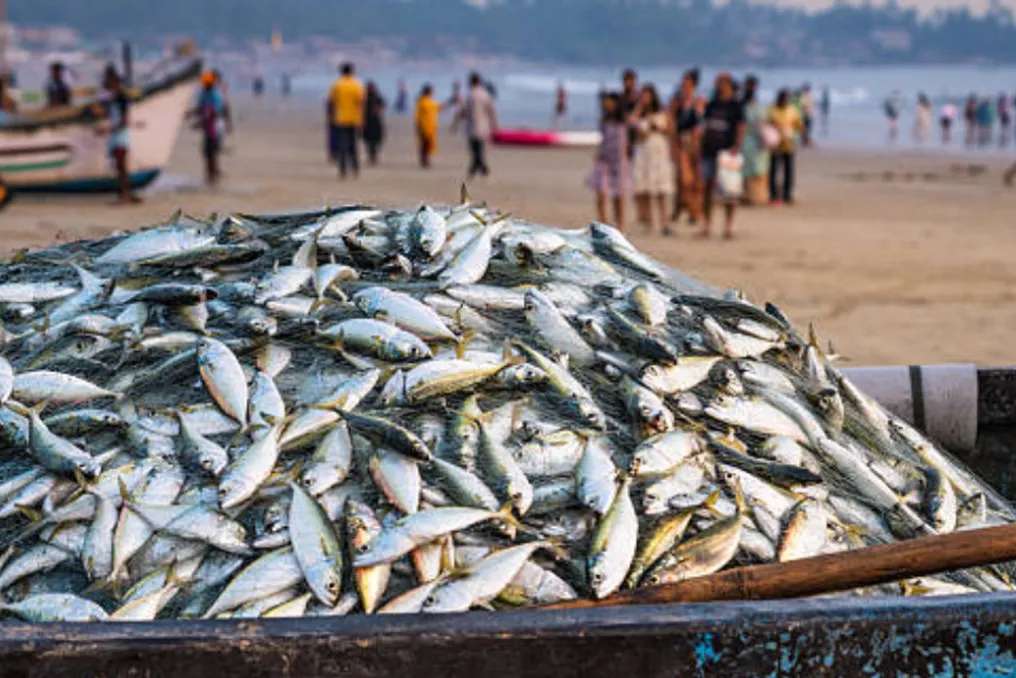
Fish inhabiting India demonstrate an astonishing ability to survive in diverse conditions—from freshwater ponds in Bengal to the saline waters of the Arabian Sea. For instance, Rohu fish can live for long periods in a pond consuming little water, whereas Bangda (Indian mackerel) in the Arabian Sea faces the opposite problem: it must prevent excessive water loss from its body while surrounded by saltwater.
Although these differences might appear purely culinary on a market stall—one becoming part of Bengali jhol, the other crispy fried fish or coconut curry—a biological divide lies beneath their scales, which has determined their methods of breathing, feeding, and survival.
The differences begin with the chemical composition of the surrounding water. Indian fish inhabit a vast spectrum of habitats: from Himalayan rivers and marshy plains to mangrove swamps, estuaries, coastal lagoons, and nearly 7,500 kilometers of coastline. For fish living in these environments, survival depends on constantly maintaining the correct balance of salt and water within the body.
Body versus Water
The central principle here is osmosis—the movement of water across a semipermeable membrane in response to a difference in solute concentration. Freshwater species, such as Rohu, Catla, Mrigal, Mahishir, or Magur, have internal fluids that are saltier than the surrounding water. Consequently, water naturally tends to enter their bodies.
This creates a problem because cells require a stable concentration of salts and other dissolved substances to function. If too much water enters, this balance is disrupted. Freshwater fish have evolved an effective mechanism to combat this: they typically drink very little water, instead producing large amounts of diluted urine to expel excess water, while specialized cells in the gills actively absorb necessary salts from the environment.
Marine bony fish face the opposite situation. Seawater is generally saltier than the internal fluids of species like Indian mackerel, sardines, and many pomfrets. Therefore, water tends to leave their bodies. To compensate for this, many marine fish drink seawater, absorb the necessary moisture, and use their gills and kidneys to excrete excess salts.
Simply put, freshwater fish try not to become too diluted, while marine fish strive not to lose too much water. This continuous balancing process is called osmoregulation.
Fish Living Between Two Worlds
The situation becomes more complex where rivers meet the sea. The estuaries, mangroves, inland waters, and coastal lagoons of India contain brackish water, a mixture of fresh and saltwater. Salinity can fluctuate depending on tides, rainfall, and river runoff.
Among these transitional zones are the Chilika Lagoon in Odisha, Pulicat Lake along the Andhra Pradesh–Tamil Nadu coast, the inland waters of Kerala, and the Sundarbans. Fish inhabiting these areas must cope with water chemistry that can change over time. Some species are capable of regulating their salt and water balance by moving between different salinity levels.
Hilsa, or Ilish, is one of the most well-known examples in India. This anadromous fish spends most of its life in marine or coastal water before migrating to freshwater rivers to spawn. During this journey, its body must adapt to changing salinity.
These ecosystems are also vital for fishing and aquaculture, supporting species such as pearlspot, Asian seabass, and milkfish. Their health matters not only for biodiversity but also for communities whose livelihoods depend on the shifting boundary between river and sea.
From Rohu to Bangda
Scientific characteristics change from one habitat to another, but the perception of fish in India is also reflected in the language. In Bengal and parts of the Ganges-Brahmaputra basin, Rohu is widely known as Rui, and Catla is often called Catla. Mrigal, Bata, Pabda, Magur, and Koi are also familiar names in eastern markets, although local names may vary regionally and linguistically.
In the west, Indian mackerel is known as Bangda in Maharashtra. Pomfret is often called Paplet in some parts of Konkan and Gujarat, and sardines are known as Mati or Chala in certain regions of Kerala.
Freshwater aquaculture has made species like Rohu and Catla widely available in inland markets. In recent years, efforts to restore local fish populations in rivers have aimed to link nature conservation with the welfare of fishing communities.
Meanwhile, marine fishing remains closely tied to the rhythms of the sea. Seasonal fishing restrictions during monsoons—set for different periods depending on the coast and fishing zone—can affect the availability of wild-caught marine fish while providing time for reproduction and stock replenishment.
What Ends Up on the Plate
The biological differences between freshwater and marine fish do not automatically determine how the fish should be cooked. Often, factors such as fat content, texture, bone structure, size, and freshness are more important. Nevertheless, these differences can often be noticed when serving a dish.
Freshwater species, such as Rohu, Catla, and Tilapia, generally have a mild flavor. Their meat is well-suited for curries, stews, and other preparations where moisture helps the fish from drying out. Marine species, such as Surmai, Bangda, and Pomfret, often have denser flesh, while fatty fish like mackerel and sardines contain more fat. These qualities make many of them suitable for frying, grilling, baking, and coastal curries.
Their nutritional profiles can also differ depending on the species. Fish in general is a good source of protein and Vitamin B12. Fatty fish, such as mackerel and sardines, are particularly known for their omega-3 fatty acid content. Some marine fish can also provide nutrients like iodine and selenium. However, the exact nutritional value depends on the species, portion size, and method of preparation.
Price and availability follow a similar pattern. Freshwater farmed fish is often more consistently available in inland markets, while the price of marine fish can fluctuate depending on the season, catch, species, and distance from the coast. Rohu might be an everyday purchase in one city, while Surmai might be a premium fish in another.
The Underwater Food Chain
What fish eat also depends on their species and ecological role. Rohu primarily feeds on phytoplankton, algae, and plant matter, while other freshwater fish may feed on insects, plankton, crustaceans, or smaller fish. In the sea, small pelagic fish like sardines and mackerel mainly feed on plankton, and larger predators may consume small fish, squid, and crustaceans.
Together, they form links in a much larger food web. Small fish transfer energy from microscopic organisms to larger animals. Predatory fish help regulate prey populations. Fish also transport nutrients throughout ecosystems and connect habitats that might seem separate on a map.
This is why the story of fish does not end at the market. Freshwater species depend on functioning rivers, wetlands, floodplains, and ponds. Marine species require healthy coastal and oceanic ecosystems. Fish that migrate through estuaries and lagoons depend on the connection between fresh and saltwater.
Thus, for Rohu in a Bengal pond and Bangda migrating in the Arabian Sea, survival begins with the same question asked in two very different ways: how do I retain the necessary amount of water in my body? The answer is written in their gills, kidneys, and cells—and ultimately, in how they end up on our plates.