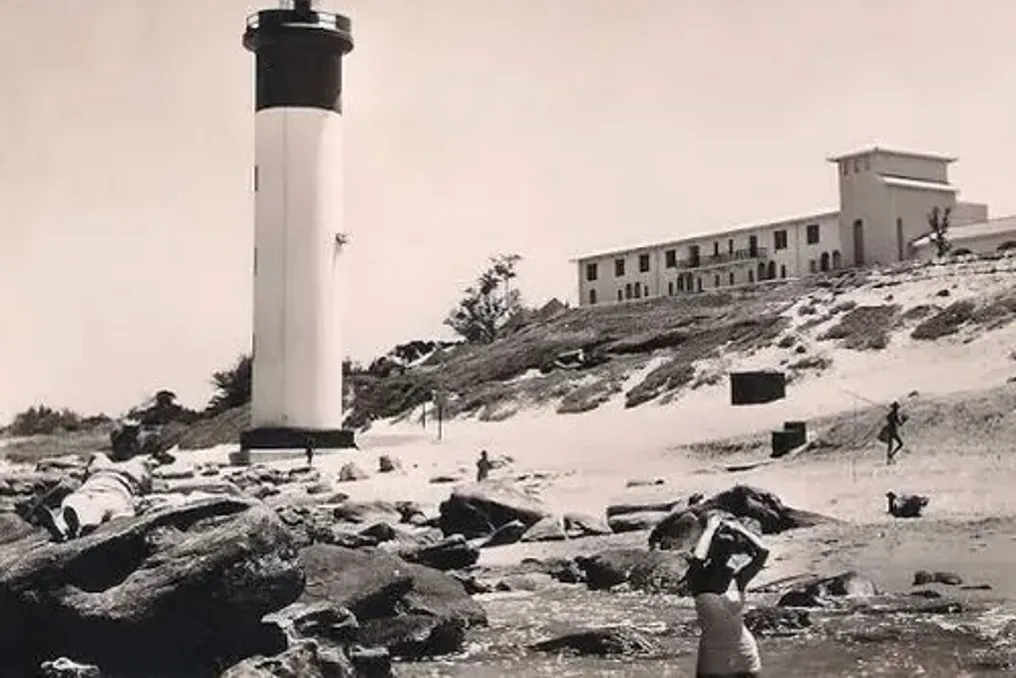
The Umhlanga Lighthouse, which can be considered a relative of the Bluff Lighthouse, was first lit on November 25, 1954, and is owned by the Transnet National Ports Authority (TNPA).
The Umhlanga Rocks tower was built shortly after the opening of the neighboring Cooper Lighthouse in Durban, which was commissioned on July 31, 1953, and has an identical structure. Construction took only four days and 19 hours, with commissioning occurring a year later. Initially, it was planned to place the lighthouse on the grounds of the Oyster Box Hotel, but heavy rain in January 1953, which caused erosion near the proposed site, led to the selection of the current location due to the presence of a rocky foundation.
This 21-meter cylindrical concrete lighthouse is located on the Umhlanga promenade, approximately 15 kilometers from the center of Durban. It is painted white with a red top and a red lantern house. The rotating lens system generates three flashes every 20 seconds.
Today, the lighthouse is automated, and TNPA carries out scheduled maintenance. It is one of two lighthouses built to replace the Bluff Lighthouse; the other is the Cooper Lighthouse. The old Bluff Lighthouse was demolished in 1941 to make way for heavy artillery during World War II.
The tower is equipped with an electric light of 600,000 CD power, installed on a rotating system, visible at a distance of 24 nautical miles. There is also a fixed red light that allows ships outside the port of Durban to monitor their position; the visibility of this red light indicates that the vessel is too close to the shore.
Currently, the lighthouse serves as a prominent landmark on the Umhlanga promenade, although the village that once surrounded it has significantly expanded. The Oyster Box Hotel, visible in the background of both images, has become one of the country's most iconic hotels.
Other lighthouses in KwaZulu-Natal include Cape Vidal (1985), Cooper (1953), Durnford (1916), Green Point (1905), Iphafa (1980), Jesser Point (1986), North Sand Bluff (1968), Port Shepstone (1906), Richards Bay (original concrete structure 1979, current structure 2018), and Tugela (1972).