The largest energy consumers in America face the problem of slow electricity procurement. While a new factory or data center can be built in 6–12 months, securing the electricity to run it is a completely different matter. Obtaining approval from the local utility company often takes three to five years.
Even if the utility grants consent, obtaining permits for new power lines and power plants will likely be required. Due to this, Voya Energy has raised $35 million to commercialize generators that run on metal instead of diesel or gas fuel.
The California-based startup announced the closing of a $35 million Series A round on August 26, 2026. The round was led by the fund Energy Impact Partners. Other major investors included John Doerr, Founders Fund, Mantis VC, StepStone, Overmatch, Seven Stars, and other venture capital firms.
The Voya system combines patented aluminum-based metal fuel with an electrochemical generator. This fuel is produced from low-grade aluminum scrap granules. Inside the generator, a special electrolyte initiates a reaction that converts aluminum directly into electricity. There is no combustion, turbine, or emissions at the point of use.
This system can be compared to a fuel cell, but solid aluminum is used instead of hydrogen. First, the aluminum scrap is granulated for safe storage and transport. Then, the granules are loaded into the fuel module. In the generator, the aluminum reacts in a metal-air cell with a patented electrolyte. This electrochemical reaction quietly produces electricity without burning anything. Since there is no combustion, there are also no local air emissions. The system is also designed for quiet operation to solve noise issues around large backup power stations.
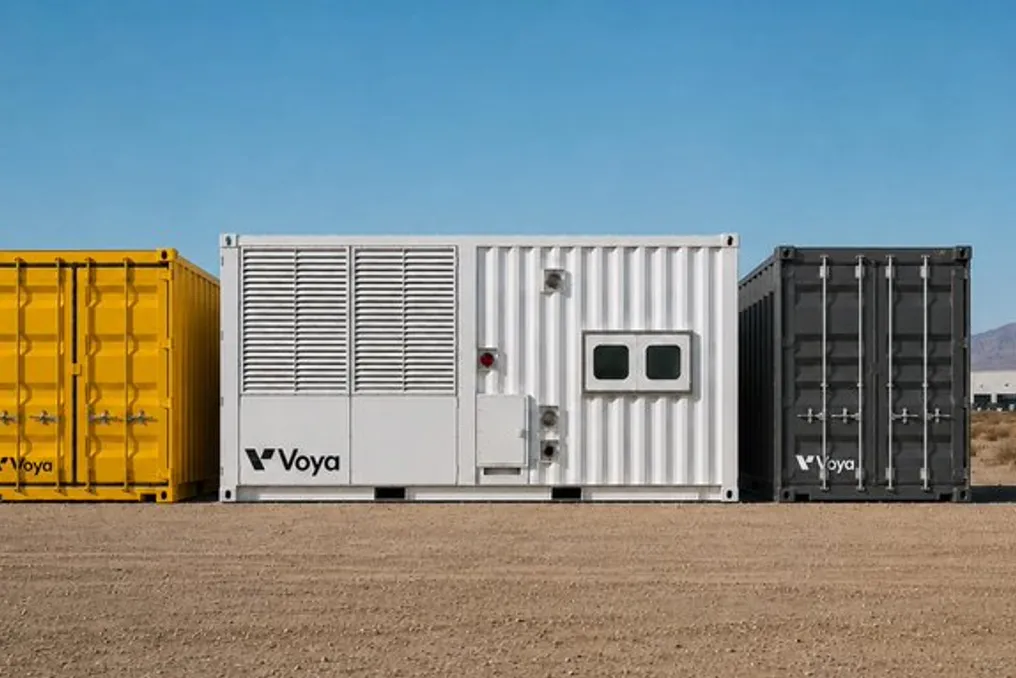
The design is modular and containerized. One standard 20-foot container provides up to 2 MW of power. A separate 10-foot module contains about 100 MWh of fuel. According to Voya, on a per-acre basis, it can provide approximately 100 MW of generation and 10 GWh of stored energy. This is about four times more compact than a park of diesel generators and one hundred times more compact than industrial-scale battery banks.
The company's plans include several stages: in 2027, pilot projects for data centers, industrial production, emergency response, and energy infrastructure, initially targeting large users awaiting grid connection. In 2028, a scaling phase is planned, which will be funded by new capital to increase production capacity. In the long term, the goal is to position aluminum fuel as a replacement for fossil fuels for critical autonomous power supply.
The founding team possesses deep experience in batteries. Richard Van previously created the startup Cuberg, which dealt with lithium-metal batteries and was acquired by Northvolt. Co-founders Matt Horton and Steven Kay have experience working at Rivian, Proterra, and Apple's Special Projects Group.
For manufacturers and industrial enterprises, this means energy independence. They can continue operating during outages or grid restrictions without relying on diesel fuel. From a climate goals perspective, this is a way to decarbonize backup and critical power supply. Since the fuel is derived from aluminum scrap, it also creates an application for metal scrap.
Investors view metal fuel as a practical transitional option. As John Doerr and Energy Impact Partners note, it is about converting an abundant, globally traded material into electricity where needed, without the process of combustion.