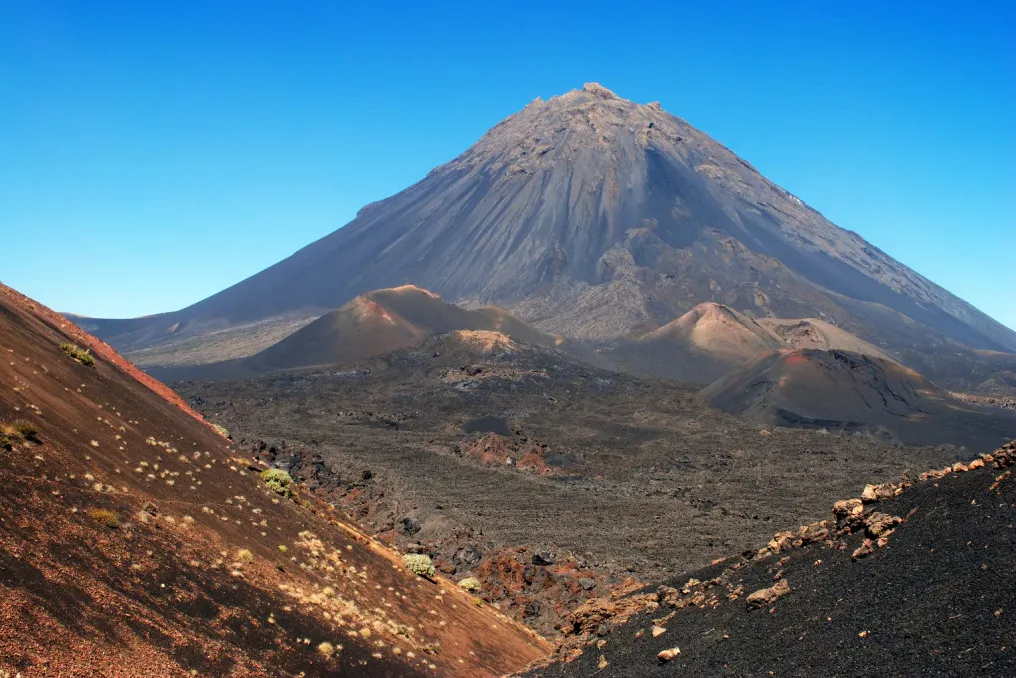
Fogo Island in Cabo Verde was formed by fire, offering visitors a contrast between the colorful buildings of São Filipe and the black lava fields near Pico do Fogo. The island's capital serves as an ideal starting point for exploring the terrain, where daily life is closely linked to growing coffee, grapes, and volcanic landscapes.
During a stay of over 48 hours, one can explore the historic streets of São Filipe and then travel to Cha das Caldeiras, from where a view opens up of Pico do Fogo, standing at 2829 meters above the island's vast volcanic landscape.
The historic center of São Filipe is included in the UNESCO World Heritage Tentative List of Cabo Verde, lending this place a special charm that distinguishes it from the country's more famous beach destinations.
Exploring the Historic Center
The journey should best begin in the historic center of São Filipe, where the characteristic buildings immediately give an idea of Fogo's past. These two-story structures are one of the defining features of the city, and their bright facades, balconies, and architectural details reflect the wealth accumulated by local landowners and traders during the island's agricultural and trade periods.
The municipal tour 'São Filipe Smart Tour' starts at Praça das Bandeiras and guides visitors through the historic center, providing information about the buildings, streets, and monuments along the way.
It is recommended not to rush, as this is not a city to be rushed through on a list of attractions. One should pay attention to the wooden balconies and painted facades, and also walk through the quiet streets where everyday life continues among these historic buildings.
During a morning walk, it is worth visiting Fortim Carlota. This small fort has changed several functions since its construction in the 17th century: it served as a customs post, hospital, police station, and prison. Its changing role reflects the history of São Filipe itself.
The fort also reminds us that Fogo's history is not limited to beautiful architecture. The prosperity of São Filipe was closely linked to colonial trade, agriculture, and the exploitation of slaves—an important part of the island's history that should be recognized alongside its architectural heritage.
Transitioning to Agriculture
During the day, attention should shift from buildings to agricultural activities. Fogo coffee is mainly grown in the greener, higher areas around Mosteiros, where coffee has been cultivated for about two centuries. The island's volcanic terrain and diverse microclimates have contributed to creating conditions for its unique production.
A trip to the Mosteiros area, where coffee is grown, adds another aspect to the history of São Filipe. Instead of just having a cup of Café do Fogo in the city, one can see the landscapes that produce it.
If the visit coincides with the harvest season, usually from February to April, the experience becomes even more interesting thanks to the annual Fogo Coffee Festival in Mosteiros, which celebrates local coffee, food, music, and culture.
Returning to São Filipe, one can purchase local coffee for home. Fogo coffee is available roasted, ground, or whole bean, and local businesses offer traditional methods of preparation and roasting.
Before sunset, one should return to São Filipe and head to the city's elevated viewpoints. The city is situated above the Atlantic Ocean, offering a different view of Fogo's geography. Dark volcanic shores are visible below, and behind, the island rises to its mountain center.
For a stop by the sea, Praia de Fonte Bila is suitable, offering an impressive stretch of black volcanic sand near São Filipe, although Fogo is better suited for exploration than for traditional beach relaxation.
As the sun sets, the city's colorful buildings take on warmer hues, and the Atlantic serves as a backdrop.
Exploring the Interior Landscape
Leaving São Filipe and moving into the interior of the island, the landscape undergoes sharp changes. The dry coastal area gives way to higher slopes before opening up to a vast volcanic caldera. Cha das Caldeiras is located within this crater landscape and forms the heart of Fogo National Park. The park covers about 8469 hectares across three municipalities of the island and includes the caldera, Pico do Fogo, and the Monte Velha forest area.
Here, Fogo ceases to feel like a typical tourist destination. Black lava stretches across the landscape, small farms appear on the volcanic slopes, and green vines sprout from the dark soil. The scale of the crater makes settlements look tiny beneath the mountain.
It is not necessary to climb Pico do Fogo to feel the volcano's presence. Local walks around Cha das Caldeiras demonstrate how people have adapted to living and farming in this unusual environment. Agriculture and livestock remain important for communities in the park alongside the growing tourism economy.
Attention should be paid to the vineyards, fruit trees, and traditional agricultural plots growing on the volcanic landscape. Among the products associated with Fogo are wine, coffee, goat cheese, and fruits.
The contrast between the black lava and the green vines is one of the most memorable details of the island: age-old agricultural traditions under an active volcano coexist with black lava and green vines.
Make lunch part of the experience, not just a break between activities. Try local products if available, including goat cheese, fruits, corn-based dishes, and Fogo wine. The island's gastronomic traditions are closely linked to what can be grown in the various microclimates.
Wine production on Fogo has centuries of history, and the vineyards around Cha das Caldeiras have become one of the most striking examples of adapting agriculture to a volcanic environment.
View of Pico do Fogo
Next comes the defining view of the trip. Pico do Fogo, reaching an altitude of 2829 meters, is the highest point in Cabo Verde and the country's only active volcano. The mountain dramatically rises from Cha das Caldeiras, its dark volcanic cone contrasting with the agricultural landscape below.
Experienced tourists can organize a tour to the summit. This is not a simple walk: the ascent requires a significant gain in altitude and crossing loose volcanic ground, so it should be done with an accredited local guide and appropriate equipment.
For others, it is enough to explore the lower slopes and the caldera. One can walk among the lava formations, visit farming communities, and photograph the mountain without attempting to reach the summit.
The last eruption of the volcano in 2014 drastically changed parts of the caldera. Today, the landscape serves as a powerful reminder that Fogo is named not just after fire—it is an island that continues to be shaped by it.
The return to São Filipe takes place in the afternoon or evening, depending on the planned activities. The descent offers another change of scenery: from the high, cool volcanic center to the warmer coastal capital. Fogo has distinct climatic differences depending on altitude, and at night in Cha das Caldeiras, it can be surprisingly cold compared to São Filipe.
Conclude your 48 hours with dinner in the city and a final cup of Fogo coffee. This is a fitting end to a short trip that took you from Portuguese-influenced architecture to agricultural landscapes, and then to the crater of an active volcano.
São Filipe plays a key role because it provides the human scale to Fogo. The volcano may be the main attraction of the island, but it is the city that explains how people lived in this landscape. Its buildings tell stories of wealth, trade, and colonial history. Its markets and restaurants connect visitors to the modern life of the island. Coffee and wine show what can grow in volcanic soil. And the trip to Cha das Caldeiras demonstrates how communities continue to farm under one of Cabo Verde's most powerful natural landmarks.
Fogo is best viewed as a destination for travelers who enjoy hiking, nature, gastronomy, and culture, rather than as a resort. Accommodation is mostly managed by locals, and the island's tourist infrastructure is less developed than in Cabo Verde's major beach destinations.
If you plan to climb Pico do Fogo, arrange a local guide in advance and check current conditions before setting out. The weather can change drastically with altitude, and temperatures in Cha das Caldeiras can be significantly lower than on the coast. It is recommended to bring sturdy walking shoes, sun protection, water, and warm clothing for the highlands. Most importantly—leave time in your itinerary to slow down. São Filipe rewards wandering, and the volcanic center of Fogo deserves more than a quick photo from a car window.