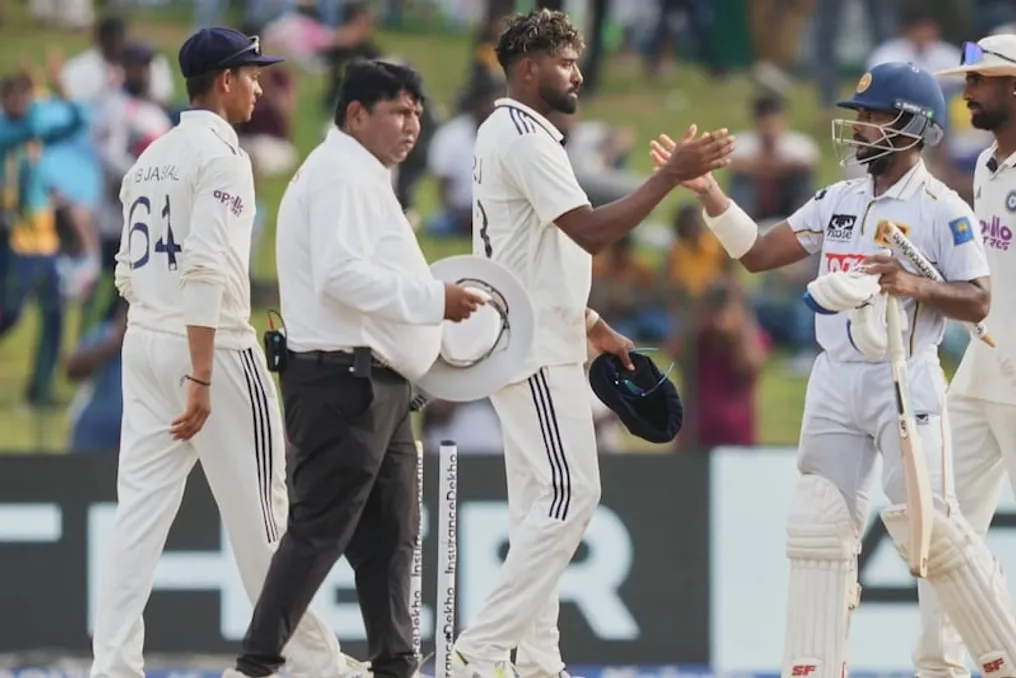
In Colombo, the Sri Lankan team managed to create such an impenetrable defense against India that the Indian bowlers could not break it even on the last day of the match. Thanks to the relentless performance of Sonal Dinusha, who scored 133 invaluable runs, Sri Lanka avoided defeat in the second and final Test, drawing the match. Despite the pitch weariness on the fifth day, the pressure of the follow-on, and muscle spasms, Dinusha maintained his resilience throughout the day. Ultimately, India failed to secure four wickets, and the game ended in a draw.
Nevertheless, India won the two-match series by 1-0. In the first Test, held in Galle, the Indian side won convincingly by 165 runs. However, the persistence shown by the hosts at the SSC ground in Colombo was an equally significant achievement for the home team.
Dinusha spent 420 minutes at the crease, facing 264 balls, and scored 133 runs without getting out. This marked his third century in this series and his fourth score over 50 in four matches. Across the two Tests, he played a total of 722 balls and batted for 1139 minutes.
At just 25 years old, Dinusha set another unique record: he became the third player in the world to score two centuries in a single match following a follow-on in Test matches. Before him, this feat was achieved by Vijay Hazare from India and Andy Flower from Zimbabwe.
Thanks to this tenacious batting, Sri Lanka declared the second innings with a total of 429/9, giving them a lead of 216 runs. After this, both teams shook hands, and the match was declared a draw.
Sri Lanka started the fifth day with a score of 229/6, holding only a slight advantage of 16 runs. It seemed that the Indian bowlers would soon finish the game. However, Dinusha and Kesara Nuwanda completely changed the course of events. They added 112 runs off 246 balls, during which Sri Lanka went through the first session without losing any wicket. Dinusha completed his century after 196 balls, starting to undermine India's hopes of victory.
After the lunch break, the first successful attack against India was made by Manav Sutara, who dismissed Nuwanda, and Dhruv Jurel caught a fine catch in the slap zone. Then Dinusha added 25 runs along with Prabath Jayasuriya. Ravindra Jadeja dismissed Jayasuriya when Jurel caught him in the second slap zone.
Even the lower-order batsmen did not give up hope. India thought victory was close, but Dinusha gained another determined partner—Lahiru Kumar. Together they added 47 runs off 170 balls for the eighth wicket. Kumar troubled the Indian bowlers, scoring 12 runs off 90 balls. Jadeja eventually sent Kumar to the pavilion, but Asitha Fernando did not leave Dinusha. Dinusha finished the game without being dismissed with 133 runs, securing safety for Sri Lanka.
There is an inherent appeal to Dinusha's game. His preferred shots are drives and pulls, but on the fifth day, what he needed was not beauty, but sheer defense. He skillfully neutralized the spin bowlers by retreating backward and held his ground well behind the ball against fast bowlers.
India also put in effort. They tried to keep Dinusha away from the strike using short and leg-side deliveries to bring the lower-order batsmen onto the field against spinners. This tactic worked partially, but Nuwanda and Kumar showed restraint instead of playing aggressively.
Fast bowler Mohammed Siraj could not inject the necessary sharpness into Dinusha's game. Captain Shubman Gill also did not exert much influence at the moment when the game slipped away from India. At one point, he even headed to the dressing room to consult with the coaching staff.
However, by that time, Dinusha and the lower-order batsmen of Sri Lanka managed to slow down the onslaught of the Indian bowling.
A positive aspect for India was that it was conducting its first Test series on foreign soil after defeating West Indies in July 2023. This was also its first win in a foreign Test series under Shubman Gill's captaincy. But the fifth day in Colombo left many questions for the Indian team, despite the series win. The inability to quickly dismiss four wickets in the lower order will cost them dearly. Although the team can cite the pitch weakness on the fifth day and the need to bowl across two innings, internally the team realizes that the old weakness in Test cricket—the inability to quickly get rid of lower-order batsmen—is still not fully addressed.
For Sri Lanka, this draw felt like a victory, and its hero was Sonal Dinusha, who created a wall between India and defeat that no Indian bowler could ultimately overcome.