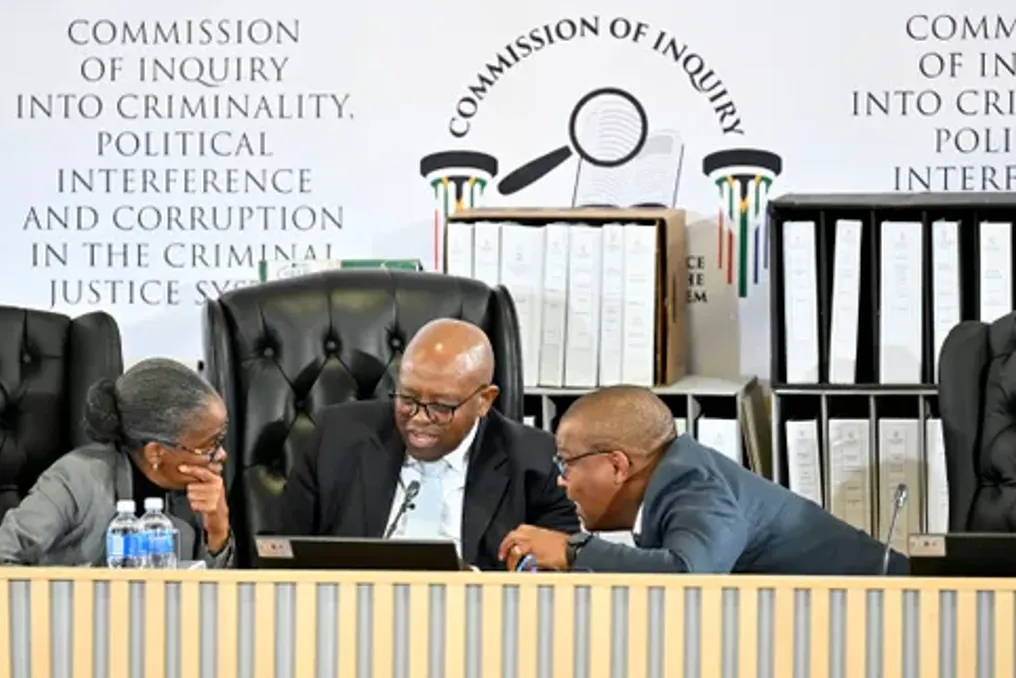
As South Africa grapples with high expenditures and the complex legacy of the Zondo Commission, the ongoing Madlanga Commission demonstrates a noticeable contrast in effectiveness. While the Zondo investigation was often criticized as a costly and protracted process, some critics viewed it more as a political spectacle than a mechanism for justice.
The Madlanga Commission was established last year in response to allegations made by KwaZulu-Natal police commissioner Lieutenant General Nlanhla Mkhwanazi regarding corruption, political interference, and crime within the criminal justice system.
The Madlanga Commission is frequently compared to the Zondo Commission (2018–2022), which investigated state capture. In September 2025, the Department of Justice and Constitutional Development assessed the preliminary costs of the Madlanga Commission at 147.8 million rand. The National Treasury subsequently included this allocation in the Revised Estimates of National Expenditure for 2025.
Chad Thomas, CEO of IRS Forensic Investigations, stated that criminal syndicates had unrestricted access to the highest echelons of national security over the past 26 years. He emphasized the need to fund the Madlanga Commission, noting that 'Zondo cost us a billion rand, there were many extensions, and we must spend whatever is necessary.'
Thomas also mentioned the Special Investigating Unit, which investigates cases sanctioned by presidential proclamations, including allegations related to public procurement. He explained that funds received by this body go into the treasury and are returned to the departments from which they were stolen.
He also referred to the Criminal Asset Recovery Account (CARA), where money and assets seized through confiscation and warrants are deposited. This account has a dual purpose: ensuring restorative justice and financial compensation for victims of crime, as well as returning money laundered by criminals to support anti-crime initiatives.
In Thomas's view, who analyzes the Zondo and Madlanga commissions, everyone considered Zondo a 'silver bullet.' He explained that one reason the Investigative Directorate became the IDAC (Investigative Directorate for Anti-Corruption) and what the public expected it to be primarily responsible for was investigating the findings of Zondo and turning them into evidence-based prosecutions.
At the time of the interview, 99 people were under investigation in cases related to Zondo. Trials had been held, adjournments granted, and settlements reached.
Thomas noted a key difference between the two commissions: 'The difference, however, between Zondo and Madlanga is that everything happened after Zondo; what we are seeing with Madlanga is what is happening in parallel.'
He added that the president received two reports, and a third is in preparation. Thomas reported that these reports prompted immediate action to ensure accountability.
Political analyst Bhekis Mngomezulu from Nelson Mandela University expressed skepticism towards the commissions because they lack prosecutorial powers. Their role is to gather evidence, compile reports, and develop recommendations, but implementing these recommendations is another matter entirely.
Mngomezulu questioned the value of the billion-rand Zondo Commission, contrasting its outcomes with the work of the Madlanga Commission. He found the latter more effective, pointing out that its real-time results—such as arrests and resignations—demonstrate a serious commitment to the principle of accountability.
Furthermore, he noted that unlike the relaxed atmosphere of the Zondo Commission, the Madlanga Commission strictly pursues the truth, demanding full cooperation from witnesses. He credited Mkhwanazi with this progress, whose decisive media briefing played a key role.
Professor Sifo Sipe, a political analyst, compared the two investigations, describing the Zondo Commission as a biased political tool marred by Zondo's refusal to recuse himself and reliance on rumors. Conversely, Sipe acknowledges that the Madlanga Commission is restoring public trust through a rigorous, evidence-based approach that prioritizes factual investigation over the political spectacle of its predecessor. He believes the Zondo Commission is difficult to take seriously, and the money spent cannot be justified.