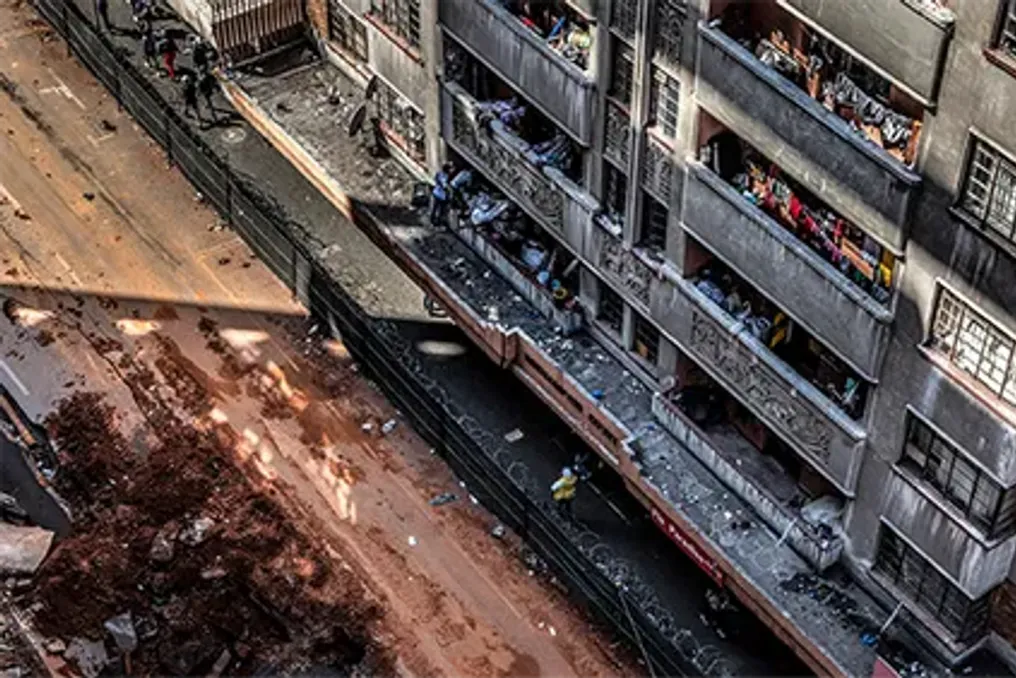
The Johannesburg municipality is facing a growing problem of unpaid bills, which have reached nearly 72 billion rand, intensifying pressure on service delivery, infrastructure maintenance, and the city's ability to pay suppliers.
The Centre for Development and Enterprise (CDE) notes that Johannesburg increasingly budgets based on the assumption that funds billed to residents and businesses will be received, despite a significant portion of this debt likely never being repaid.
According to the latest CDE publication titled 'Joburg’s Broken Budget,' the total amount of outstanding bills owed to the city has increased from approximately 15 billion rand in 2014/15 to nearly 72 billion rand in 2024/25. The CDE analysis describes a vicious cycle where unreliable services reduce customers' willingness or ability to pay, weakening the revenue needed for investment and maintenance.
CDE Executive Director Ann Bernstein emphasized that Johannesburg's financial crisis is far more serious than just an annual budget deficit. She stated that the city has become dangerously detached from financial reality: it issues invoices, records them as income, and spends, assuming receipt of funds, which is happening less and less often.
Pressure to collect debt is rising
According to CDE, the growth in clients' unpaid debt in 2024/25 is equivalent to about 1 rand for every 6 rand billed by the city for tariffs and services. This analytical center calls this a municipal 'death spiral': residents receive poor or unreliable services, payment levels drop, and the city responds by increasing tariffs for paying customers while simultaneously deferring maintenance.
Bernstein explained that when residents face deteriorating services, they become less willing or able to pay. In response, the city increases rates and tariffs for those who do pay, forcing more customers into difficulty with payments or to seek ways to reduce consumption of municipal services. This further weakens revenue, leads to deferred maintenance, and a renewed decline in service quality.
The worsening situation is reflected in Johannesburg's audit opinion: it dropped from 'unqualified' in 2023/24 to 'qualified' in 2024/25. The South African Auditor-General also pointed to serious financial management issues across all major cities in the country, noting that no metropolis received an unqualified audit in 2024/25.
For Johannesburg, it is important to distinguish positions: some individual financial statements of the city received a qualified audit opinion in 2024/25, while the consolidated group of the City of Johannesburg received an unqualified opinion.
Additional strain is created by debts owed to suppliers. CDE reports that Johannesburg's unpaid debts to suppliers exceeded 28 billion rand by June 2025, compared to 12 billion rand a decade ago. Bernstein noted that this means Johannesburg is forced to make suppliers finance their operations, which is not a sustainable funding model.
Furthermore, employee costs have risen from 8.6 billion rand to 20.7 billion rand over the decade and now account for about 40% of funds collected from customers. Meanwhile, according to CDE, capital investments in infrastructure have sharply decreased in real terms, making it difficult to maintain and modernize aging water, electricity, and road infrastructure.
The city acknowledges service delivery problems
Johannesburg's leadership has acknowledged the scale of service delivery and city management problems. In the Integrated Development Plan for 2026/27, Executive Mayor Dada Morelo wrote that too many residents continue to experience the city 'through failures, not opportunities.'
Morelo identified aging infrastructure, governance weaknesses, service interruptions, and a 'eroding social contract' as factors requiring renewal. In her plan, she stated: 'Our task for 2026/27 is clear: to restore foundations, restore potential, and bring Johannesburg back to the forefront.'
The plan includes the city's commitment to reducing water outages, improving electricity reliability, maintaining roads, and simplifying municipal administration for residents and businesses.
Collection, expenditure, and infrastructure
CDE points out that the contribution of electricity to municipal revenue has decreased from 34% in 2014/15 to 28% in 2024/25, and the volume of electricity bought and sold has also decreased. The center estimates power losses at approximately 30% of the power purchased by the city. The report states that households and businesses installing alternative power systems are reducing their dependence on municipal supplies, further weakening the city's revenue base.
It is also noted that unpaid water bills have been rising rapidly over the last decade, complicating the financing of water infrastructure maintenance and modernization. Bernstein stressed that the city needs revenue to maintain and upgrade its water infrastructure, but the less reliable the infrastructure becomes, the harder it is to accurately bill, consistently collect payments, and convince residents of the justification for paying for the quality of service provided.
CDE calls for more decisive action
CDE insists that Johannesburg must improve debt collection while protecting vulnerable households, controlling staff and contractor costs, increasing infrastructure investment, and reducing supplier debt. The organization believes that external financial support may eventually be necessary, but warns that any aid must be conditional on substantial financial and operational reforms.
Bernstein concluded: 'There is no solution without pain. Johannesburg does not need another budget speech full of promises of a turnaround. It needs a review.'