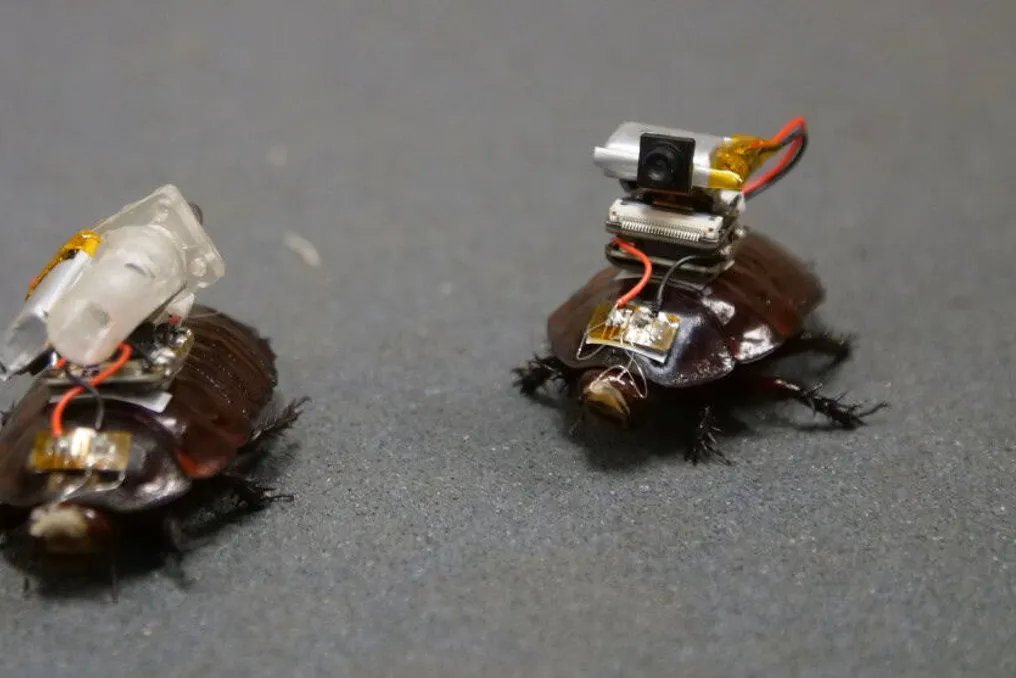
Researchers from Australia are developing insect cyborgs capable of carrying cameras and small injection systems to perform search and rescue missions after building collapses.
These insects, named 'paraborgs,' are being studied by teams from the University of Queensland and the University of New South Wales. The project's goal is to deliver aid to people whom rescuers cannot reach, while all treatment decisions remain with the humans.
The project utilizes the giant ground beetle (Macropanesthia rhinoceros), a species found in the far north of Queensland. Researchers have installed lightweight electronic components, cameras, and remotely controlled self-injection systems on it.
The insect must not only find a path but also get close enough to the target to ensure a stable position for administering an injection. Initial tests showed promising results: at a distance of up to 15 centimeters, the insects successfully administered an injection in 95% of cases. When navigation and application were considered together, the success rate was 72%.
Thang Vo-Doan, a bio-robotics engineer from the University of Queensland, noted the desire to move to the next stage: whether they can truly help after locating a victim.
Hai Nhan Le, a graduate student involved in the research, emphasized that accuracy is one of the biggest challenges, as even the slightest change in position can affect the administration of the injection.
The potential application of these insects covers areas difficult for large machinery or emergency service teams to penetrate. During the installation of electrodes and microchips, the cockroaches are anesthetized, and after the equipment is removed, they live as long as other cockroaches.
This idea has attracted the attention of the New South Wales Fire and Rescue Service. According to supervisor Tim Hassiotis, insects capable of penetrating inaccessible areas could expand the capabilities of teams.
Hassiotis stated: 'If insect cyborgs can safely enter places we cannot reach, find victims, and ultimately help provide emergency assistance, they could become another valuable tool in future urban search and rescue.'
Vo-Doan is already considering a more ambitious phase—using swarms of insects where different individuals perform complementary tasks. Researchers predict that such teams could appear in real emergencies within five to ten years. Until then, the main task will be to transform the results obtained during testing into a solution capable of operating with the required precision for a rescue operation.