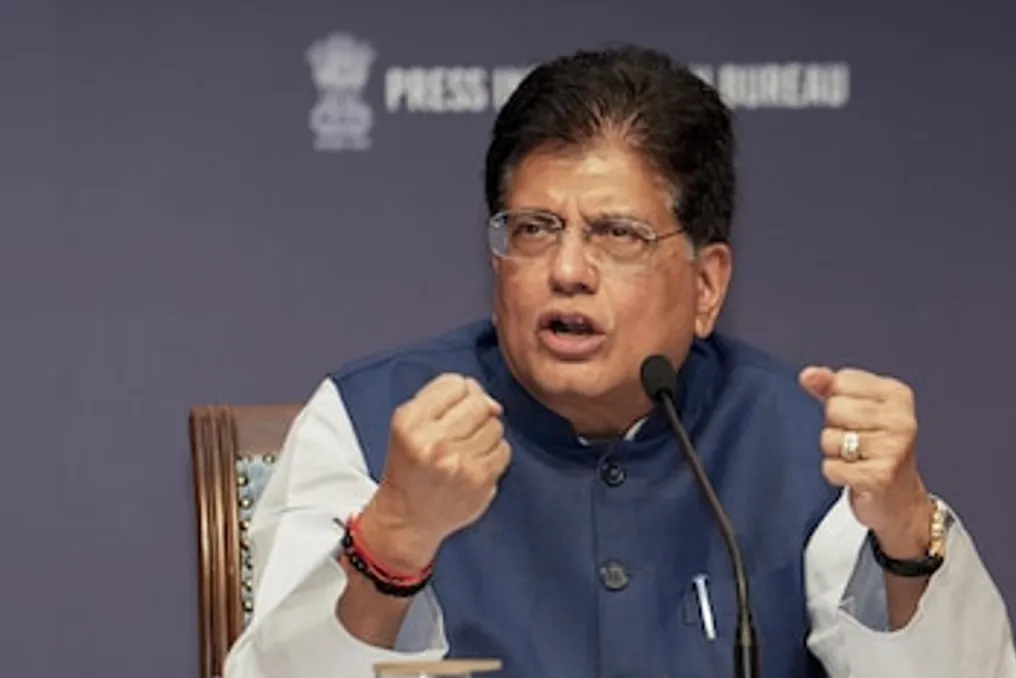
Commerce and Industry Minister Piyush Goyal announced on Thursday that improving processes and procedures, along with more effective Know Your Customer (KYC) norms and simplified procedures, will help accelerate the inflow of foreign direct investment and provide greater confidence to investors.
Goyal noted that there are very few sectors where foreign direct investment (FDI) is restricted, and the government is ready to accept proposals from the industrial sector for further refinement of the investment regime.
Responding to a question about considering a proposal to ease doing business for foreign investors, Goyal told PTI that the main focus is on processes and procedures. He emphasized the huge potential to improve these processes to facilitate a faster flow of FDI and enhance investor comfort.
He added that in cases requiring approvals from DPIIT (Department for Promotion of Industry and Internal Trade) or other government clearances, the processes can be optimized for increased speed. Furthermore, it is possible to implement faster and more efficient KYC norms, as well as conclude Mutual Recognition Agreements (MRAs) with mutually respectful regulators from other countries.
Goyal also mentioned that several new ideas emerged during meetings with the industry and stakeholders in Japan. He stressed that this will be an ongoing process where ideas will be gathered, consultations with stakeholders conducted, and improvements continued.
In most sectors, India allows 100% FDI under the automatic route, but some sensitive industries and activities have restrictions or require government approval. The government is considering a proposal to raise the threshold for FDI applications requiring approval from the Cabinet Committee on Economic Affairs from the current 500 billion to 1.5 trillion rupees to improve the country's investment climate. A proposal to ease FDI norms for investments in lower tiers of the supply chain is also being discussed to stimulate the inflow of foreign funds.
FDI into India grew by 17 percent, reaching $94.5 billion in 2025-26. When asked about Japan's proposal for India to join the 12-member Comprehensive and Progressive Agreement for Trans-Pacific Partnership (CPTPP), the minister replied that many people ask India to consider this proposal, but they have not fully thought about it yet. He clarified that India's priority is bilateral trade pacts.
Currently, India is negotiating trade agreements with countries and groups such as Israel, Chile, Peru, Canada, GCC (Gulf Cooperation Council), EAEU led by Russia, and SADC (Southern African Customs Union). Terms are being finalized with Mexico to begin trade agreement negotiations, and India is studying the possibility of expanding its existing preferential trade pact with Mercosur.
While Commerce Secretary Rajesh Agrawal is in Chile to review trade pact negotiations, progress with Peru is slow. CPTPP is a major free trade agreement among 12 countries in the Asia-Pacific region and Europe, including Japan, Australia, Canada, the United Kingdom, and New Zealand; India is not part of this group.
Goyal stated that efforts to develop manufacturing in India are aimed at complete industrialization at both the upstream and downstream stages, as well as attracting enterprises operating in or planning to enter India. Citing the paint industry as an example, he noted that since India significantly imports titanium dioxide for this product, the country is promoting its production. Similarly, in semiconductors, the focus is not only on design and testing but also on attracting the entire value chain. He concluded that their efforts are becoming deeper and are geared towards self-sufficiency.
Regarding Japan's request to waive import duties on certain semiconductor materials, the minister reported that it concerned only one product—a compound that had an exception under the trade pact with Japan. However, some unscrupulous elements exploited this exception, forcing the suspension of benefits. Currently, it is being studied how to create a framework to prevent such abuse while adhering to CEPA (Comprehensive Economic Partnership Agreement) obligations.
Concerning the Middle East crisis and India's exports, he noted that Gulf countries are now paying attention to their eastern shores and creating new routes. New pipelines and railway lines are emerging, and some individuals are creating alternative paths. Additionally, all imports and exports continue to be carried out through other routes; otherwise, there would not be such impressive results in the first four months. From April to July of the current fiscal year, exports grew by 17.04 percent to $173.78 billion, and imports increased by 19.27 percent to $292.38 billion.
As for PLI (Production Linked Incentive) schemes for new sectors, the minister stated that this is an ongoing process, and these issues are at different stages of discussion. He added that if a price deficit in India compared to other locations is convincingly proven and needs to be addressed fairly, then such sectors will be considered for PLI.