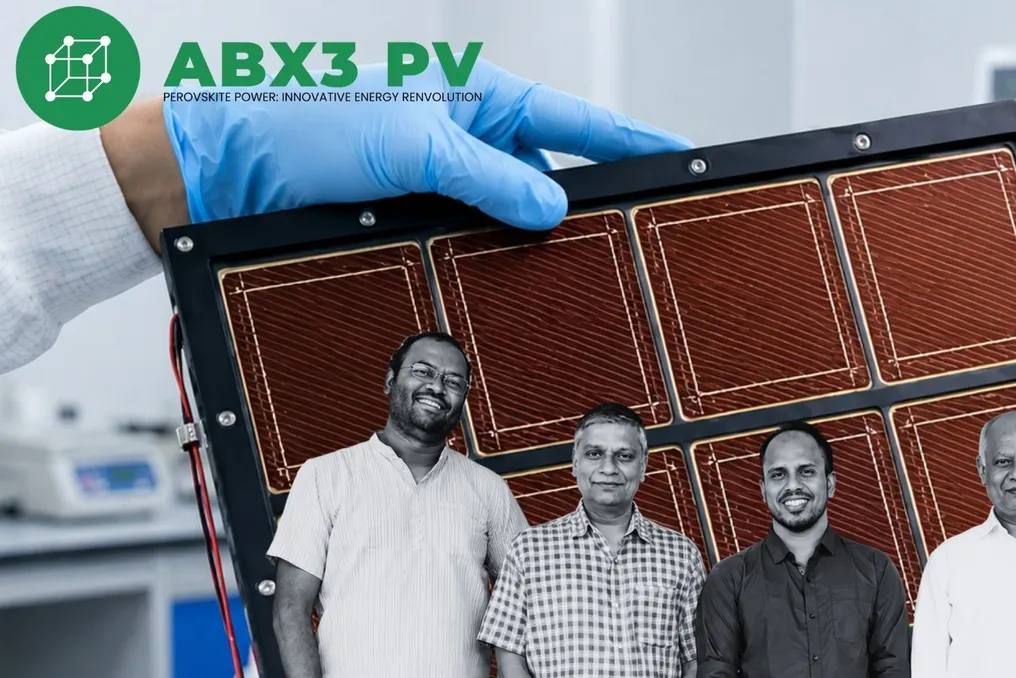
IISc company develops flexible, foldable perovskite solar panel
Read more
YourStory [india, en]
yourstory.com

IISc company develops flexible, foldable perovskite solar panel

Traditional solar panels are rigid glass sheets with silicon inside. They require high-temperature production in furnaces, so they are usually installed on roofs and fields, which necessitates the construction of a supporting structure.

Perovskite material changes these limitations. It can be deposited from a solution at low temperatures, allowing it to be applied to a flexible sheet instead of using a rigid plate. Such a flexible panel can be placed on a curved roof, vehicle, equipment, or any surface unsuitable for glass.

The company, founded in Bengaluru in 2023 and housed in the incubator of the Indian Institute of Science's Science and Innovation Development Fund, is developing perovskite solar modules in both rigid and flexible formats.

The company name is a chemical reference, as perovskites have an ABX3 crystal structure. Here, A, B, and X denote different components that can be substituted to tune the material's behavior, which is what makes this group so adaptable.

The company's main focus is on manufacturing processes rather than the materials themselves. The company positions itself as a provider of comprehensive technologies for creating perovskite modules, including processes, equipment, methods, and cell design.

This distinction is significant in the field of perovskites because while laboratory cells have repeatedly set record efficiencies, most of these achievements have not been translated into mass production due to laboratory methods not scaling up to a production line.

The company describes its approach as environmentally oriented, focusing on sustainable production and recycling. The team's expertise extends beyond photovoltaics to include work with green hydrogen, ammonia, and direct carbon capture.

The company considers applications beyond roofs and fields: building surfaces, vehicles, portable devices, and space systems where weight or shape precludes the use of standard panels.

The team includes specialists educated at institutions such as Oxford, Cambridge, UC Berkeley, Bar-Ilan, Technion, Milan, Rome, NTNU Trondheim, Helmholtz Centre Berlin, and IISc. This international composition is considered a deliberate choice for a company of this size.

According to the company, revenue for the year ending March 2025 is in the range of zero to 10 crore rupees. ABX3 PV, supported by FSID and INCeNSE at IISc Bangalore, has secured over $11 million in Letters of Intent, according to the Bharat Innovates platform. The company plans to scale up production to a 500 kW commercial line for use in drones and satellites, aligning with its deep technology roadmap.

The company's work has been noted in IISc's own newsletter. In 2024, the company demonstrated its flexible module at national technology events, including the startup exhibition at Bangalore Tech Summit and an event organized by IIT Hyderabad.

Despite this, the company does not publish data on efficiency, module specifications, clients, production timelines, or funding amounts; the latest announcements date back to 2024.
Similar stories

ART-PV develops tandem solar cells by combining silicon and perovskite to increase efficiency
Read more
yourstory.com

ART-PV develops tandem solar cells by combining silicon and perovskite to increase efficiency

Existing silicon solar cells have a physical efficiency limit because silicon absorbs only part of the solar spectrum, leaving other wavelengths unused; this imbalance limits the efficiency of a single silicon cell to approximately 29%, while commercial panels operate significantly below this figure.

To overcome this barrier, the industry is moving towards using multiple materials. A tandem cell is a structure where a second layer is placed over silicon, and this top layer is tuned to capture the wavelengths that silicon absorbs poorly. Perovskite has been chosen as the material for this top layer because its absorption can be adjusted by changing its chemical composition, and it can also be applied at a low temperature onto a finished silicon cell.

Advanced Renewable Tandem-Photovoltaics India, established in India and under the aegis of IIT Bombay, originated from the National Centre for Photovoltaic Research and Education at the same institute, where Professor Dinesh Kabra leads the work.

The company announced the creation of a two-terminal monolithic tandem cell that achieved 29.8% conversion efficiency by combining silicon and CdTe with perovskite. The term 'monolithic' means that the layers are grown as a single device, and 'two-terminal' indicates that it has the same two electrical connections as a standard panel, allowing it to be integrated into existing systems.

Although this figure was obtained in laboratory conditions, and full-sized modules always demonstrate lower results than individual cells, this architecture surpasses the capabilities of any single silicon cell.

The company's commercial advantage lies in compatibility with two major panel technologies: the top layer can be applied to both crystalline silicon, which dominates the global market, and thin-film cadmium telluride, which is the main alternative.

The project is supported by First Solar, an American manufacturer with a thin-film plant near Chennai, and Waaree, India's largest crystalline silicon manufacturer. Both companies are partners, and the company claims they hold preferential licensing rights in exchange for assistance in developing and commercializing the technology.

The Ministry of New and Renewable Energy is funding a pilot production facility worth about $10 million at IIT Bombay, intended for producing commercial tandem cells, not laboratory samples. ART-PV India has access to a cleanroom of about 5,000 square feet in the institute's research park, equipped with equipment for manufacturing, characterization, and modeling.

The institutional basis of the project is unusual: the National Centre for Photovoltaic Research and Education was established at IIT Bombay in 2010 with ministerial funding and received over 200 crore rupees in fifteen years. The company emerging from this center starts with equipment and experience that a startup would take a decade to acquire.

The support was both financial and political. During a visit to the center, Union Minister for New and Renewable Energy Pralad Joshi called this cell a national achievement and one of the most highly efficient metrics achieved in India, noting that the pilot facility is designed to keep intellectual property within the country.

However, production timelines, module-level efficiency figures, durability results, or information on the commercial product have not been published. The central unresolved issue with perovskite is its degradation under heat, moisture, and ultraviolet radiation, and the tandem cell inherits this weakness from its top layer.

Popular