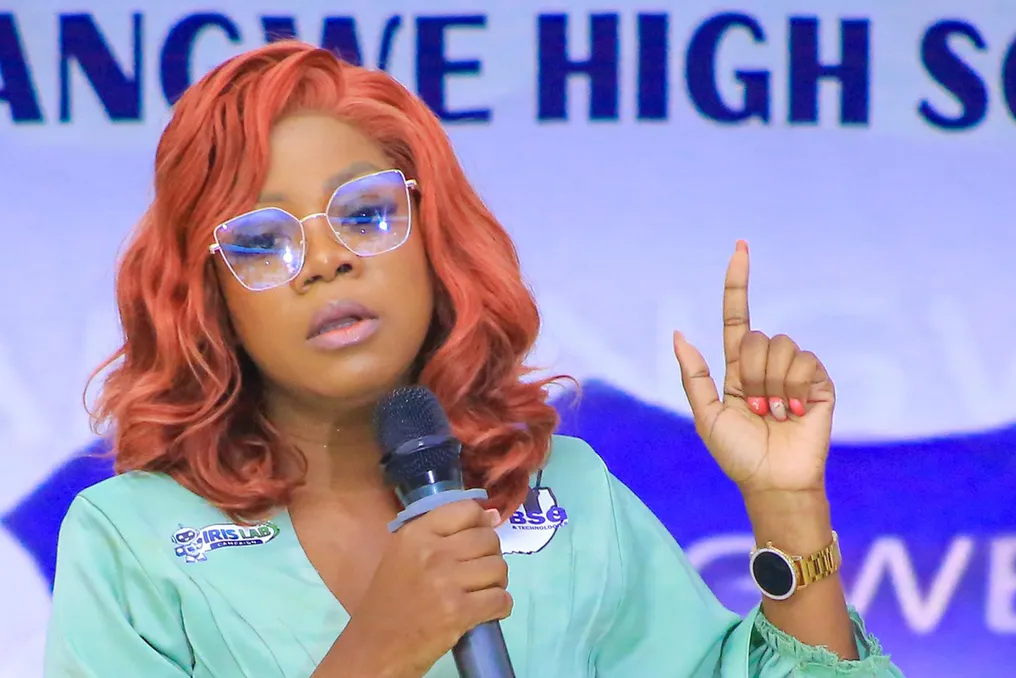
When the robot tutor Iris was launched in Durban last August, the state news service announced its intention to ensure this humanoid AI tutor would be in every classroom in South Africa by the end of October of that same year. However, eleven months after the set deadline, the robot is only used in five schools: Amangwe High, Mgidla Secondary, Ekuthuthukeni Secondary, George Caltex Primary, and Intakemazolo Secondary, all located in KwaZulu-Natal, and all operating on equipment donated by the manufacturer.
Despite public support, including recent events this month, the Department of Science, Technology and Innovation (DSTI) has provided no financial contribution to the project. A department representative, Veronica Mohapeloa, stated: 'The department has not yet allocated funding for Iris. We support innovators in South Africa and the promotion of STEM education. Regarding Iris, we did not consider funding it.'
Iris is a wheeled humanoid, roughly the height of an elementary school student, equipped with a chest screen and speakers for voice communication. Teachers interact with it via keyboard or verbally, and the robot answers student questions, explains concepts, assists with assessments, and records class reactions. It functions in all 11 official languages and aligns with the South African curriculum from early childhood development to high school graduation. The core idea is that Iris is an assistant, not a replacement for a teacher: the robot handles grading and material review while the teacher conducts the lesson.
Support, Not Investment
The science department attended the launch in August 2025, coordinated the involvement of the KwaZulu-Natal Department of Education, and returned to the event this month with the Agency for Technological Innovation. There, Deputy Minister of Science Nomalungelo Gina called Iris proof that South Africa can become a 'producer, not just a consumer of advanced technology.' This support is an endorsement, not an investment. Currently, the money behind Iris largely belongs to its founders.
Founder Bonisive 'Tando' Gumede reported that a full installation of Iris in one school costs approximately 650,000 South African Rand. This amount includes 250,000 Rand for the robot itself, plus 20 integrated laptops, a 65-inch smart TV for the teacher, as well as necessary cybersecurity and Wi-Fi services. Her company, BSG and Technologies Services, donated the systems to the five schools currently using the robot.
Scaling these figures explains the silence. Providing a robot in each of South Africa's 22,381 public schools would cost approximately 5.6 billion Rand. The complete system would cost 14.5 billion Rand. Gumede stated that DSTI 'asked to buy some Iris for some schools, but we had no commitment regarding the number of schools or timelines.' After informing the department that it was not considering funding, she added: 'No, they haven't committed to anything yet. So everything was self-funded.'
To be fair, education is a provincial competency, and the science department does not have a budget for schools. Nevertheless, this department organized the launches, and the state news service published the October deadline. The department's statement described the launch of a production facility, and other South African publications reported on this this month. Gumede made it clear to TechCentral that it is not a factory—at least not yet. Parts are manufactured at her company's facility in India and sent to Durban for assembly. 'Over the next two or three years, we will assemble this part while conducting training on local Iris production,' she said. Full local production depends on capital, which the company lacks, for 3D printing and cutting machinery. 'Only capital is holding us back. If we can get money to build a factory, we can localize even this year.'
Iris is a genuine collaboration with an Indian firm, which Gumede readily emphasized. As a physics and mathematics teacher in KwaZulu-Natal, she independently learned programming in 2022 to create a tool for analysis and grading, winning the Miss.Africa Digital contest that year. In 2023, she met with the Kerala robotics firm MakerLabs at an event at the embassy in India. 'They were thrilled to see my software system,' she recounted. 'We started building Iris together.'
The robot was publicly presented in a school in Kerala in March 2024; in Indian publications, it was noted as a MakerLabs development before Gumede brought it home and adapted it for South African languages. In India, it was rolled out school by school, advertised as Kerala's 'first AI teacher,' and then Assam's, rather than nationwide.
Does the Equipment Justify Its Price?
International data is mixed regarding whether such an expensive physical robot is worth it. A meta-analysis of 146 studies published in Frontiers in Robotics and AI in March showed that a robot working alongside a teacher provided a significant increase in knowledge, whereas a robot replacing a teacher provided no increase. Compared to a standard screen interface, the robot's advantage was minor, and the authors noted that the novelty effect 'usually fades quickly.'
Iris is positioned as a teacher's assistant, which is supported by research, and Gumede describes it as automating work that overwhelmed her in a class of 285 students. A cautionary example is Elias from Finland, a famous robot teacher who spoke 23 languages. He operated on the NAO platform from SoftBank, which the manufacturer Aldebaran sold about 37,000 robots in 70 countries before entering mass production in June 2025, leaving buyers with unsupported equipment. Today, Elias is sold as an application. Decade-long support is a real test for a school robot, and Iris carries the same long-term burden in terms of software, maintenance, and spare parts.
Jobs and a Cheaper Path
Gumede's claim about job creation is based on this long-term outlook. The forecast of over 20,000 jobs within five years covers manufacturing, delivery, installation, maintenance, and teaching using Iris. The company trains 637 people in robot assembly, of whom 300 are provided to Nkosi Mqwanazi, a traditional leader in KwaZulu-Natal, at 9,500 Rand per year each, with sponsor support. The course lasts 18 months online, followed by six months of practical training, after which selected graduates are promised jobs at Dube TradePort.
There is also a more budget-friendly option for the same classrooms. Maski, a WhatsApp AI tutor from Bytefuse and Maskew Miller Longman, reached 100,000 users in six months at a cost of 55 million Rand and without any hardware. The question left open by the department's approval is not how smart Iris is. The question is who, if anyone, will pay to put it in a classroom that cannot even afford its existing teachers.