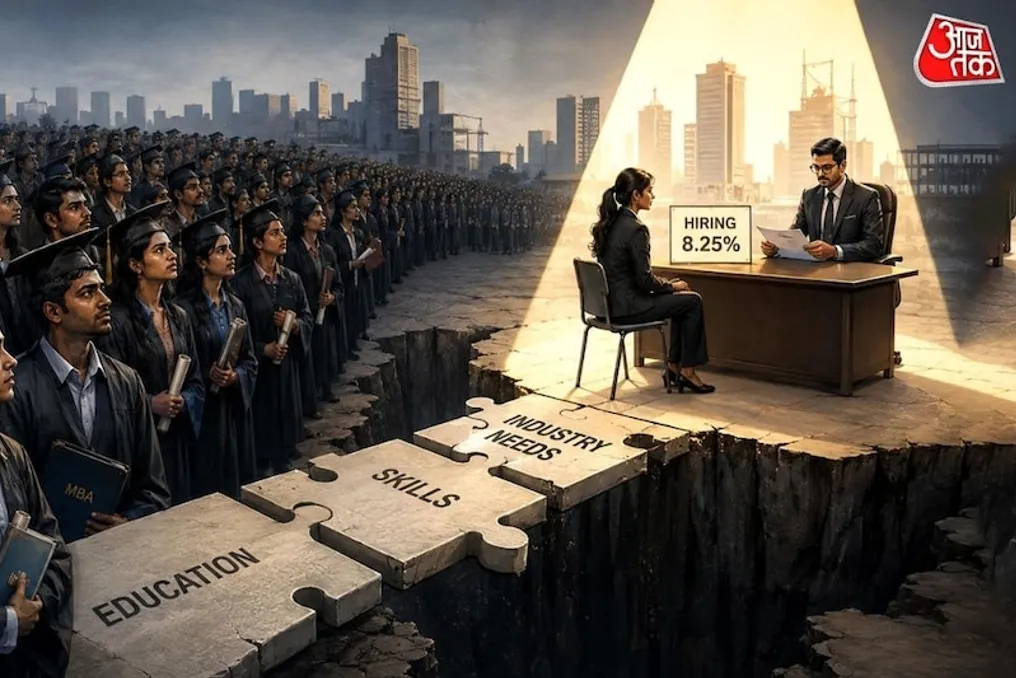
During election coverage, the opinion of the older generation is often heard that youth remain at home without work, sometimes not even looking for it, but just watching videos. However, when speaking with young people, they often point to a lack of clear employment opportunities or a mismatch between skills and market demands.
These common observations have taken a more structured form in a new report from the government's analytical center—NITI Aayog, titled 'Reimagining Skilling for Viksit Bharat@2047'. The report provides an honest analysis of India's current situation and proposes ways to transform the country into a developed nation by 2047, the centenary of independence.
Instead of simply counting the number of trained individuals, the report examines the barriers that determine whether training leads to real employment. Factors such as financial capacity, access to information, mobility, family circumstances, access to institutions, and work experience play a vital role. Thus, the document reveals a broader picture of how birth conditions can influence a person's life path.
The report pays special attention to the group of young Indians who do not fit into standard categories: they are neither in school nor college, nor are they working or undergoing training. Researchers have developed the acronym NEET for them, which stands for 'Not in Education, Employment, or Training.'
What exactly is NEET?
The new NITI Aayog report records that 87 million people fall into the NEET category among India's population. After some reports interpreted this figure as an unemployment indicator, the government issued a clarification. It specified that the 87 million estimate refers to young people who were not seeking work, whereas the unemployed constitute a separate group drawn from a different population base.
In the report, NEET youth are defined as individuals aged 15 to 29 who are not engaged in education, work, or training. A footnote indicates that about nine crore people fall into the 'NEET, excluding job search' category according to the 78th round of NSS for 2021, noting that approximately 88% of them were engaged in domestic duties.
In its clarification, the government provided further clarity, stating that this category includes young people engaged in volunteer work or home-based businesses, those performing domestic duties, those unable to work due to health conditions, those spending free time, and others.
Analysis of the NEET concept
The Covid Factor
NITI's demographic data begins with an assessment of India's total population at 145 million people. According to this data, 65.4 million, or 45.1%, are in the workforce, while 79.6 million, or 54.9%, are outside it. Among those in the workforce, 29.23 million are in agriculture, 34.24 million in non-agricultural work, and about 2 million are unemployed. The unemployed are included in the workforce because they are actively seeking work.
The population outside the workforce is divided into approximately 29.1 million students, 11.3 million children under five years old, 15.7 million people aged 59 and above, 14.7 million in other categories, and 8.7 million NEET youth.
There is another important clarification: the 8.7 million estimate is based on the 78th round of NSS for 2021, which included the Multidimensional Income Status (MIS) survey to assess various socio-economic parameters. The government later noted that the data used to calculate this figure was collected in the financial year 2020-21 during the Covid-19 pandemic, when education and employment were severely disrupted. Therefore, it was noted that this figure might reflect a deviation from the usual trajectory.
The government refers to the latest PLFS data to indicate that the percentage of NEET youth is now 'significantly lower'. The annual PLFS report for 2025 estimates that 25.0% of Indians aged 15 to 29 had no employment, education, or training by standard metrics. For the age group 15 to 24, the corresponding figure was 21.0%.
The NITI report itself warns that its demographic summary is a 'snapshot' compiled using various datasets, including PLFS, UDISE, AISHE, and NSS, with reference years from 2021 to 2024.
NITI applied a mixed approach to analyzing five groups: schoolchildren, higher education students, formal and informal non-agricultural workers, NEET youth, and women as a cross-section. Agriculture was excluded because NITI believes this sector requires a separate analytical structure.
Quantitative data was obtained based on the MSDE Skills Survey for 2024, covering about 8,000 students, and the BCG Higher Education Survey for 2023, covering about 4,000, supplemented by over 60 in-depth interviews, focus groups, and industry discussions.
NEET Youth Faces Information Problem
Among the surveyed NEET youth who did not attend or complete a training program, 43% cited lack of awareness of suitable programs as one of the three main reasons they are not in training. The corresponding share was 55% among informal workers, 52% among formal workers, 47% among women, and 36% among higher education students.
The report indicates that young people often make decisions based on exam results, family preferences, cost, or social prestige, rather than a clear understanding of what is needed to get a job. Vocational education and ITIs are often viewed as second-rate options, while online courses are perceived as unreliable.
Financial Problem
NITI describes accessibility as a 'limiting factor'. NEET youth, according to NITI, face a specific disadvantage of having no income while incurring 'opportunity costs' from previous education. Simply put, these are expenses already incurred on education that may not have led to work.
Even a free course can be expensive for low-income workers if attending it means losing wages. In other words, the opportunity costs of training can remain high even if the course itself is free.
The report demonstrates how price-sensitive the broader training market is. Over 80% of informal workers undergoing training do so for free or for less than 10,000 rupees. Among women undergoing training, 72% choose a free course or pay less than 5,000 rupees, compared to 52% of men.
NITI's recommendation for NEET youth is based on understanding this reality. It advocates for affordable or subsidized training with financial support, as well as the possibility of combining study with earning, instead of stopping work for weeks or months.
Courses Have 'Weak Outcome Orientation'
NITI reports that 82% of NEET respondents note a gap in basic knowledge in existing training programs regarding interview preparation and networking for employment. Here, the report focuses on the training system itself. NITI defines 'weak outcome orientation' as the 'main constraint' of many existing training programs. It notes that programs often prioritize enrollment and completion rather than outcomes in terms of employment, promotion, or income.
This observation becomes significant when compared to the massive scale of the skilling initiative in India. The report states that over 76.7 million people were trained from 2014 to 2015, and approximately 340 billion rupees were allocated for training-related expenses in central ministries in the fiscal year 2025-26.
Meanwhile, the government states that it is beginning to implement some recommendations from this report. It points to the Integrated Scheme in the architecture of learning (ISSA) worth 600 billion rupees, announced in the Union Budget for 2026-27, as part of efforts to strengthen alignment between education, skilling, employment, and lifelong learning.
Reasons for Feeling Disconnected
The problem identified by NITI is visible even among people who continue their studies. It notes that 80% of higher education students cite the lack of practical experience and industry contact as the main problem, while 47% of formal workers point to the lack of prior work experience and internships as the main difficulty in finding a new job.
Among undergraduate students dissatisfied with their education, 34% cited skill gaps, and 18% cited inadequate interview preparation. Among higher education students aspiring to entrepreneurship, the report shows that 61% do not know the paths to realize it.
The broader conclusion is that having a degree alone does not guarantee job readiness. The path from education to earnings must be more reliable somewhere between the classroom, the training center, and the employer.
A Sample Path
NITI uses a character named 'Meera' to illustrate how its proposed system could work. In this illustration, she receives some vocational training in school but drops out due to family circumstances and early marriage at 18, becoming NEET. She then discovers a nearby short-term beauty course, receives a skills voucher, gets a part-time job at a local salon, and eventually transitions to self-employment.
In NITI's illustration, this part-time job earns her 15,000 rupees per month before she starts taking clients independently. The point is that for someone who has dropped both education and work, returning to life is unlikely to be a single leap from NEET to permanent salaried employment. Usually, it goes through a short course, flexible work, and then to a more stable lifestyle.
Official unemployment statistics are only one indicator. It is also important whether young Indians remain connected to at least one of the three systems: education, skilling, or earnings.
NITI's findings point to something more than just a skills deficit; they also point to a privilege gap. Bridging this privilege gap may be the most crucial takeaway from NITI's roadmap to 2047. India's demographic dividend will be realized not just by counting the number of people who received training certificates. It will depend on whether young Indians, regardless of their starting circumstances, have a credible pathway from training to earnings.