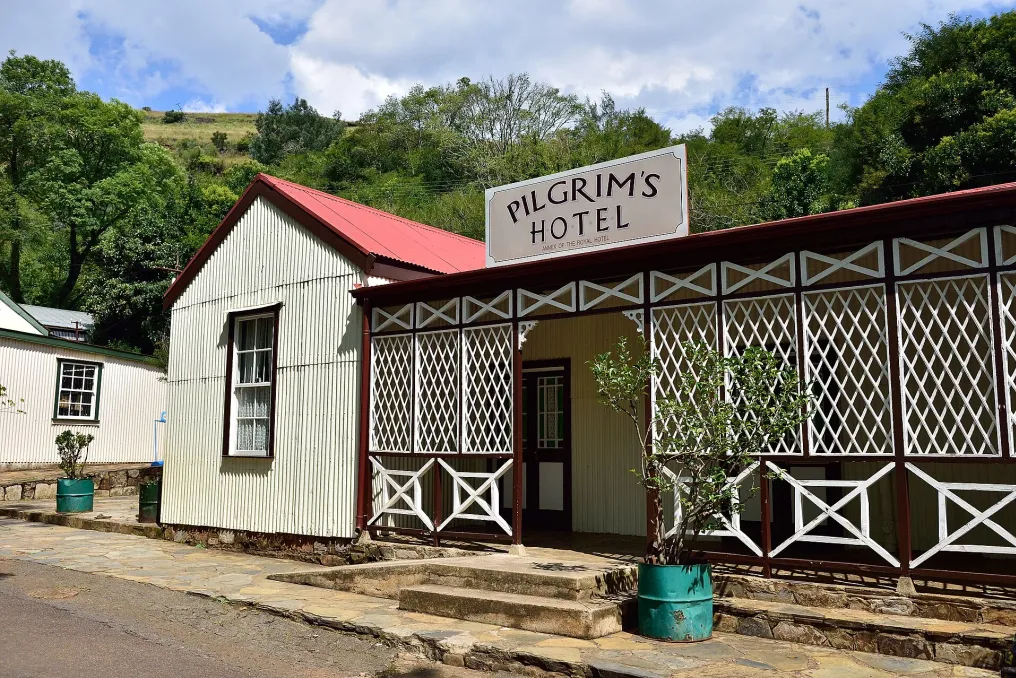
In South Africa, there are places where history is neatly presented in museums or books, but Pilgrim's Rest is different; it feels like a place that simply refused to move on. Located in the mountains of the Mpumalanga province, about 16 kilometers from Graskop on the Panorama Route, this former gold mining town looks less like a typical tourist attraction and more like a living reminder of the past.
Stone buildings with corrugated iron line quiet streets, while old mining sites are scattered among the surrounding hills. The historic structures offer insight into the time when hopeful prospectors arrived with nothing but a sieve, a pickaxe, and hope for wealth.
Today, Pilgrim's Rest is a provincial heritage site and a living museum, reminding visitors how quickly the discovery of gold could transform an isolated corner of the country. The story began in 1873 when prospector Alec 'Bicycle' Patterson left the crowded mines of Mac Mac to search for gold elsewhere. He discovered rich alluvial deposits in a stream that became known as Pilgrim's Creek.
Another prospector, William Trafford, soon followed him and registered his claim, after which the news spread. Pilgrim's Rest was declared a gold field on September 22, 1873. By the end of that same year, around 1500 prospectors were working on approximately 4000 claims in the valley and its surroundings. What was once a remote landscape suddenly filled with prospectors chasing the promise of easy riches.
Most of the early mining was alluvial, meaning gold was extracted from riverbeds, streams, and their banks. Prospectors used sieves and pans to separate the precious metal from the sediment. According to the Mpumalanga Museums, gold valued at 2 million Rand was extracted from the valley during the first seven years of alluvial mining.
This boom did not last forever. As easily accessible alluvial gold was depleted, larger mining companies took over, employing more complex methods to extract gold from deeper seams. The town transformed from a cluster of temporary camps into a more permanent settlement, attracting businesses, homes, and public buildings.
This transformation is part of what makes Pilgrim's Rest so captivating today. Here, visitors are not just looking at a recreated gold rush town; much of what remains is connected to the settlement that grew around the original deposits. Gold is only one chapter in the history of Pilgrim's Rest.
During the Anglo-Boer War, the town unexpectedly became a site for the creation of emergency currency. Since the Boer government was cut off from the official mint in Pretoria and faced shortages to fund its troops, gold from the area was used to produce the famous Rand coins. The coins were minted under harsh military conditions, and the dies were hand-cut. A study published on the material history of South African coinage showed that a total of 986 Rand coins were eventually struck.
This is a striking detail that can be discovered when exploring a place already defined by gold. The same metal that attracted thousands of hopefuls to the valley later became emergency currency during the war.
By the twentieth century, mechanized mining changed the industry again. Mining continued in the area for decades, with the last operational mine closing in the early 1970s, according to recent historical records. After that, the preserved character of the town became its main draw.
In 1986, Pilgrim's Rest was declared a National Monument, and its buildings and streets have been protected as part of its cultural heritage ever since.
The best way to experience Pilgrim's Rest is to take your time. Instead of just driving through the town, you should walk. The town is compact enough to explore on foot, and its streets, old buildings, and preserved structures allow you to feel how the settlement functioned. The architecture, especially the corrugated iron buildings, is part of the location's appeal.
The Prospector's Claim Museum is an obvious starting point. Managed by the Mpumalanga Museums, it focuses on the gold rush era and the mining activities that shaped the town. The historic cemetery adds another layer to the history, including the old legend of the so-called Robber's Tomb.
There is also the Alanglide House Museum, which provides insight into the daily life associated with the later mining period. These sites help illustrate what life looked like when the gold lodes were still active, rather than just stating that Pilgrim's Rest was once prosperous.
And, of course, the gold itself. Sifting for gold remains one of the most tangible ways to engage with the town's history. Instead of viewing an old mining tool behind glass, visitors can try the basic technique that once drew prospectors to the valley. It is a small activity, but it makes the history feel tangibly less distant.
For those who prefer sifting walks, there is the Prospector's Trail. This network of trails combines the surrounding landscapes with the history of the gold fields, following in the footsteps of those who once sought their fortune here.
Pilgrim's Rest is worth visiting on its own, but its location allows it to be easily incorporated into a longer trip through Mpumalanga. From the town, the Panorama Route opens up, leading to one of the province's most dramatic landscapes. This route includes sights such as God's Window, Three Rondavels, and the Blyde River Canyon, with waterfalls and cliff viewpoints adding to the beauty along the road.
Three Rondavels are particularly impressive. They were formed by erosion where the Blyde and Treur rivers meet, and the cylindrical rock formations mark the beginning of the Blyde River Canyon.
Contrast is part of the appeal. One moment you are walking between old mining buildings, imagining the gold rush; the next, you are looking at a vast landscape shaped over geological time. It is this combination that makes Pilgrim's Rest a worthwhile stop for travelers who want more from the Panorama Route than just a series of viewpoints. It gives context to the scenery. The mountains were not just a backdrop to the gold rush; they were the source of the gold, the landscape over which prospectors traveled, and ultimately, the reason the town became such a lasting heritage site.
Pilgrim's Rest is not polished like some major heritage sites, and that is precisely why it can be so appealing. There is something valuable about visiting a place where the past has not been completely erased and repackaged. The quiet streets, the preserved buildings, and the old mining landscape tell a story of ambition, wealth, hardship, and eventual decline. The town's history is tied not only to those who found gold but also to those who came searching and left with far less than they hoped.
This encourages approaching the town with curiosity rather than expecting a gold rush theme park. It is important to remember that heritage-based tourism matters here. Pilgrim's Rest has weathered years of pressure and calls for revival, with tourism playing a vital role in sustaining the viability of the town and its surrounding community. Recent reports have highlighted renewed efforts to revitalize the historic settlement.
Thus, by stopping for lunch, browsing shops, visiting the museum, booking local experiences, or spending the night in the area, you do more than just tick an old town off a travel list. You contribute to preserving the relevance of a place whose value now lies in its memory, not in what it produces.
Pilgrim's Rest is no longer the bustling mining settlement that attracted thousands of prospectors to Mpumalanga in the 1870s. The easy gold is gone, the mines are closed, and the fortunes once dependent on this valley have long since passed. What remains may even be more interesting.
Here are the old buildings, the traces of mining, the museums, the stories, and the landscape that still gives an idea of why people came here in the first place. Stroll slowly through its streets, look beyond the photographs and shop windows, and it becomes easier to imagine the clamor of the prospectors, the movement of people in the camps, and the extraordinary optimism that accompanied the gold discovery. Pilgrim's Rest does not need to recreate its past to be worth visiting. Its greatest charm is that enough of that past remains here to be discovered.
}} , 3. {