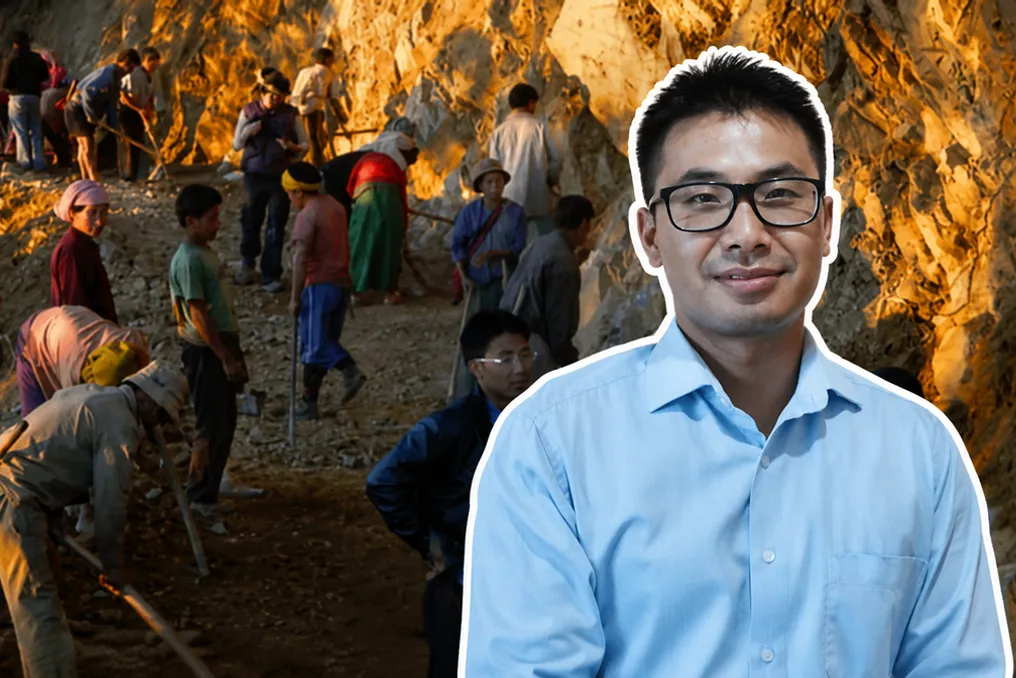
In the village of Tusem, which falls under the Tamenglong district in Manipur, residents previously had to cross the river on foot and then walk for five hours to the nearest settlement because there was no road wide enough for vehicles, forcing the transport of the sick on bamboo stretchers.
For thirty years, the governments of Manipur and the central level sanctioned, studied, and then abandoned the project for a 100-kilometer highway that could have changed this situation. The final construction became possible thanks to a newly appointed assistant district official, a refusal of funding, and the use of a Facebook page.
The Government That Refused to Build the Road
In 2012, Armstrong Pame, a 28-year-old officer from the 2009 batch of the Indian Administrative Service (IAS), was appointed as the Assistant District Magistrate of Tusem. He is originally from Tamenglong and, being the first IAS officer from the Zeme Naga community, understood the characteristics of the terrain he was supposed to serve.
The Tamenglong-Haflong road, intended to connect Tusem with the rest of Manipur, as well as Assam and Nagaland, was initially included in the Sixth Five-Year Plan in the early 1980s. Public works workers laid part of this road during that decade; however, in 1997, the Border Roads Organisation refused to continue work due to planning defects, and ministerial visits in 2006 and 2011 only brought assurances but did not lead to construction.
When Pame officially requested funding for the missing section from the state government, this request was rejected due to lack of resources.
The Road Paid For From Delhi to New York
Instead of waiting, Pame turned to his family and Facebook. He contributed 5,000 rupees from his personal savings, his brother, who teaches at Delhi University, added 1,000 rupees, and his mother contributed his father's monthly pension. He then created a Facebook page, calling for donations, and was surprised by the reaction. Overnight, an unknown person from the United States donated $2,500, followed by a Sikh man from New York with $3,000. As the information spread in the media, contributions came from collection points established in Delhi, Pune, Bengaluru, Chennai, Guwahati, Shillong, and Dimapur, as well as from the Indian diaspora in Canada, the United States, and the United Kingdom.
In total, about 4 million rupees were collected, which was enough to rent bulldozers and earthmovers, but not to pay labor. In a country where mountain trails were often built by citizens themselves using hammers and chisels, Pame's project was initially collective. About 250 villagers, more than 100 of whom were women, came with shovels on the day construction began.
When Pame asked them about their actions, one simply replied, 'This is our road, we are building it together with you, sir.' Construction started in August 2012, paused during the monsoon season, and resumed several weeks later when residents cleared the undergrowth with machetes and hoes, and also provided fuel, food, and lodging for the work crews.
Tusem's Miracle Worker
The road was completed in seven months and solemnly inaugurated on February 17, 2013, in the village of Katangnam, where a monolith bearing the names of all participants is now located. This road was named the People's Road, and Pame became known as the Miracle Worker throughout Manipur.
In the same year, he was nominated for the CNN-IBN Indian of the Year award in the public service category, flew to the Facebook headquarters in California to talk about the project, and later in 2015 received the 'Most Outstanding IAS Officer of India' award, and in 2021, the Distinguished IAS Officer Award.
As a district collector in Tamenglong, he has since opened his home to schoolchildren from across the district, hosting them for a weekly dinner, saying he hopes this will give them 'the drive to live well and realize their dreams.' Pame continued to work in various positions across India, including Director of the Department of School Education and Literacy, and later Deputy Secretary in the Union Ministry of Higher Education, before returning to Manipur in May 2026, joining the long line of district officials whose daily decisions quietly transform governance from the bottom up.
These 100 kilometers of road, which he helped build with small sums, remain the most vivid proof in Tamenglong that patience with government promises has its limits, and communities given a chance to build for themselves rarely let it slip away.